Showing posts with label 1966. Show all posts

Monday, February 02, 2009

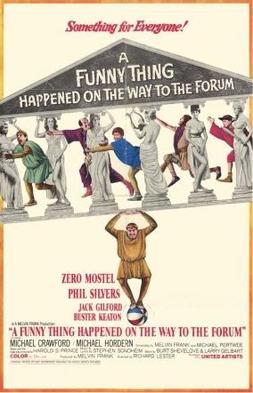
Revisit: A Funny Thing Happened on the Way to the Forum


An MGM release 1966

Directed by Richard Lester

Written by Melvin Frank & Michael Pertwee
Based on the musical play by Burt Shevelove & Larry Gelbart
With lyrics by Stephen Sondheim


It's a shame Buster Keaton spends his last screen credit hiding in the shadows of Zero Mostel -- not that Mr. Mostel wasn't a terrifically talented performer, but this aborted fetus of a musical-comedy doesn't do either of them justice.

Released at the low-point of musical-comedy's popularity, this Forum is a stripped down version of the stage play, substituting most of Sondheim's trademark bouncy show tunes with sight gags, puns & wordplay.

I watched this because I was in the stage version in high school and wanted to see how it translated to film. I got my answer: it doesn't. Without the songs, there simply isn't much to go on; stripping to the show to it's essence you sort of realize slavery, prostitutes and Greek tragedy aren't that funny. Add in tons of jokes that are more stale that Roman fresco and you've got yourself one cornball comedy. Likewise, the directorial 'flashes', including jump cuts and the kind of dance sequences Mel Brooks liked to spoof, don't add much flavor.

The cast is terrific -- Phil Silvers, Zero Mostel, Jack Gilford and Mr. Keaton all working hard to elevate the material. They are a pleasure to watch. But it's just not enough. This is a story meant for the stage -- where you can feel the energy -- not the screen.
Wednesday, January 17, 2007

Revisit: Masculine Feminine


A Franco-Swedish Production 1966
Written & Directed by Jean-Luc Godard

Paul (Jean-Pierre Léaud) is young, just demobbed from national service in the French Army, and dishillusioned with civilian life. As his girlfriend Madeline (Chantal Goya) builds herself a career as a pop singer, Paul becomes more isolated from his friends and peers ('the children of Marx and Coca Cola') and their social and emotional politics.

A great introduction to the Brechtian workings of Godard, Masculine Feminine contains many of the formal and thematic motifs concurrent throughout Godard's career. The film is divided into '15 precise facts' or acts - a device stemming from Brect's idea of the "separation of the elements/a theater of interruptions" - that act like a staged newspaper. Given the date of December 1965, the film has a specific timliness to it, with Godard acting as a sort of sociologist, tapping into the attitudes of young French men and women; Paul, the passionate male lead, takes a job as a surveyor, but is rather Godard and his audience who are surveying him. Interruptions can be found throughout the film; each couple presented are interrupted by a third party, and there is a distinct lack of privacy that reflects the Parisian way of life. Themes of high and low culture, forms of prostitution, and indiffrence towards violence are prevelant as well.


Like many of Godard's films, Masculine Feminine is anti-realist (the film contains virtually no eyeline matches between characters, jump cuts that tinker with time and space, text intertitles that separate chapters), yet it remains rooted in the rhythm of everyday life. It's a reminder that reflexivity and realism are not mutually exclusive - an autuerist stamp of Godard. The use of sound is of note here, as each noise presented is equal; the sound of a car horn rivals that of the dialogue.

Godard is a figure who often questions the way we view films; with no distinct linear plotline or Hollywood style arch, Masculine Feminine is the kind of film that's meant to be discussed. A great example of Godard's style for those who know little about the director.