Top Movies of 2007
My favorite films of the year thus far:


And there are still many more I have to see... Things may change after voting for this year's Independent Spirit Awards begins.
Here's this year's NYC Screening Room dates
My favorite films of the year thus far:
And there are still many more I have to see... Things may change after voting for this year's Independent Spirit Awards begins.
Here's this year's NYC Screening Room dates
A Look at Female Spectatorship & Genre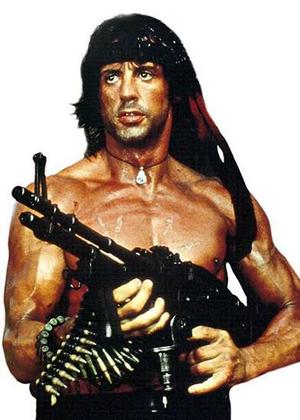
The role of the female in cinema as both screen presence and spectator exists as a highly debated struggle between filmic representation and psychological theory. In her essay Visual Pleasure in Narrative Cinema, Luara Mulvey explores the power of the female image in relation to cinema and psychoanalysis. Early in this essay, she writes: "Woman then stands in patriarchal culture as signifier for the male other, bound by a symbolic order in which man can live out his fantasies and obsessions through linguistic command by imposing them on the silent image of a woman still tied to her place as bearer of meaning, not maker of meaning" (Mulvey 838). In simpler terms, Mulvey describes the woman as an object of fantastic lust trapped in a male-oriented society. She furthers this concept by discussing Freud's notions of scopophilia and the voyeuristic gaze. According to Freud, it is natural human instinct to regard other people as objects, often subjecting them to controlling, curious, or erotic gazes. Mulvey aligns this with the cinema, considering film a stimulant of the voyeuristic instinct and separating it into a contradition between the libido and ego. Out of this contradiction, she surmises, forms identification processes and elicits sexual desire. From there she continues to outline the cinematic functions of the female: "as erotic object for the characters within the screen story, and as erotic object for the spectator" (Mulvey 841-42). She describes the current Hollywood narrative format as supportive of the male role in accelerating story, and thus controlling fantasy and gaze. She writes: "the male protagonist is free to command the stage, a stage of spatial illusion in which he articulates the look and creates the action" (Mulvey 842). Consequentially, spectatorss can identify with male protagonists, and indrectly possess the sexualized female. Mulvey broadens these ideas with more psychoanalysis; the threat of sexual castration, represented by the female screen presence, forces the male to escape this anxiety via the destruction or fetishizing of the female.
Mary Ann Doane's essay Film & the Masquerade: Theorizing the Female Spectator takes these concepts one step further, allowing room for the female audience. Like Mulvey, Doane channels her theories through Freud and psychoanalysis. She writes that the voyeur must maintain distance between objects and self in order to create desire, and that the female spectator can never form this distance because of a "claustrophobic closeness" to the female body present on screen (Doane 24). Too easily related to the objectified, female spectators must therefore readily accept a masculinized form of spectatorship. Doane likens this to the transvestite; mobile in their sexual identity, females can steal masculine traits, and often compensate for this masculinity by excessively flaunting femininity. This explains the creation of the femme fatale character, a sort of sexually empowered distinctly feminine mask. Doane fuels her article with cinematic examples of desirous, gaze controlling females - all of whom are punished or meet untimely deaths. She concludes by almost dismissing the feminine spectral gaze entirely.
My interest in these theories lies not in general assessments of feminine spectatorship, but rather as they apply to specific film genres. Though it is fair to characterize the female role in cinema, both as spectator and image, according to current pyschological practices, I do not feel it is worthwhile to apply these theories to cinema as a whole. Rather, it is of great necessity to study the feminine gaze in relation to genre and the evolving trends of cinematic practice. Genre, defined as the categorical division of artistic works based on specific criterion, shapes a great deal of cinematic traditions and representations. How an object appears and functions on screen depends significantly on the genre or genres in which a film is based. For example, a gun in a horror film might signify death or fear to the spectator, while at the same time affirming safety or security in an action thriller. This does not stand to negate Mulvey or Doane's claim that women are assigned certain (often surface or erotic) positions in cinema, but rather calls for the further exploration of these positions as they are related to distinct filmic types.
Other film critics seem to agree with me. Linda Williams writes: "this [feminine] victimization is very different in each type of film and cannot be accounted for simply by pointing to the sadistic power and pleasure of masculine subject positions punishing or dominating feminine objects" (Williams 732). In her essay Film Bodies: Gender, Genre & Excess, Williams complicates Doane's assertions about the female spectator by raising questions specific to genre. For example, Williams discusses Horror, a genre referred to by Doane as an example of defeating feminie gaze, claiming that even in the most violent of feminine suffering, there must always remain a component of either power or pleasure for the woman victim. Similarly, Williams argues that while melodrama might seem to drown female viewers in an excess of forced emotion, it also suggests and alignment with powerful matriarchal figures. Ultimately, she concludes: "the subject positions that appear to be constructed by each of the genres are not as gender-lionked and gender-fixed as has often been supposed" (Willaims 735).
But what happens when we remove the sexualized woman from the screen entirely? What if she is replaced by glorified male figures? What, if anything, shifts in gendered spectral gaze? In order to address these questions, we must find a film genre in which the female screen presence is rendered obsolete. The Macho Action film may fit this description. 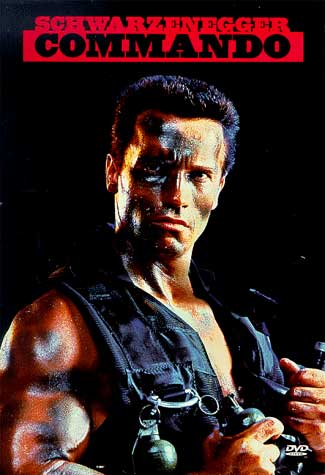
Developed out of Hollywood's displacement of art to action in the 1980's, the Macho film places and emphasis on a sort of surreal masculinity where the male body occupies the main narrative focus. Fueled by a sort of weightless politics, these hyper-male heroes obliterate their way through thinly outlined, special-effects-laden espionage scenarios. Starring buff body-builders such as Arnold Schwartzenegger, Sylvester Stallone, and Chuck Norris, the Macho film glorifies the sculpted male figure, often focusing on the charm and sex appeal of the Macho while still remaining action packed. Camera use in these films general accents physical size, featuring extreme close-ups of biceps, triceps, pecks and other impressive physical attributes. These male bodies can also withstand extreme physical pain, as if they posses superhuman tolerance and can refocus their agony towards eliminating the enemy. And, interestingly enough, sexualized female presence in these films appears almost non-existent (Vincente).
Look out for Macho Feminism Part II coming soon!

Starring two of the genre’s biggest names – John Wayne and Jimmy Stewart – The Man Who Shot Liberty Valance strips the Western of its window dressing, providing a reflection on the motifs and common themes that only a director as experienced in the genre as John Ford could produce. However, perhaps most striking are its competing protagonists who, through their dual natures, become a commentary on the Western hero and on the power of mythmaking, the film’s central theme.
Liberty Valance makes its dual protagonist structure quite clear from the very beginning. Stewart’s character, an established politician named Ransom Stoddard, heads to the small town of Shinbone for a funeral. Acting as narrator, he recounts the story of the deceased – John Wayne as Tom Doniphan – through flashback. This structure, coupled with the billing of two top stars, immediately implies dual protagonists.
Doniphan, “the toughest man south of the Picketwire”, is pragmatic and bound to nothing. Like Shane, he represents the savage side of the West: he lives in a house well outside of town, is nomadic and authoritative, and, most importantly, believes in the power of a gun. Doniphan doesn’t see much use for the law books and school teaching that Stoddard brings to the town of Shinbone. Stewart’s character represents civilization in its most pure, democratic, idealized form. A young lawyer from the East headed west to strike it big, Stoddard’s knowledge of the law, ability to read and write, and sheer idealism prove to be quite useful. However, over the course of the film, Stoddard finds that he needs to adapt to Doniphan’s more savage ways to survive. In the end, he comes out on top, remembered forever as “the man who shot Liberty Valance.”
This myth is the central point of the film: while Stoddard is memorialized for ending Valance’s reign, it was Doniphan who actually did the deed. Liberty Valance pits these two characters in direct competition and uses this structure to comment upon the myth-making abilities of the West. The fact that Stoddard is remembered for Valance’s death, and not Doniphan, shows how the West as an open frontier was rife with possibility for a man to prove himself – and how rumors could easily become truths by way of the press. As Maxwell Scott, editor of a now civilized Shinbone Star says, “When the legend becomes fact, print the legend.”
Doniphan is forgotten by nearly everyone at the end of the film. Unlike Shane, his valiant efforts and self-sacrifice are not lauded or memorialized, but hidden, rejected by those who control the myth-making process for the sake of civil progress. However, Stoddard’s civility is not portrayed as cut-and-dry as that in Shane either. Stoddard lapses into savage ways, and finds his well-intended career built on a myth. It is in such a way that the themes of Liberty Valance differs from that of Shane; whereas one films finds honor in the Western Hero, the other exposes a bittersweet reality.
Check out The Western Heroes Dual Part I & Part II!

Directed by George Stevens and featuring Alan Ladd in the title role, Shane tells the story of a mysterious gunfighter who comes to the aid of an oppressed group of homesteaders. The film maintains much of the traditional iconography of the genre, from vast, sweeping landscapes to a sinister, gun-slinging villain. While consciously working within this set of images, Shane produces a vision of the West in which savage means are necessary for civil progress. The title implies that Shane, the almost miraculous gunfighter, is the main protagonist, but there are in fact two: Joe Starrett (Van Heflin), leader of the homesteaders, is equally important. These two protagonists are inexplicably linked, but embody certain opposing semantics of the West. 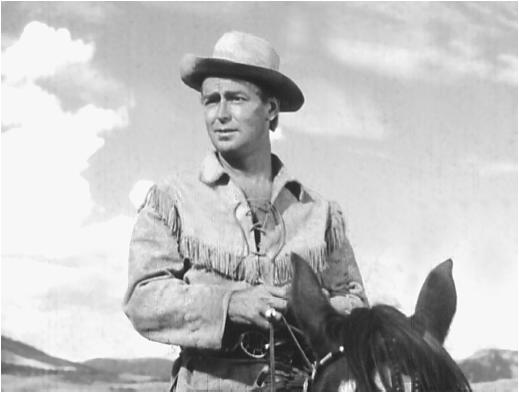
Shane is portrayed as a weary gunfighter, a wanderer with no place to hang his hat. He literally rides in from nowhere, his past a mystery never discussed. From the first shot of him riding on his horse, it is clear that Shane represents a dying breed of cowboy. Conversely, Joe Starrett is a family man who believes in the notion of private property and democratic organization. He represents civility, a new order of prosperity. Much of the narrative structure of the film relies on their relationship, their strengths and their weaknesses, to shape meaning.
Though wary of each other at first, the two are quickly presented as a team, working together to mutually improve quality of life. Joe hires Shane as an extra hand on the farm, providing him a temporary home, and the film shows how Shane’s cowboy qualities come in use. One scene boils it down into an easy metaphor: a tree stump too heavy for Joe to move by himself is lifted, with some strain, when he works with Shane. This scene could be interpreted as a summation of the movie; Joe can’t seem to shake the ranchers that want him off the land, but together with Shane, the two manage to put up a fight. 
The oppression from the ranchers is much greater than that of a stump, however, and develops a much more complex relationship between the two protagonists. Both Shane and Starrett can fight physically – an extended fight sequence in the saloon exhibits this fact – but Shane’s quick-shot skills are necessary in keeping the film’s ultimate villain, a gun-for-hire named Jack Wilson (Jack Palance), at bay. Conversely, Shane’s presence irks some of the homesteaders, some of which feel they “don’t need no bodyguard” while others simply want to pack up and quit. Starrett’s unending optimism and oratory skills, coupled with his American ideals of individualized prosperity, manage to keep the homesteaders aligned even in the darkest of times, something Shane could not do. In turn, Shane and Starrett bridge together traits from both the savage and civil West that are necessary in accomplishing the plots ultimate goal – winning the land for the homesteaders.
However the narrative also pits the two characters in competition with one another, especially in relation to the Starrett family. Joe’s young son is constantly sizing his father up in comparison to Shane. He asks Joe many questions – “Could you shoot better than Shane? Could you whip him?” – that elaborate upon why Shane’s presence is so necessary for the homesteaders. Likewise, Joe’s wife, precautious but intrigued by the gunfighter, develops a flirting infatuation for Shane, which Starrett comes to recognize towards the end, admitting that if something were to happen to him, he’d at least know she’d be “taken care of and in good hands”.
This competition elaborates upon why the savage Westerner was so crucial, and helps glorify his nature, but the film remains conscious that he is a dying breed. Shane’s gun-toting way of life, though helpful in the circumstances, cannot work in the civil setting. He is conscious of this: “There's no living with a killing. There's no goin' back from one,” he says. “Right or wrong, it's a brand... a brand sticks. There's no goin' back... And there aren't any more guns in the valley.” The film ends with Shane riding back into the wilderness, but the shouts from Starrett’s son are a reminder that he is one cowboy that will not be forgotten.
Such is not the case for The Man Who Shot Liberty Valance...
Check out Part I
The Western Heroes Dual Part III coming soon!

As a film genre deeply rooted in the transposition of civilized and savage elements, the Western inherently allows for the exploration and establishment of specific, individualized moral codes. In turn, the Western offers a variety of protagonist archetypes: the outstandingly upright Ladds, the forthright and masculine Waynes, the morally ambiguous Eastwoods, the slightly on edge Stewarts. These Western Heroes may have spurs and a sense of ruggedness in common, but it’s their distinct moral personalities that made them legends. Perhaps this is why it is most interesting when a film places two protagonist types in a dual narrative structure. Aside from adding layers of tension to melodrama, dual protagonists allow for a tiered representation of the civilizing process; a kaleidoscope that refracts concepts of a blossoming America. 
However that is not to say all Westerns with dual protagonist structures reach the same conclusions. Both Shane (1953) and The Man Who Shot Liberty Valance (1962) feature dual protagonists, but their reflections on the civilized West are much different. Each film contains a ‘savage’ and ‘civil’ protagonist, and both favor the prospect of democratic growth. But where Shane shows clear praise for it’s savage hero, Liberty Valance paints a storybook West in which one myth is exchanged for another. The next few posts will be dedicated to exploring dual protagonists as they exist in these two films.
The Western Heroes Dual Part II coming soon!

An MGM film 1962
Directed by Sam Peckinpah
Written by N.B. Stone Jr.
Ride the High Country is a eulogy for the traditional western. The film is conscious of the myth of the American Frontier, presenting it as dying legend that can, and has been, manipulated. Here is a version of the West where Eastern civilizing culture and ideals have pushed savage lands to the very corners of the Earth. However, that’s not to say that such savage ideals don’t exist. The film doesn’t exactly regret the loss of traditional Western values, but rather appears to celebrate moral ambiguity in the genre, desiring to push that trend even further.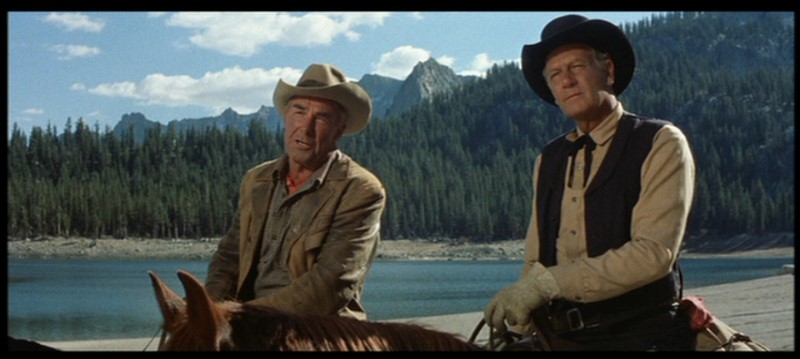
The film provides three male heroes: Steve Judd, moral and upright, the Gary Cooper template for the classical Western hero; Gil Westrum, a good but morally gray man, the John Wayne type; and Heck Longtree, a youngin’, the next generation of cowboy. While Judd is presented as upstanding, his character is constantly referred to as old and out of date; even from the beginning, when he mysteriously rides into town in the most classical fashion, it is made clear that this character’s function in the genre is no longer effective. In the end, he is the only one killed off. Westrum, seemingly corrupt and villainous at times, is redeemed, rewarded in the end for his ability as a character to make sacrifice and overcome immoral temptation. Likewise, Longtree grapples with morality, ultimately establishing an honor code from both Judd and Westrum.
Peckinpah finds good humor in the banter between the two dying breeds of hero, but the real excitement in the film comes through the villains. These men are equally morally blurred, as they exhibit knowledge of moral codes, but choose to ignore them, instead settling for insincere symbolic measures that clean the appearance of their evil ways. The Hammond Gang represents tiers of damaged psychology, from sharp and sly to straight crazy, and they incite all of the riotous action in the film. While Ride the High Country is aware that it is declaring the end of one classical mode, it appears to be celebrating a newfound interest in damaged characters, and ambiguity in savagery.
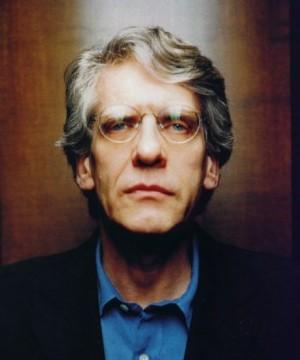
Primer: David Cronenberg
The Onion's AV Club has taken the liberty of dictating a pretty basic introduction to the works of one of my favorite filmmakers, David Cronenberg, for those of you unfamiliar with his body of work. Cronenberg is the genius behind some of the most psychologically twisted, reality-bending films of the past three decades, not to mention the inventor of 'body horror'. It's a great read, check it out.
A Modern City
The formal differences between Godard’s approach to modernization in Two or Three Things and Tati’s Mon Oncle are clear: one takes on a lingual, documentary style while the other focuses on visual cues and spatial relations. However, both films feature similarly negative views on modern construction and seem to be of the viewpoint that ‘newer’ doesn’t necessarily mean ‘better’. While Godard is preoccupied with the cinema and modernizations effects on language, his assertions that commoditized culture has negatively impacted individualism mirror Tati’s sentiments. Likewise, Tati’s affinity for old time housing and ways of life can be seen in Godard’s demonizing of urban organization and physical growth.
However, neither film is without hope. While Tati’s message may seem bleak, his humor-based approach stands as a silver lining. Likewise, Godard’s playful attempts to render verbal and written language through the cinema act as a call for greater attention to language as a cultural entity. The results are a vision of Paris, a modern city, which is both culturally expanding and aware of its own deficiencies.
WORKS CITED
Barthes, Roland. “Towards a Semiotics of Cinema: Barthes in interview with Michel Delahaye, Jacques Rivette”. Cahiers du Cinema: The 1960s. Jim Hillier. Massachusetts: Harvard University Press, 1986.
Chion, Michel. The Films of Jacques Tati. New York: Guernica, 1997.
Leutrat, Jean-Louis. “The Power of Language”. The Cinema Alone: Essays on the Work of Jean-Luc Godard. Michael Temple & James S. Williams. Amsterdam: Amsterdam University Press, 2000.
Makeieff, Macha. Playtime. Notes on Lecture, 4/10/2007.
Ramierz, Francis and Christian Rolot. Mon Oncle: Jacques Tati. Collection Synopsis, no. 16. Paris: Nathan, 1993.
Mon Oncle. Jacques Tati. DVD. Criterion, 2001.
Stam, Robert. French New Wave II. Notes on Lecture, 2/8/2007.
Thiher, Allen. “Postmodern Dilemmas: Godard's Alphaville and Two or Three Things That I Know about Her”. Boundary 2, Vol. 4, No. 3. (Spring, 1976), pp. 947-964.
Two or Three Things I Know About Her. Jean-Luc Godard. VHS. New Yorker Films, 1988.

Godard plays with the idea of consumption and mass culture throughout Two or Three Things. He offers many symbols of culture – magazine covers, famous quotes, novels – but sets them up so that, as signifiers, they offer little meaning. In one scene, Juliette and fellow prostitute Miriam don duffel bags bearing TWA and PAN-AM logos and are forced to parade around naked. In another, two men sit in a café compiling sentences out of novels in the hope of composing the ultimate book. Both these scenes exhibit the appropriation of cultural images or objects, but recontextualize them so that all meaning is obscured.
Godard keeps a philosophical dialogue going throughout the film via a non-diegetic voiceover. Considering the narrator’s penchant for the first person, and his lengthy transcendental musings, it’s almost appropriate to assume that it is a surrogate for Godard himself. One scene is particularly telling of this idea: as the camera focuses in on a cup of coffee, the narrator laments his inability to understand objects, and his verbose speech peters out into a verifiable spew of words. It is as if Godard himself is lamenting the way language has been corrupted by culture, rendered ineffective. “To say that the limits of language, of my language, are those of the world, of my world, and that in speaking, I limit the world, I end it” he cries. 
If Two or Three Things presents the idea that consumerism has limited man’s ability to communicate, than it also suggests that the modern environment limits man’s ability to connect. As previously stated, construction is depicted in the film as imposing, a dominating force. But already established edifices are given equally biting critiques. “A landscape is like a face”. Towards the end of the film, Godard pans around Juliette’s building complex as she says this phrase. We see that the area is completely enclosed by buildings, each one composed of tiny little boxes, presumably individual apartments. The space is called le grand ensemble, a new form of urban organization implying a certain sense of togetherness, and yet we can only perceive the area in fragments, as each individual who lives there must do as well.
To Be Continued...
Two or Three Things Godard Knows About Language
“I examine the city, its inhabitants, and the bonds between them as closely as a biologist examines the relations between individuals and race in evolution. Only thus can I tackle problems of social pathology and formulate hope for a genuine new city” - Narrator
The opening credits of Two or Three Things I Know About Her feature an inter-title that informs the viewer that the word Her refers to the Paris region, while it also refers to the main protagonist and the actress playing her. This concept – the suggestion of dual intendment behind a word – is crucial to the film. Like in Mon Oncle, Two or Three Things offers a semblance of a narrative: the film follows a day in the life of a suburban housewife who practices prostitution part-time in order to afford luxuries that society deems necessary. Through herstruggles to stay on top in life, the film explores mankind’s relationship to language, semiotics and meaning.
Two or Three Things opens with the image of a large highway construction site. The interminable racket of modern development heard over the credits is hushed as a voice over begins, outlining history and establishing philosophical viewpoints. Both of these elements remain constant throughout the film. Godard offers documentary style visuals of the physical growth of Paris; giant cranes and dump trucks, unfinished highways over dilapidated homes. The construction seems daunting, as modern buildings and work sites seem to tower into the sky, envelope older cityscapes. The fact that these are actual shots of Paris reinforces the cinematic idea of injecting symbolism onto reality, an idea that plays a crucial role in the film. How do we accept cinematic representations as being ‘real’ when the basic properties of film automatically convert all images into symbols? Godard plays with this idea by showing these construction sites, presenting them as they exist, but over-scoring their presence, having them appear monstrous and dwarfing. Thus the audience understands both what is ‘real’, and the critique of progress the images present.

A similar example of this idea can be found at the beginning of the film when the main protagonist, Juliette, is introduced. The voice over first introduces her as the actress Marina Vlady. Then the scene repeats, reintroducing her under her characters name. This demonstrates how the cinematic medium converts what is real into a symbol; Vlady is at once her real self, and her fictional cinematic counterpart. As Allen Thiher points out, this allows Juliette, as a cinematic character, to have multiple voices: “On one level she speaks as a fictional housewife-prostitute in a non-reflexive manner. On a second level she examines her language and uses self-reflexive language. This level leads to a third where she tests her language against her environment, which often shows how absurdly incongruous her language is with regard to the images that present her situation” (958).
From here, Godard is able to disregard conventional cinematic standards for conversation and allow the character to slip out of a scene and impose additional commentary. This, coupled with the film’s documentary style approach, grants access into the thoughts of both major and minor characters, almost in a novel-like fashion, highlighting the shortcomings of language and the cinematic medium. 
For example, in the scene in the shop where Juliette purchases a new dress, the camera picks up the banal chatter of several young girls. In one shot, the camera stops and focuses on a girl, who says “I have a date with Jean-Claude at 8. We go to a restaurant, sometimes a film.” This part of the scene appears like a documentary, the camera focusing on the girl as if it were asking her a question.
However, when Juliette speaks into the camera seconds later, it becomes clear that Godard is not interested in the banality of the girls conversation, but rather their inability to fully communicate due to the consumer-based, degrading environment surrounding them. “I know how to talk. Let’s talk together,” Juliette begins. “Together is a word I like. Together means thousands of people, perhaps a whole city. No one knows what the city of the future will be like. Part of the wealth of meaning it had will undoubtedly be lost. The creative and formative roles of the city will be taken over by other forms of communication. Maybe… television and radio…Vocabulary and syntax, consciously and deliberately.” This reflexive speech seems to draw on the Parisian girls inability to discuss anything real. And yet, the speech itself seems equally disgenuine, clearly scripted. The following shot of a trashy paperback shows Godard is commenting on the way language seems to have piggybacked off of a massified culture. Language is no longer an effective mode of expression, because it has been commoditized, marketed, and consumed.
To be continued..
Check out Paris in Pictures parts 1,2, and 3!
Sterility is a major theme throughout the film. The old sect is constantly littered with garbage; a man is put to the seemingly never-ending task of sweeping, and can be seen constantly, but contently, attempting to clean up after his fellow townspeople. Madame Arpel is obsessed with cleaning as well, but their overly aseptic home provides her with little opportunities for any actual work. So, she can be seen constantly scrubbing windows that are already clear, objects that aren’t dusty. The best example of this comes in the Arpels introduction, in which she can be seen washing windows, pulling at creases on her husbands suit, fixing his tie, and scrubbing strange objects: a plant, the front gate, her sons briefcase, the car. Everything she touches she has to give a good once-over with her washcloth. Madame Arpel especially treats her son, Gerard, with a germicidal zeal. “Gerard, don’t mess up your room! Take off your shoes and wash your hands!” she tells him when he enters the house. Gerard can be seen rubbing his feet furiously on the mats outside, and his mother, dressed like a nurse in a long white coat and blue gloves, sprays him with a large hose. 
Sterility can be found in the kitchen as well. The Arpel’s modern home allows them to cook without ever touching the food. Cooking is impersonal, handled at a distance by buttons and machines. Madame Arpel flips a grey, sickly-looking steak by pressing a button under the stove; she butters a pan by spraying it with a hose-like object. This is shown in stark contrast to the way food is handled in the old town. The local market features carts of vegetables and fruits fingered by all sorts of people; an old woman picks up a head of lettuce, weighs it in her hand, and puts it back for a different piece. Later, a man grills meats and sweet bread for children on a large wooden cart, handling the food with a charred spatula. The children accept readily with their hands.
This idea of sterility stems from the Arpel’s obsession with status. Madame Arpel gives three separate tours of the house in the film, each time pointing out insignificant objects and highlighting the ultra-modern aspects of the space. One object, a ridiculous looking fish-shaped fountain, is particularly telling of this obsession with status. Madame Arpel rushes to turn it on whenever someone enters the gate. However, if it’s not someone she is trying to impress (Hulot, peddlers), she shuts it off in disgust. Likewise, Monsieur Arpel’s car is an object of status. However, once it enters the main road, we that everyone in town owns a car that appears only slightly different. The cars show that the modern society upholds an ideal of massified individualism funneled through consumerism. 
It would appear that Tati is making a concrete criticism of modern society – that so-called ‘progress’ leads to disconnect with humanity, with an over-emphasis on status quo – however, that’s not entirely the case. While the characters in the old section are presented as livelier and less preoccupied than that of the new one, there is no evidence to show that the residents of the modern world are discontent. In fact, it would appear that the Arpels are perfectly happy in their tech-savvy world. Likewise, Hulot’s inability to adjust to their world stems not from his disinterest, but rather his lack of familiarity and physical awkwardness. We must, then, view these people as social types, representative of ways of being and not specifically critical of any particular way of life.
It is only in Gerard, the indelible young nephew of Hulot, that we see any true character-based critique of the modern society. Gerard seems stifled by the trappings of his parent’s modern ways, and is sternly attached to the lackadaisical Hulot; he prefers the simplistic toy presented to him by his uncle to the complex motor engine given to him by his father. When in the modern home, Gerard appears despondent, bored, and lifeless. He seems to desire nothing more than to join the group of mischievous troublemakers who play freely in the old town; and, when he finally does join their company, his face exudes pure joy. Here, Tati presents perhaps his most biting criticism: that the shiny conveniences of modern life stifle the imagination of youth.
Check out Paris in Pictures pt. 2 and pt. 1!
Mon Oncle & Forms of Comedy
“This is our very own corner… The vase… All of our house is air-conditioned… And I must tell you it was all designed at my husbands factory!” – Madame Arpel
With the release of Play Time in 1967, Jacques Tati completed his masterwork: a film so expertly handled, with so much precise attention to detail, that it took over ten years and required the construction of an entire city to complete. At first glance, Play Time may seem to be the perfect film to address when referring to visions of a modernized Paris. With its ultra-chic, hyper-stylized formations and startling empty spaces, Tatiland appears on screen as a futuristic version of the city, impersonal and indifferent to its inhabitants. But the critique in Play Time is not so much specific to Paris as it is to cities as a whole; as Tati historian Macha Makeieff points out, “Tatiland is not a vision of Paris, but of cities across the globe.” Despite a single scene in which a reflection of the Eiffel Tower is visible in a swinging glass door, Play Time offers much evidence that the city represented within is not specific to a singular location, but rather an amalgamation of multiple regions.
Rather, it is in Tati’s earlier picture, the less abstracted Mon Oncle, where one finds his most distinct representation of Paris. Released in 1958, Mon Oncle is in many ways Tati’s most straightforward film. Michel Chion writes: “Mon Oncle (1958) is, in the works of Tati, the film which most conforms to the classical narrative system, and even represents the only example of its creator’s efforts to unfold a genuine story till the end, starting from a succession of causes and consequences” (32). That story, which focuses on Madame Arpel’s attempts to ‘clean up’ her brother, the insufferable M. Hulot, is in it’s own right a direct representation of modernization. Tati’s Hulot, who lives a simple life in the old part of town, cannot seem to conform to his sister’s hyper-controlled, sterilized ways. While the humor and themes remain constructed through Tati’s dialogue-less, seemingly meandering style, the film is very much aware of its narrative focus, going so far as to make self-reflexive nods. “Listen, what my poor brother needs is an objective… a home… like all this!” proclaims the most determined Madame Arpel. 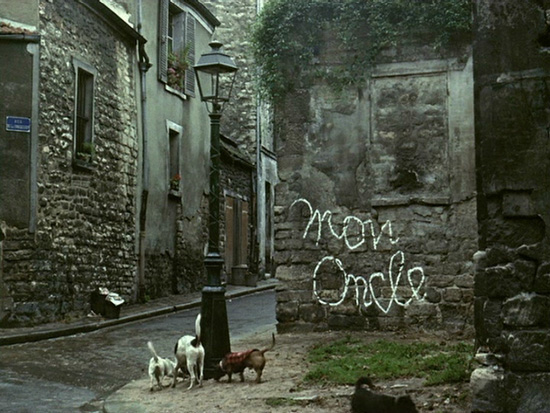
Tati divides his vision of the city into two halves: the quaint, cobblestone old town in which Hulot lives, and the homogenized modern section of the Arpels. The film sets up this division immediately in the opening credits. Beginning with a shot of a crane and the harsh jackhammer sounds of a construction site, the camera pans down across architect nameplates, which feature the credits. The main title, however, is scribbled in chalk on a building in the old world, and the flighty musical theme of the film begins. This theme becomes a crucial cue in distinguishing the two locations. While the music is prevalent throughout the old section, it is never heard in the modern one, except for in a single scene in which Monsieur Arpel telephones Hulot from his boss’ office to see if he would be interested in a position at the factory. Even then, the music is heard only through the telephone, and disappears when their conversations ends, further accenting the juxtaposition between the whimsical old town and the stuffy modern one. In fact, most of the sounds in the modern section are sharp, grating, or otherworldly; strange buzzes, odd bloops, and accented clanks. However, the pervading sonic mode is silence.
Further shots accent the division between the two sections of the city. The old section is notably characterized by its brick buildings and cobblestone streets, which give it a lively sense of color and human-like imperfections. Conversely, the new section features stark grey buildings that seem identical in form. When a character transitions between the two, Tati offers a shot of a crumbled brick gate, a figure of the old town, with the skyline of the grey modern section dominating the background. This shot, used multiple times in the film, is representative of the deteriorating old ways of Paris. Likewise, inhabitants of the old section seem free to walk as they please, harmonious with nature, while in the modern section, distinct pathways direct characters in motion. In the Arpel’s home, no one is allowed to step on the grass, for fear of ruining the perfect lawn.
Start this article at the beginning with Paris in Pictures pt. 1!

The image seems clear. A giant crane towers over fractured earth; its red steel beams crosscutting sections of a bright blue sky. Thunderous shrieks of metal rubbing against rust permeate the air as the machine slowly turns, moving large pieces of pipe to their desired destination. A group of men in plastic orange suits work feverishly below, setting fire to steel and debating the specifics of their creation. Dump trucks rush past, carrying tons of dirt and rock, leaving trails of dust in their place. Fragments of ground spew forth; everywhere the land is shifted, reshaped, recycled.
The image seems clear, but it is contradictory. It is at once a sign of progress, and of gentrification. Construction and deconstruction. Destruction. We tear down the past to make room for the future. Destroy in the name of creation. The City is no stranger to the effects of modernized men; who, of the belief that ‘newer’ is synonymous with ‘better’, rebuild to reconstitute their surroundings and align them with contemporary modes of thought.
But what effects does this modernization have on the people? Where does the simple man fit into this neoteric equation? And who is to say that progress necessitates physical growth?
The French New Wave directors were not quick to dismiss old ideas, nor were they content to celebrate innovation. As post-war Paris experienced its largest development since 1914; as the suburbs began to expand considerably with the construction of large social estates known as cites; as a comprehensive express subway system, the RER, was built to complement the Métro and a network of freeways began circling around the city, New Wave directors explored city life with a watchful eye, observant of the profound effects innovation had on its inhabitants.
And perhaps no two directors were more cognizant of this transmuting social climate than Jacques Tati and Jean-Luc Godard. Tati, with his long overcoat and towery frame, seemed ill suited for modern life, uncomfortable in his surroundings as he was within his own skin. More a predecessor than a part of the New Wave, his uncompromising vision and inability to meld into modernity made him an influential figure within the movement, and it is difficult to separate his image from that of la Nouvelle Vague. Likewise, Godard, the figurehead and an inscrutable insurgent, proposed radical explorations of humanity and social order. His films question the commonality of the human experience, and prompt viewers to re-evaluate the significance, practice, and capacity of culture. 
For both directors, the devastating effects of modern times proved fertile ground for thematic exploration across multiple films. However, Tati’s Mon Oncle (1958) and Godard’s Two or Three Things I Know About Her (1967) are their respective seminal works on the subject. While they were made almost ten years apart from each other, both films present representations of the modernization and physical growth of Paris. Both filmmakers use intertexts to comment upon this rapid expansion: Godard through semiotics and the written word, Tati through the modes of silent comedy.
However, beneath these intertexts lies each director's comprehensive knowledge and technical abilities to make full use of the malleability of the film image. It becomes necessary, then, to explore these two films specifically as representations of a ‘modern’ Paris and how these representations relate to the flexibility and sculpture-like qualities of the cinematic image.
Have you noticed it? You walk past the local movie theater and see an ad for that documentary or dumb comedy you’ve been waiting to see. You promise yourself that you’ll catch it in theaters but you can’t make time, and within two weeks it’s gone, no longer playing. Normally you’d expect to wait months for the video, but a trip to Blockbuster proves surprising – it’s already available on DVD.
Yes, the time frame between a film’s theatrical release and its appearance on video store shelves is getting smaller. Facing competition from Internet piracy and websites like Youtube.com, Hollywood distributors are starting to abandon the age-old tradition of staggered release dates for shorter time frames between theatrical and DVD distribution. In fact, some distributors are eliminating that window of time entirely. It’s a distribution move called simultaneous multi-platform release, and it’s coming to a theater, TV screen, and DVD player near you.
The concept is simple: instead of releasing a film in theaters and waiting months or even years for it to become available for home viewing, distributors are removing that time window by releasing films in theaters, on DVD, and through digital on-demand cable all on the same day. Though the technique has been used mostly on small budget, independent films that normally wouldn’t get distribution, the strategy challenges one of Hollywood’s most basic – and lucrative – traditions.
The idea for such a radical form of distribution stems from “the belief that the choice as to how consumers view films should rest with the consumer and that theatrical, DVD and Internet forms of distribution need not threaten each other, and may indeed be mutually complimentary,” says John Lentaigne, producer of the film EMR, a deft thriller about drug addiction and paranoia shot for under $100,000 in both the UK and the US by James Erskine and Danny Mccullough. Distributed simultaneously in theatres, on DVD and over the Internet on July 15th, 2005 by a fledgling independent company in the UK called Dogwoof Digital, EMR was the first film to ever to attempt the simultaneous release strategy.
“Our main belief is that simultaneous releasing gives opportunities to release small independent films that are otherwise uneconomical to release,” says Andy Whittaker, CEO of Dogwoof Digital. “We hope to build an audience and give the audience a choice of when, where, and how they watch the film.”
“One of our biggest challenges is distribution,” says Michelle Byrd, executive director of IFP’s New York chapter. IFP – or Independent Feature Project, as the acronym stands for – is a non-profit organization that works to help struggling independent filmmakers find a place for their films. Byrd, who has seen the difficulties of distribution firsthand, believes that simultaneous multiplatform release can do a lot of good for the independent community. “Once you’re done [with your film], how do you actually connect and engage with an audience? I feel that topic is so important,” she says. “Simultaneous release gives filmmakers a way to cover all their bases.”
That belief seems to have caught on. Since EMR’s first attempt at simultaneous release in 2005, three films have followed in its footsteps: A-list director Steven Soderbergh’s improvisational experiment Bubble, released January 27th 2006, Caveh Zahedi’s autobiographical meta-film I Am A Sex Addict on April 12th 2006, and Michael Winterbottom’s docudrama The Road to Guantanamo on June 23rd. They were joined by another, when director Brad Silberling’s 10 Items or Less comes out on December 1st. 10 Items was of particular interest because it was be the first major star vehicle (the film is a road trip buddy comedy featuring Morgan Freeman) to utilize the simultaneous release strategy.
In each of these instances, the simultaneous release strategy seems to have made sense. All were features whose directors felt deserved theatrical release, but for whom such distribution was simply not economically viable. Soderbergh’s Bubble cost a little over 1.5 million dollars, yet went on to gross a mere $145,000 in theaters. Likewise, according to Caveh Zahedi, I Am Sex Addict would have had to gross “one million [theatrically] to put me in the black.” The film performed amiably, but failed to yield much more than $112,000 in revenue. Zahedi says that simultaneous release allowed for his dream of seeing his film on the big screen come true, while also making sure the film turned a profit. “Theatrical distribution is so high a risk that video on demand suppresses it. It’s a way of [distributors] protecting themselves, I don’t think they would have released it otherwise.”
Zahedi’s distribution story is particularly interesting in that it exhibits some of the problems with simultaneous release, as well. Originally expecting to see his film in cities across the nation, Zahedi received word a week before release that Sex Addict was being pulled from fifteen Landmark Theaters across the country. Landmark Theaters chain owner Mark Cuban pulled the film after he discovered that it was going to be available for viewing on Comcast On Demand, a major competitor of Cuban’s own HDTV/HDNet Films brand. Cuban, as he notes in his blog, is a “full supporter of the simultaneous release platform,” as he believes “that Hollywood’s distribution system requires radical change”. However, his decision to pull the film from theaters exemplifies the reality of the business, and the tricky situations simultaneous release may create.
For now, it seems as though the simultaneous multiplatform release structure may be relegated as a solution for the independent community only. Hollywood won't know the impact of simultaneous release until a studio tries it with a big-budget picture. But staggering the release of a movie between various formats has been a huge source of revenue for many years, and it might not be easy to dislodge such a lucrative, antiquated model. The biggest chain theaters, including AMC Entertainment, Cinemark Entertainment and National Amusements, have openly said they have no interest in carrying a film with a model that could undercut their own business. “We choose films to show based on what we think will fill the seats,” says a manager at City Cinemas Village East. “I wouldn’t choose something that I knew people could see at home.”
However, the consumer will ultimately make the decision. With new video technology appearing on the net each day, and home theater system quality improving, theatrical distribution faces a major threat. But for some, nothing can replace the magic of the theater. “I think it’s cool but it’s not for me,” says Paul Walker, a senior cinema studies student at NYU and employee at Focus Features. “I’m a theater man. I prefer to see films in theaters. But I could see its appeal for others.”
One of the most successful films in box-office history, Jurassic Park represents a milestone in big-budget filmmaking. Seamlessly blending science with adventure, humor, horror, and suspense, the film utilizes puppetry and computer generated images to bring one of nature's oldest mysteries—the dinosaurs—to life. Upon its release, Jurassic Park boasted the most innovative and breath-taking onscreen effect sequences, particularly in regards to CGI, a new medium at that time. Since then, the film has stood as a model for special effects filmmaking, a landmark moment in blockbuster history.
To attribute this success solely to the film's groundbreaking effects, however, would be unsound. Though the effects do serve as the ultimate spectacle for the audience, Jurassic Park exhibits a true understanding of timing and build-up, of how to construct a cinematic sequence in order to wring out the greatest amount of tension. This can be accredited to Steven Spielberg, the acclaimed director of other smash hits such as Jaws and Raiders of the Lost Ark. Spielberg acts almost as a guide through Jurassic Park, expertly building conflict while ultimately adding a sense of representational duality through editing, framing, and iconography. As an example of such multi-dimensional representation, the gated entrance in Jurassic Park serves not only as a symbolic introduction to the spectacle of the film, but acts as a conscious product of the standard Hollywood blockbuster.
The gated entrance of Jurassic Park is, quite literally, a giant gate. It appears approximately one third of the way into the film, just as the characters begin the motorized tour. Before this moment, Spielberg develops escalating levels of excitement, briefly exhibiting a dinosaur and using time to verbally explain the mystery and wonder of the park. However, the tour marks the point at which the characters (and audience) will finally receive visual confirmation of what they've been waiting to see, and consequentially the tone of the scene reflects this ripe anticipation. It is only appropriate that the gate is introduced by a guiding verbal announcement: “Hey, look!” This statement identifies and defines the gate foremost as an object to look at, a spectacle—a direct convention of the blockbuster genre, if defined as such. Following this dialogue is the first shot of the entranceway, a lengthy long-distance tracking shot in which the gate appears to grow in size as the camera approaches it. This slow build-up both mirrors and accelerates the tone of the scene; the slowly decreasing distance between the audience and the gate, coupled with its seeming rise in size and stature, affirms and builds audience anticipation.
As the cars move along the track, we see awe and enthusiasm among the characters faces. Spielberg's next shot brings the audience into the cars, eye-level with the characters in the film. This direct association between audience and character strengthens the sincerity of the visuals, placing the audience inside the adventure, promoting a shift from passive to active view. It also allows Spielberg to contort the size of the entranceway yet again; now it fills the entire front window of the car, spilling out past the frame. The camera pans upward, using the open sunroof to capture the rest of the image. At this view the gate appears huge, towering over the motorized cars with its immense presence. Spielberg continues this theme with his next two gate shots—a canted angle crane shot, followed by a medium distance shot of the entrance doors closing, both of which give the appearance of the gate dwarfing the tour group.
This concept of size, particularly at the introduction of the park tour, signifies the spectacle that waits within. Spielberg's construction of the gate through edits creates a towering force, producing a physical representation of the powerful visual display present throughout the film. However, elements of mis-en-scene other than editing aid in this interpretation. John William's score pervades the scene, bombastically celebrating the arrival at the park gate. Characterized by ecstatic blasts of trumpet and the epic rise and fall of strings, William's theme for the film not only narrates emotions felt by the characters, but guides the audience disposition as well. The swelling of the music, particularly as the gate closes, toys with the audience's anticipation, portraying sonically what Spielberg had previously conveyed visually.
Similarly, dialogue acts to reiterate the theme of magnitude. As the cars move through the entrance, Dr. Ian Malcolm (Jeff Goldblum) quips “What do they got in there, King Kong?” This direct reference to the 1933 classic about a colossal ape amok in New York City—a special effects extravaganza that remains a large influence on blockbuster filmmaking to this day—creates a link between the films in terms of graphic scale in relation to the presence of a giant gate. Like in Jurassic Park, the gate in King Kong appears approximately one-third of the way into the film. Unsurprisingly, it looks almost exactly like the one in JP—a towering wooden structure studded with torches. Introductory dialogue (“Colossal!” “I want to know what's on the other side!”) establishes the spectacle of the gate, while a thunderous aboriginal ceremony at its front signifies a certain larger symbolic significance. As the ceremony moves forward, we see the gate open to unveil a religious altar; the natives scale the top of the gate to watch as Kong, the gigantic ape, completes the sacrifice.
At this point, the gate serves three cinematic purposes: a self-referential object realizing the grandiosity of the film, a diegetic object of protection and religious importance for the indigenous peoples within the story, and a barrier between the civilized world and the world of Kong, a dangerous territory where spectacle and special effects reign. Before the display of the gate, King Kong builds anticipation through dialogue: “Money! Adventure! Fame! It's the thrill of a lifetime!” exclaims Carl Denham, the punchy, persistent coordinator of the fateful trip. However, once the characters pass through the gate, they are overwhelmed by effects, turned into pawns for puppets and claymation figures. Later in the film, as Kong busts through the gate, the two worlds collide, and the final spectacle of the film is realized—the blending of chaos and civilization.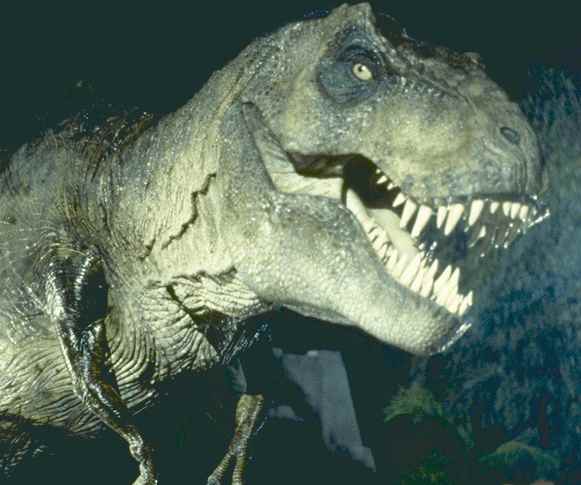
Ultimately, what purpose does the gate in Jurassic Park serve? In relation to the diegetic world of the film, the gate offers no protective use, disconnected from the electrified fences used to pen the dinosaurs. In fact, the gate is never shown in the film again! And though it presents the point at which the action bleeds into chaos, marked moments of effects before this point in the film separate Spielberg's building-block approach to tension from that of King Kong's distinct filmic binary. In the end, the gates of Jurassic Park represent a hypocritical sort of necessary excess, both within the world of the film and as part of the spectacle of modern blockbuster filmmaking. Constructed through multiple elements of mis-en-scene, the gate as an entity alludes to the important of size and showmanship without serving any other real function. It maintains the film's thematic narrative criticism of gluttonous entertainment-business practices (Represented, for example, by the lawyer, the JP products, “spared no expense,” etc), while at the same time succumbing to Hollywood's own brand of profligacy. Perhaps this complexity results from Spielberg's deft direction, but it seems more likely a product of Hollywood blockbuster tradition, where spectacle overrules necessity, even in this most minute scene.
Originally published on Metaphilm.com December 4th, 2005.

The Ideal Imposter: Paul Newman & the Cinematic South
A parody of the Christ story set on a Florida chain gang, Cool Hand Luke is one of those movies so many people think is great that critics who recognize life is short just shudder and change the subject. It’s not worth trying to get fans to notice how pointless Luke is, or how inordinately pleased the filmmakers are by the hip equation of the hero with Jesus—which is cleverness in a vacuum, because the equation actually doesn’t tell us anything about either man.
it’d be a mistake to call the disconnect incongruous; a more accurate word would be crucial. Audiences always knew this puckish smoothie was just acting when he curled his lip to taunt us with his contempt for gentility—not really plumbing the depths of postwar sophistication or bitterness, but showing us what a rakish good time could be had in their shallows. A tragedian he wasn’t, and that’s why he was so phenomenally enjoyable. It made him the ideal inauthentic Southerner for a Hollywood whose new appetite for bold themes was in hock to the old imperative of making them congenial.
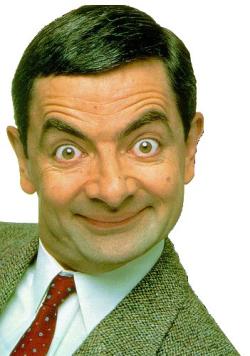
How did Mr. Bean become Britain's unofficial ambassador?
The lastest Bean film, Mr Bean's Holiday, is a global smash hit, No 1 in 21 countries and top of the international box office. And if you ask a non-Brit to describe Mr Bean, these are the words they deliver back: hapless, awkward, self-conscious, childlike, disaster-prone ... and British. Resplendent in geeky tweed, the Mini-driving Mr Bean increasingly seems to be a symbol of Britishness around the globe.
One of the many ironies in this story is that Atkinson says his quintessentiallyBritish creation was in part inspired by a French comic character, Monsieur Hulot, invented by French actor, director, writer and producer Jacques Tati, who released a series of films, including Monsieur Hulot's Holiday. Mainly, however, Bean was the result of decades of the comic studying himself.
The character has been popular across the Middle East, from Israel to Iraq, for years. The new film is currently the No 1 box-office attraction in Lebanon and the United Arab Emirates. There have been more than 14m Mr Bean videos sold worldwide; many have been sold in Tehran's shops and stalls.

A Toho Company release 1961
Directed by Akira Kurosawa
Writing credits:
Akira Kurosawa
Ryuzo Kikushima
A wandering samurai (Toshiro Mifune) enters a rural town divided between two gangsters and plays one side off against the other. 
A United Artists release 1964
Directed by
Sergio Leone
Writing credits:
Ryuzo Kikushima (screenplay Yojimbo)
Akira Kurosawa (screenplay Yojimbo)
Víctor Andrés Catena (screenplay)
Jaime Comas Gil (screenplay)
Sergio Leone (screenplay)
A wandering gunfighter (Clint Eastwood) plays two rival families against each other in a town torn apart by greed, pride, and revenge.
A Fistful of Dollars is most well known as the first installment of Sergio Leone’s popular spaghetti western trilogy featuring Clint Eastwood as the nameless gunslinger. These films demythologize the traditional American western, appropriating standard genre motifs and reinventing them; shot in Spain by Italians and produced by Germans, these spaghetti westerns exist as a reflection of America the melting pot. However, Fistful is also of particular note in that it is a transcultural adaptation of Akira Kurosawa’s samurai film Yojimbo. The films share much in common, especially in regards to character and story arc, but ultimately the transitioning of genres separates the two from each other.
Yojimbo takes place in 1860, a time where samurai were beginning to be erased by a thriving middle class. The film follows a hungry ronin (Toshiro Mifune) who finds himself in a desolate town split in two by a pair of feuding gangsters. The samurai, who names himself Sanjuro Kuwabatake in film, seizes the opportunity to play sides, ultimately killing all the gangsters and making some money in the process. Similarly, Fistful of Dollars deals with a nameless character that enters a town ravaged by gangsters and follows his attempts at confounding the corrupted. Both films also feature subplots that involve the rescue of a concubine and the subsequent return to her family.
The construction of character in both Yojimbo and Fistful is very similar as well. The main protagonist in each is portrayed as a mysterious, mythologized version of their real-life equivalent. Both the samurai and the gunslinger exhibit physical abilities beyond the norm: the gunslinger is a perfect shot, the samurai a fierce, unparalleled warrior. Their clever manipulation of the gangsters mimics a god-like force, supported by the frequent elevated character placement – “Everything looks different from up high,” says the gunslinger – and use of close ups and altered perspective to make the characters appear bigger than their surroundings. Rolling boughs of fog introduce each character, and both are equated with death and ghosts at some point, reinforcing character mythologization. 
It is clear that the basic details of both of these films are very similar. However, what most disrupts these similarities is the transition of genre from samurai film to western. For example, the introduction of a gun in Yojimbo is a major turning point. The gun represents a new threat, western technology and the rising middle class, and the samurai’s ability to avoid and castrate the gun supports the mythological presentation of his character. Because it’s a western, everyone in Fistful uses a gun. The threat is now about size (colt vs. rifle), and though the mythological effect remains, the symbol of the gun loses its multi-layered meaning.
Likewise, the town in Yojimbo is divided evenly into two equally powerful gangs, whereas the town in Fistful is split between the ineffective law (Sheriff Baxter and his gang) and the ruthless Rojo gang. This alteration places the feud in a different context, making the division line between good and bad seem a bit more clear. This is a definite convention of Leone’s work: though the characters are all portrayed as morally ambiguous, there still exists a sort of tiered hierarchy that allows for the sympathy of characters on multiple levels. This does not really exist in Yojimbo; the gangsters are all clearly bad, and the samurai exists as the only morally complicated character. Finally, the subplot involving the concubine and her family is anchored as a central plot device in Fistful, rather than as an effect of narrative discourse like in Yojimbo. The concubine is shown within the first few frames in Fistful of Dollars, visually alerting the audience to her condition and foreshadowing the inevitable rescue. Eastwood’s character seems fascinated by her in the film, almost as if he were about to fall in love. This foregrounding of the concubine story shifts character motivation and provides a sort of romantic element that is unexplored in Yojimbo.
Ultimately, Yojimbo and A Fistful of Dollars share much in common. However, the translation of genre provides for some very distinct changes that make Fistful its own unique film.
Eisenstein - Battleship Potempkin Odessa Steps scene 1925
Riefenstahl - Triumph of the Will 1935
Maya Deren - Ritual in Transfigured Time 1946
Orson Welles' uninterrupted track shot from Touch of Evil 1958
Uncle Eddie's Theory Corner got me thinking a bit about editing and the power of montage. No time to discuss now, but I'll expand upon this post with some commentary later!
Special effects play a large role in both War of the Worlds and Jaws. They reinforce the fear of the ‘other’ by revealing its physical characteristics in a spectacular fashion. In the case of War of the Worlds, these effects dominate the screen right from the beginning. From earth-shattering explosions to enormous alien ‘tripods’ to the Martians themselves, Worlds is an onslaught of big budget, state of the art wizardry. In fact, most of the excitement and thrills in War of the Worlds rely on the fantastic visuals. On the other hand, the special effects in Jaws appear sparingly, substituting shark POV shots for the actual beast. Part of this is due to budget restrictions (Jaws cost $10 mil., which even by today’s dollar would be significantly less than Worlds $132 mil.) and part to technical complications; according to Peter Biskind’s book Easy Riders, Raging Bulls mechanical malfunctions forced Spielberg to scale down some of the intense shark scenes he had originally planned (Biskind 265). Regardless, the use special effects mark a severe difference in rhythm between the two films. War of the Worlds moves at breakneck speed, hardly stopping the effects extravaganza, while Jaws is punctuated, building the image of the shark piece by piece until the beast is revealed in the climactic final act.
Ultimately, these posts might come off as a bit biased. They talk a lot about the ways in which Jaws succeeds as a film and War of the Worlds fails. It’s crucial to keep in mind that, in terms of Spielberg’s career, Jaws remains the template for many of his subsequent films. The structural similarities between Jaws and his other movies are certainly present and, after all, Jaws was a tremendous hit, so it would only make sense for Spielberg to retain its mold. Clearly, differences influenced by budget cost, social issues, source text, and technology have effected the ways in which Spielberg makes movies. His increased use of special effects also reflects the current movie market, in which audiences look for new thrills in the form of new technology. However, one element strings all of Spielberg’s works together: excitement.

