The formal differences between Godard’s approach to modernization in Two or Three Things and Tati’s Mon Oncle are clear: one takes on a lingual, documentary style while the other focuses on visual cues and spatial relations. However, both films feature similarly negative views on modern construction and seem to be of the viewpoint that ‘newer’ doesn’t necessarily mean ‘better’. While Godard is preoccupied with the cinema and modernizations effects on language, his assertions that commoditized culture has negatively impacted individualism mirror Tati’s sentiments. Likewise, Tati’s affinity for old time housing and ways of life can be seen in Godard’s demonizing of urban organization and physical growth.
However, neither film is without hope. While Tati’s message may seem bleak, his humor-based approach stands as a silver lining. Likewise, Godard’s playful attempts to render verbal and written language through the cinema act as a call for greater attention to language as a cultural entity. The results are a vision of Paris, a modern city, which is both culturally expanding and aware of its own deficiencies.
WORKS CITED
Barthes, Roland. “Towards a Semiotics of Cinema: Barthes in interview with Michel Delahaye, Jacques Rivette”. Cahiers du Cinema: The 1960s. Jim Hillier. Massachusetts: Harvard University Press, 1986.
Chion, Michel. The Films of Jacques Tati. New York: Guernica, 1997. Leutrat, Jean-Louis. “The Power of Language”. The Cinema Alone: Essays on the Work of Jean-Luc Godard. Michael Temple & James S. Williams. Amsterdam: Amsterdam University Press, 2000.
Makeieff, Macha. Playtime. Notes on Lecture, 4/10/2007.
Ramierz, Francis and Christian Rolot. Mon Oncle: Jacques Tati. Collection Synopsis, no. 16. Paris: Nathan, 1993.
Mon Oncle. Jacques Tati. DVD. Criterion, 2001.
Stam, Robert. French New Wave II. Notes on Lecture, 2/8/2007.
Thiher, Allen. “Postmodern Dilemmas: Godard's Alphaville and Two or Three Things That I Know about Her”. Boundary 2, Vol. 4, No. 3. (Spring, 1976), pp. 947-964.
Two or Three Things I Know About Her. Jean-Luc Godard. VHS. New Yorker Films, 1988.
Sterility is a major theme throughout the film. The old sect is constantly littered with garbage; a man is put to the seemingly never-ending task of sweeping, and can be seen constantly, but contently, attempting to clean up after his fellow townspeople. Madame Arpel is obsessed with cleaning as well, but their overly aseptic home provides her with little opportunities for any actual work. So, she can be seen constantly scrubbing windows that are already clear, objects that aren’t dusty. The best example of this comes in the Arpels introduction, in which she can be seen washing windows, pulling at creases on her husbands suit, fixing his tie, and scrubbing strange objects: a plant, the front gate, her sons briefcase, the car. Everything she touches she has to give a good once-over with her washcloth. Madame Arpel especially treats her son, Gerard, with a germicidal zeal. “Gerard, don’t mess up your room! Take off your shoes and wash your hands!” she tells him when he enters the house. Gerard can be seen rubbing his feet furiously on the mats outside, and his mother, dressed like a nurse in a long white coat and blue gloves, sprays him with a large hose.
Sterility can be found in the kitchen as well. The Arpel’s modern home allows them to cook without ever touching the food. Cooking is impersonal, handled at a distance by buttons and machines. Madame Arpel flips a grey, sickly-looking steak by pressing a button under the stove; she butters a pan by spraying it with a hose-like object. This is shown in stark contrast to the way food is handled in the old town. The local market features carts of vegetables and fruits fingered by all sorts of people; an old woman picks up a head of lettuce, weighs it in her hand, and puts it back for a different piece. Later, a man grills meats and sweet bread for children on a large wooden cart, handling the food with a charred spatula. The children accept readily with their hands.
This idea of sterility stems from the Arpel’s obsession with status. Madame Arpel gives three separate tours of the house in the film, each time pointing out insignificant objects and highlighting the ultra-modern aspects of the space. One object, a ridiculous looking fish-shaped fountain, is particularly telling of this obsession with status. Madame Arpel rushes to turn it on whenever someone enters the gate. However, if it’s not someone she is trying to impress (Hulot, peddlers), she shuts it off in disgust. Likewise, Monsieur Arpel’s car is an object of status. However, once it enters the main road, we that everyone in town owns a car that appears only slightly different. The cars show that the modern society upholds an ideal of massified individualism funneled through consumerism.
It would appear that Tati is making a concrete criticism of modern society – that so-called ‘progress’ leads to disconnect with humanity, with an over-emphasis on status quo – however, that’s not entirely the case. While the characters in the old section are presented as livelier and less preoccupied than that of the new one, there is no evidence to show that the residents of the modern world are discontent. In fact, it would appear that the Arpels are perfectly happy in their tech-savvy world. Likewise, Hulot’s inability to adjust to their world stems not from his disinterest, but rather his lack of familiarity and physical awkwardness. We must, then, view these people as social types, representative of ways of being and not specifically critical of any particular way of life.
It is only in Gerard, the indelible young nephew of Hulot, that we see any true character-based critique of the modern society. Gerard seems stifled by the trappings of his parent’s modern ways, and is sternly attached to the lackadaisical Hulot; he prefers the simplistic toy presented to him by his uncle to the complex motor engine given to him by his father. When in the modern home, Gerard appears despondent, bored, and lifeless. He seems to desire nothing more than to join the group of mischievous troublemakers who play freely in the old town; and, when he finally does join their company, his face exudes pure joy. Here, Tati presents perhaps his most biting criticism: that the shiny conveniences of modern life stifle the imagination of youth.
Mon Oncle & Forms of Comedy “This is our very own corner… The vase… All of our house is air-conditioned… And I must tell you it was all designed at my husbands factory!” – Madame Arpel
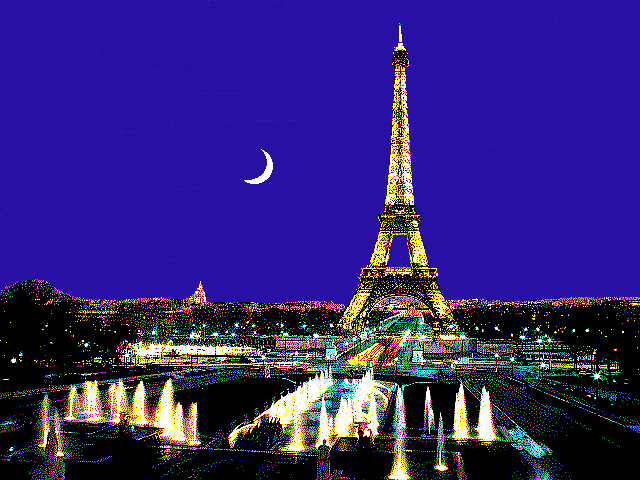
With the release of Play Time in 1967, Jacques Tati completed his masterwork: a film so expertly handled, with so much precise attention to detail, that it took over ten years and required the construction of an entire city to complete. At first glance, Play Time may seem to be the perfect film to address when referring to visions of a modernized Paris. With its ultra-chic, hyper-stylized formations and startling empty spaces, Tatiland appears on screen as a futuristic version of the city, impersonal and indifferent to its inhabitants. But the critique in Play Time is not so much specific to Paris as it is to cities as a whole; as Tati historian Macha Makeieff points out, “Tatiland is not a vision of Paris, but of cities across the globe.” Despite a single scene in which a reflection of the Eiffel Tower is visible in a swinging glass door, Play Time offers much evidence that the city represented within is not specific to a singular location, but rather an amalgamation of multiple regions.
Rather, it is in Tati’s earlier picture, the less abstracted Mon Oncle, where one finds his most distinct representation of Paris. Released in 1958, Mon Oncle is in many ways Tati’s most straightforward film. Michel Chion writes: “Mon Oncle (1958) is, in the works of Tati, the film which most conforms to the classical narrative system, and even represents the only example of its creator’s efforts to unfold a genuine story till the end, starting from a succession of causes and consequences” (32). That story, which focuses on Madame Arpel’s attempts to ‘clean up’ her brother, the insufferable M. Hulot, is in it’s own right a direct representation of modernization. Tati’s Hulot, who lives a simple life in the old part of town, cannot seem to conform to his sister’s hyper-controlled, sterilized ways. While the humor and themes remain constructed through Tati’s dialogue-less, seemingly meandering style, the film is very much aware of its narrative focus, going so far as to make self-reflexive nods. “Listen, what my poor brother needs is an objective… a home… like all this!” proclaims the most determined Madame Arpel.
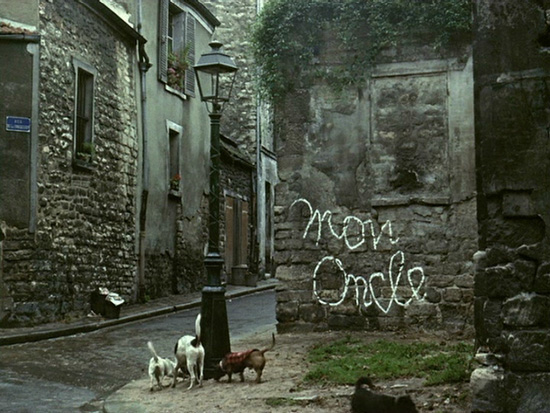
Tati divides his vision of the city into two halves: the quaint, cobblestone old town in which Hulot lives, and the homogenized modern section of the Arpels. The film sets up this division immediately in the opening credits. Beginning with a shot of a crane and the harsh jackhammer sounds of a construction site, the camera pans down across architect nameplates, which feature the credits. The main title, however, is scribbled in chalk on a building in the old world, and the flighty musical theme of the film begins. This theme becomes a crucial cue in distinguishing the two locations. While the music is prevalent throughout the old section, it is never heard in the modern one, except for in a single scene in which Monsieur Arpel telephones Hulot from his boss’ office to see if he would be interested in a position at the factory. Even then, the music is heard only through the telephone, and disappears when their conversations ends, further accenting the juxtaposition between the whimsical old town and the stuffy modern one. In fact, most of the sounds in the modern section are sharp, grating, or otherworldly; strange buzzes, odd bloops, and accented clanks. However, the pervading sonic mode is silence.
Further shots accent the division between the two sections of the city. The old section is notably characterized by its brick buildings and cobblestone streets, which give it a lively sense of color and human-like imperfections. Conversely, the new section features stark grey buildings that seem identical in form. When a character transitions between the two, Tati offers a shot of a crumbled brick gate, a figure of the old town, with the skyline of the grey modern section dominating the background. This shot, used multiple times in the film, is representative of the deteriorating old ways of Paris. Likewise, inhabitants of the old section seem free to walk as they please, harmonious with nature, while in the modern section, distinct pathways direct characters in motion. In the Arpel’s home, no one is allowed to step on the grass, for fear of ruining the perfect lawn.
The image seems clear. A giant crane towers over fractured earth; its red steel beams crosscutting sections of a bright blue sky. Thunderous shrieks of metal rubbing against rust permeate the air as the machine slowly turns, moving large pieces of pipe to their desired destination. A group of men in plastic orange suits work feverishly below, setting fire to steel and debating the specifics of their creation. Dump trucks rush past, carrying tons of dirt and rock, leaving trails of dust in their place. Fragments of ground spew forth; everywhere the land is shifted, reshaped, recycled.
The image seems clear, but it is contradictory. It is at once a sign of progress, and of gentrification. Construction and deconstruction. Destruction. We tear down the past to make room for the future. Destroy in the name of creation. The City is no stranger to the effects of modernized men; who, of the belief that ‘newer’ is synonymous with ‘better’, rebuild to reconstitute their surroundings and align them with contemporary modes of thought.
But what effects does this modernization have on the people? Where does the simple man fit into this neoteric equation? And who is to say that progress necessitates physical growth?
The French New Wave directors were not quick to dismiss old ideas, nor were they content to celebrate innovation. As post-war Paris experienced its largest development since 1914; as the suburbs began to expand considerably with the construction of large social estates known as cites; as a comprehensive express subway system, the RER, was built to complement the Métro and a network of freeways began circling around the city, New Wave directors explored city life with a watchful eye, observant of the profound effects innovation had on its inhabitants.
And perhaps no two directors were more cognizant of this transmuting social climate than Jacques Tati and Jean-Luc Godard. Tati, with his long overcoat and towery frame, seemed ill suited for modern life, uncomfortable in his surroundings as he was within his own skin. More a predecessor than a part of the New Wave, his uncompromising vision and inability to meld into modernity made him an influential figure within the movement, and it is difficult to separate his image from that of la Nouvelle Vague. Likewise, Godard, the figurehead and an inscrutable insurgent, proposed radical explorations of humanity and social order. His films question the commonality of the human experience, and prompt viewers to re-evaluate the significance, practice, and capacity of culture.
For both directors, the devastating effects of modern times proved fertile ground for thematic exploration across multiple films. However, Tati’s Mon Oncle (1958) and Godard’s Two or Three Things I Know About Her (1967) are their respective seminal works on the subject. While they were made almost ten years apart from each other, both films present representations of the modernization and physical growth of Paris. Both filmmakers use intertexts to comment upon this rapid expansion: Godard through semiotics and the written word, Tati through the modes of silent comedy.
However, beneath these intertexts lies each director's comprehensive knowledge and technical abilities to make full use of the malleability of the film image. It becomes necessary, then, to explore these two films specifically as representations of a ‘modern’ Paris and how these representations relate to the flexibility and sculpture-like qualities of the cinematic image.
Writing credits Jacques Lagrange Jean L'Hôte Jacques Tati
M. Hulot bumbles his way through this satire of French modernization that emphasizes the problems with upperclass living - namely, style over practicality. Despite its two-hour run time, the film is light, easy to watch and geniuinely funny. Tati, as always, draws from silent-era slapstick and Chaplinesque characters to create humor that is easy to understand in any language. Highly-focused sound effects add to the films unique rhythm. Only bested by Tati's follow-up, Play Time.
Is there anyone who speaks French who could translate this interview for me? I'm really interested to see what Tati has to say about the making of the film.
Eisenstein - Battleship Potempkin Odessa Steps scene 1925
Riefenstahl - Triumph of the Will 1935
Maya Deren - Ritual in Transfigured Time 1946
Orson Welles' uninterrupted track shot from Touch of Evil 1958
Uncle Eddie's Theory Corner got me thinking a bit about editing and the power of montage. No time to discuss now, but I'll expand upon this post with some commentary later!