Showing posts with label 1953. Show all posts

Friday, November 16, 2007

The Western Heroes Dual Part III


Starring two of the genre’s biggest names – John Wayne and Jimmy Stewart – The Man Who Shot Liberty Valance strips the Western of its window dressing, providing a reflection on the motifs and common themes that only a director as experienced in the genre as John Ford could produce. However, perhaps most striking are its competing protagonists who, through their dual natures, become a commentary on the Western hero and on the power of mythmaking, the film’s central theme.

Liberty Valance makes its dual protagonist structure quite clear from the very beginning. Stewart’s character, an established politician named Ransom Stoddard, heads to the small town of Shinbone for a funeral. Acting as narrator, he recounts the story of the deceased – John Wayne as Tom Doniphan – through flashback. This structure, coupled with the billing of two top stars, immediately implies dual protagonists.

Doniphan, “the toughest man south of the Picketwire”, is pragmatic and bound to nothing. Like Shane, he represents the savage side of the West: he lives in a house well outside of town, is nomadic and authoritative, and, most importantly, believes in the power of a gun. Doniphan doesn’t see much use for the law books and school teaching that Stoddard brings to the town of Shinbone. Stewart’s character represents civilization in its most pure, democratic, idealized form. A young lawyer from the East headed west to strike it big, Stoddard’s knowledge of the law, ability to read and write, and sheer idealism prove to be quite useful. However, over the course of the film, Stoddard finds that he needs to adapt to Doniphan’s more savage ways to survive. In the end, he comes out on top, remembered forever as “the man who shot Liberty Valance.”


This myth is the central point of the film: while Stoddard is memorialized for ending Valance’s reign, it was Doniphan who actually did the deed. Liberty Valance pits these two characters in direct competition and uses this structure to comment upon the myth-making abilities of the West. The fact that Stoddard is remembered for Valance’s death, and not Doniphan, shows how the West as an open frontier was rife with possibility for a man to prove himself – and how rumors could easily become truths by way of the press. As Maxwell Scott, editor of a now civilized Shinbone Star says, “When the legend becomes fact, print the legend.”

Doniphan is forgotten by nearly everyone at the end of the film. Unlike Shane, his valiant efforts and self-sacrifice are not lauded or memorialized, but hidden, rejected by those who control the myth-making process for the sake of civil progress. However, Stoddard’s civility is not portrayed as cut-and-dry as that in Shane either. Stoddard lapses into savage ways, and finds his well-intended career built on a myth. It is in such a way that the themes of Liberty Valance differs from that of Shane; whereas one films finds honor in the Western Hero, the other exposes a bittersweet reality.

Check out The Western Heroes Dual Part I & Part II!

Tuesday, November 06, 2007

The Western Heroes Dual Part II


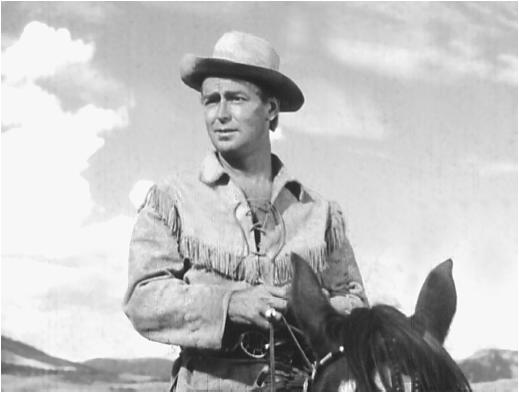
Directed by George Stevens and featuring Alan Ladd in the title role, Shane tells the story of a mysterious gunfighter who comes to the aid of an oppressed group of homesteaders. The film maintains much of the traditional iconography of the genre, from vast, sweeping landscapes to a sinister, gun-slinging villain. While consciously working within this set of images, Shane produces a vision of the West in which savage means are necessary for civil progress. The title implies that Shane, the almost miraculous gunfighter, is the main protagonist, but there are in fact two: Joe Starrett (Van Heflin), leader of the homesteaders, is equally important. These two protagonists are inexplicably linked, but embody certain opposing semantics of the West.


Shane is portrayed as a weary gunfighter, a wanderer with no place to hang his hat. He literally rides in from nowhere, his past a mystery never discussed. From the first shot of him riding on his horse, it is clear that Shane represents a dying breed of cowboy. Conversely, Joe Starrett is a family man who believes in the notion of private property and democratic organization. He represents civility, a new order of prosperity. Much of the narrative structure of the film relies on their relationship, their strengths and their weaknesses, to shape meaning.

Though wary of each other at first, the two are quickly presented as a team, working together to mutually improve quality of life. Joe hires Shane as an extra hand on the farm, providing him a temporary home, and the film shows how Shane’s cowboy qualities come in use. One scene boils it down into an easy metaphor: a tree stump too heavy for Joe to move by himself is lifted, with some strain, when he works with Shane. This scene could be interpreted as a summation of the movie; Joe can’t seem to shake the ranchers that want him off the land, but together with Shane, the two manage to put up a fight.


The oppression from the ranchers is much greater than that of a stump, however, and develops a much more complex relationship between the two protagonists. Both Shane and Starrett can fight physically – an extended fight sequence in the saloon exhibits this fact – but Shane’s quick-shot skills are necessary in keeping the film’s ultimate villain, a gun-for-hire named Jack Wilson (Jack Palance), at bay. Conversely, Shane’s presence irks some of the homesteaders, some of which feel they “don’t need no bodyguard” while others simply want to pack up and quit. Starrett’s unending optimism and oratory skills, coupled with his American ideals of individualized prosperity, manage to keep the homesteaders aligned even in the darkest of times, something Shane could not do. In turn, Shane and Starrett bridge together traits from both the savage and civil West that are necessary in accomplishing the plots ultimate goal – winning the land for the homesteaders.

However the narrative also pits the two characters in competition with one another, especially in relation to the Starrett family. Joe’s young son is constantly sizing his father up in comparison to Shane. He asks Joe many questions – “Could you shoot better than Shane? Could you whip him?” – that elaborate upon why Shane’s presence is so necessary for the homesteaders. Likewise, Joe’s wife, precautious but intrigued by the gunfighter, develops a flirting infatuation for Shane, which Starrett comes to recognize towards the end, admitting that if something were to happen to him, he’d at least know she’d be “taken care of and in good hands”.


This competition elaborates upon why the savage Westerner was so crucial, and helps glorify his nature, but the film remains conscious that he is a dying breed. Shane’s gun-toting way of life, though helpful in the circumstances, cannot work in the civil setting. He is conscious of this: “There's no living with a killing. There's no goin' back from one,” he says. “Right or wrong, it's a brand... a brand sticks. There's no goin' back... And there aren't any more guns in the valley.” The film ends with Shane riding back into the wilderness, but the shouts from Starrett’s son are a reminder that he is one cowboy that will not be forgotten.

Such is not the case for The Man Who Shot Liberty Valance...

Check out Part I
The Western Heroes Dual Part III coming soon!

Friday, November 02, 2007

The Western Heroes Dual, Part I


As a film genre deeply rooted in the transposition of civilized and savage elements, the Western inherently allows for the exploration and establishment of specific, individualized moral codes. In turn, the Western offers a variety of protagonist archetypes: the outstandingly upright Ladds, the forthright and masculine Waynes, the morally ambiguous Eastwoods, the slightly on edge Stewarts. These Western Heroes may have spurs and a sense of ruggedness in common, but it’s their distinct moral personalities that made them legends. Perhaps this is why it is most interesting when a film places two protagonist types in a dual narrative structure. Aside from adding layers of tension to melodrama, dual protagonists allow for a tiered representation of the civilizing process; a kaleidoscope that refracts concepts of a blossoming America.


However that is not to say all Westerns with dual protagonist structures reach the same conclusions. Both Shane (1953) and The Man Who Shot Liberty Valance (1962) feature dual protagonists, but their reflections on the civilized West are much different. Each film contains a ‘savage’ and ‘civil’ protagonist, and both favor the prospect of democratic growth. But where Shane shows clear praise for it’s savage hero, Liberty Valance paints a storybook West in which one myth is exchanged for another. The next few posts will be dedicated to exploring dual protagonists as they exist in these two films.

The Western Heroes Dual Part II coming soon!

Wednesday, January 03, 2007

Revisit: The Affairs of Dobie Gillis

An MGM Release 1953
Directed by Don Weis
Screenplay by Max Schulman

Grainbelt University has one attraction for Dobie Gillis (Bobby Van) - women, especially Pansy Hammer (Debbie Reynolds). Pansy's father (Hanley Stafford), however, does not share her affection for Dobie. A plagarized essay which almost revolutionizes English instruction, and Dobie's role in a chemistry lab explosion convinces Mr. Hammer to send broken-hearted Pansy to New York, but with the help of best pal Charlie Trask (Bob Fosse), his girl Lorna (Barbara Ruick), and Happy Stella Kolawski's (Kathleen Freeman) all-girl band, Dobie secures Pansy's return to Grainbelt.

This movie is truly absurd. It's a musical-comedy in the classical sense, but it swipes a lot from rock'n'roll and really reflects the care-free attitude of the era. I don't think I've ever seen a film that reinforces an "no work, all play" attitude so strongly as this. It'd be interesting to see a comparison between Gillis and Frank Tashlin's 1954 film The Girl Can't Help It, as they appear to be rooted in the same material while being polar opposites on almost all levels; one is a simplistic, black and white, classical musical 'updated' for the rock'n'roll age, the other a real rock'n'roll movie with biting satire and bright colors. Both have a certain cartooniness to them as well - the whole chem lab explosion has served as a plot point for almost every modern cartoon I can think of. The performances here are stellar - Debbie Reynolds shines with starry eyes and a sensational singing voice, and Bob Fosse's footwork is impressive as always. Not a must see, but a fun way to kill a quick 90 minutes.