One would assume that this 1990 remake of George Romero's zombie apocalypse classic Night of the Living Dead exists for the same reason as Zack Snyder's Dawn of the Dead - advanced film-making techniques "update" a horror classic for modern audiences. There are only two problems with this theory: Tom Savini's amateur direction, coupled with his DIY special-effects aesthetic, are rudimentary even for early 90's standards.
Alas, the remake does the original little justice, and brings little new to the table. Aside from being filmed in color, everything seems a lot more routine this go-round, particularly in the shadows of Day and Dawn of the Dead. A few alterations are made to the plot of Romero's classic horror tale, including the survival of our hero Barbara, who doesn't make it out alive in the first film. Romero has gone on to amend and augment much of his zombie apocalypse universe, with Land of the Dead and other recent forrays, so the chance to revisit his pioneering classic was, and still is, presumably very tempting.
I'll give Savini some credit -- Living Dead is his directorial debut, and hand-made effects are always a delight. But it doesn't negate the fact that the film is, quite frankly, a pointless excursion.
Ultimately you're better off watching the original or one of it's earlier sequels. But if you're a splatter fan or zombie freak, you could do worse. It's better than Return of the Living Dead by a long shot.
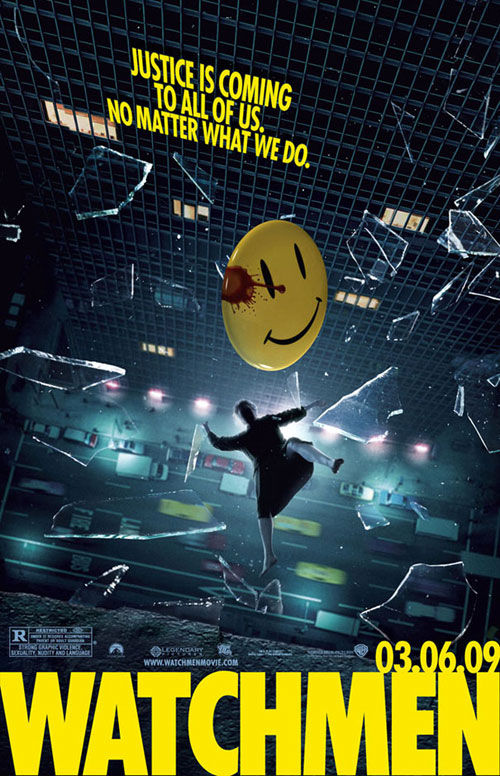
When an ex-superhero is murdered, a vigilante named Rorschach begins an investigation into the murder, which begins to lead to a much more terrifying conclusion.
Long considered 'unfilmable', Watchmen is one of the most celebrated graphic novels of all time, and often credited for ushering in an era of more serious, cerebral, adult-themed comic books. Hollywood took stabs at bringing Alan Moore & Dave Gibbon's time-altering, mind-bending grit fest to the screen for nearly 3 decades, with everyone from Paul Greengrass to Terry Gilliam to Michael Bay set to direct. Zack Snyder finally succeeded in producing the film, which finally hit theaters this week after much fanboy anticipation.
Fanboys like myself, who fell in the love with the graphic novel's sharp thematic and formal critique of the medium, as well as it's intense philosophical and political exploration, engrossing characters and wonderfully rich universe. Watchmen the novel is as complete a package as one could ever expect or want; a vast and detailed world with no stone unturned tenderly committed to the page.
Which begs the question -- why make it into a movie at all? Particularly one that adheres so faithfully to it's source?
Of course, that's the question I asked myself before the movie was released, and after having seen it, I'm not sure I have a full answer. From a business standpoint, I could understand why the movie was made -- large built-in fan base, a film that paves the way for grittier, more difficult graphic novel adaptations, and lots of fanboy cred for the distributors. But artistically, what are the merits? It seems there are some, but mainly the film exists as a celebration of Moore & Gibbon's work.
To their credit, Warner Brothers and Mr. Snyder have delivered one balls to the walls, full-force, hard R, uncompromising vision of Watchmen. Like the comic's creators, they left no stone unturned in bringing this epic to the big screen, inserting as much possible detail with extra care. For those unfamiliar with Watchmen's source, the film must be a dizzying experience with many WTF? moments, but fanboys rejoice: never has there been such a detailed adaptation in the history of the medium.
Snyder's visual flair and special effects prowess certainly help bring the panels to exacting life. Some sequences, particularly the Dr. Manhattan chapter, the back-peddling opening credits and almost anything involving Rorschach, are undeniably brilliant. Others, such as the Silk Spectre father reveal and the tweaked ending, lack some of the emotional punch delivered in the novel, but are nonetheless visually arresting.
Perhaps my biggest problem with the film is that it could never replicate all that the novel contains. Much of the climate of the Watchmen universe -- the nuclear war paranoia, the aggression towards authority figures, the degrading of social moral -- is reduced to blanket statements and quick set ups. The majority of the second and third tier characters present in the novel, many of which establish and elaborate these themes to flesh out the temporal backdrop, are absent here. Likewise, many details surrounding the characters origins are trimmed down, making their screen counterparts feel somewhat incomplete.
The music, too, felt jarring to me. The film deserves it's own original score, not some smattering of pop songs that vaguely adhere thematically to the action. I think Warner Brothers were a tad afraid of mainstream audience reactions, and figured if they put some huge pop hits behind some of the more audacious sequences it would make them more palatable. Maybe -- but it also severely undermined the tone. I highly doubt Hendrix would be blasting while Rorcshach and Nite Owl scourge Antarctica for Ozymandias's hideaway.
But with that said, it's amazing how much Synder and his team managed to cram into this two and a half hour epic, and it's even more amazing that Warner Brothers was willing to see through on his vision. This is one bloody disgusting, gut-wrenching, depressing, dark as hell film. It's views on humanity and social decency make Dark Knight look like kiddie play time. As does the on-screen sex and violence.
Watching the origins of Dr. Manhattan unfold on screen will remain one of my favorite cinematic moments for a long time. Billy Crudup does an amazing job and really nails the character to the T. But seeing it come alive, watching it unfold in real time -- nothing will ever compare. It's breathtaking. And that alone makes Watchmen worthy of repeat viewings.
And I definitely think I need to see it again, now that the fanboy giddiness is out of my system. It's hard to really critically assess Snyder's formal elements in that malaise. There is too much immediate beauty in the imagery to really look deep into what Snyder uses to shape the story. Regardless, Watchmen remains a unique ride, one that will (probably) never be duplicated.
Gordon Williams: (novel "The Siege of Trencher's Farm") (as Gordon M. Williams)
Sreenplay by: David Zelag Goodman and Sam Peckinpah
Plot description: A young American and his English wife come to rural England and face increasingly vicious local harassment.
Upon its release in 1971, director Sam Peckinpah was engulfed by a storm of controversy (what else is new?) surrounding his latest film, Straw Dogs. Peckinpah and his crew were attacked for the vicious and sick scenes of violence and rape that occur in the film. While many claime the scenes were too extreme for audiences, the film is not merely violent without purpose. Straw Dogs centers on David and Amy Sumner (played by Dustin Hoffman and Susan George), and their life in a small rural village in the UK. Sumner is an American mathematician who was given a grant to work in the film's setting, where he has recently overtook his wife's farm and where the couple now lives. In conducting renovations on the house the two are incessantly harassed by a violent collection of brutes who were commissioned to repair their home. Ultimately, the provocations turn to violent action and Amy Sumner is raped by the workers and their home assaulted by the men. David Sumner, ever the reluctant pacifist, is forced to defend his home and the lengths to which he goes are partly what give the film its gritty, extreme violence.
In Straw Dogs, Peckinpah (forever remembered for his unflinching and gruesome depictions of violence) is at the top of his game. What separates the film from his other works such as The Wild Bunch or Bring Me The Head of Alfredo Garcia is that in addition to jarring, blood-soaked physical violence (as expected), the film presents equally disturbing forms of psychological, and psycho-sexual torment. Hoffman plays David Sumner perfectly, summoning his then famous Benjamin Braddock persona from The Graduate, except adding a vicious, demented, and downright schizophrenic twist. Sumner is a reclusive, shy scholar whose reticence to engage in action is clearly established from his very first appearence. However, as the film progresses we see that he and his wife torment each other frequently, generally through verbal stabs and sexualized exchanges. In these exchanges we notice a peculiar agency on both their parts, as though David's shyness is not always sincere - it is in part an act, an attempt to outsmart others by allowing them the ease of assumption. Similarly, Susan George plays Amy with a double-face: In one sense she is the naive sexbot who never graduated from the lecherous gazes she no doubt received as a youngster/to this day. In other scenes, such as one in which she taunts the construction workers by walking topless in her bedroom as a form of revenge on David, she clearly possesses the agency and intelligence that her appearances before David obscure.
The film manages to provide both of these characters, each with seemingly split personalities all while using a setting in which every local townsperson is downright nasty, hateful and violent. What Peckinpah is suggesting with the stereotypical scholar David and the deviant, sexy wife have the capacity for all types of behavior, and as the film progresses David proves that he is in fact no different than the menacing lunatics trying to murder him and his family.
Overall, Straw Dogs is an extremely provocative and compelling film, and careful viewing proves that the criticisms that it is a one dimensional, blood-fest are unfounded. Peckinpah's strengths are in his ability to convey the potential darkness of man, and contextualizing this darkness within an appropriately familiar and quotidian setting. Much like Cronenberg's A History of Violence (only 35 years prior), Peckinpah's film deconstructs audience identification and their notions of "justifiable violence" in a meta-discursive fashion while within the narrative he explores the intricate sexual tensions that exist between man and woman. Straw Dogs is a primal and damn near bestial film both in its story and Peckinpah's signature film aesthetic of harshness and brutality. Peckinpah's shots (filthy and drained of all pleasantness the countryside could provide), disorienting edits and movements (perfectly embodied during Amy's rape flashbacks at a church gathering as well as the break-in scene), and ability to generate both seemingly obvious exploitation and ambiguity in the same breath make this flick a must-see.