Tragedy besets a broken family when a mysterious uncle returns from prison with more on his mind than a happy reunion.
An unsettling film with a strong Southern voice, Undertow is a fine representation of David Gordon Green's skills as a director. While far from perfect - the script takes a while to get going, stumbles in some information reveals and relies a little heavily on Christ metaphors - Undertow is a captivating mix of melodrama, suspense, and horror. Green really makes the most of the setting, a Southern bayou, letting cinematographer Tim Orr really stretch his camera and get a good feel for the murky, hot, muddy surroundings. Performances from Josh Lucas, Jamie Bell, and Dermot Mulroney are more than passable, elevating the somewhat leaden script to a much scarier place. Ditto for composer Philip Glass's music, which certainly adds to the tension and moves many of the scenes. Under anyone else's supervision, Undertow may have been a sub-par or downright silly affair. But David Gordon Green and his crew make it something more: a sort of modern day Night of the Hunter, fairy-tale-esque and all the more tragic. Worth a watch.
Directed by: Ludwig Berger Michael Powell Tim Whelan Alexander Korda(uncredited) Zoltan Korda (uncredited) William Cameron Menzies (uncredited)
Written by Miles Malleson
Prince Ahmad is the rightful King of Bagdad but has been blinded and cast out as a beggar. Together with Abu, the best thief in all Bagdad, the Prince sets out on a series of adventures that involve a Djinni in a bottle, a mechanical flying horse, an all-seeing magic jewel, a flying carpet and a beautiful princess in order to restore his kingdom from the wicked Grand Vizier Jaffar.
Old school Hollywood in all its splendor, The Thief of Bagdad features exotic locales (!), amazing special effects (!), beautiful women (!), and high-flying action (!), all in glorious Technicolor (!!!). Not to be confused with the (arguably better) 1924 silent film of the same name, this Thief cobbles its plot from a bunch of stories out of Arabian Nights, which makes for some spectacular sequences that were then re-imaged for the Disney animated film Aladdin.
The film is delightfully simple stuff -- easy to digest and fun to look at with a lot happening on screen but little going on up stairs. For some reason, none of the actors are Arab -- Sabu (who plays Abu in the film, why'd they even bother to change his name?) is the most famous actor here, and the most ethnic, having been one of the first Indian actors in Hollywood. It also marks John Justin's film debut, a British stage actor who occasionally dabbled in film. He sports a hilarious thin-lip-stache and struggles to hide his British roots throughout the film. We had a lot of fun making jokes at his expense while watching.
Legend has it that producer Alexander Korda was so demanding that he went through six directors during the making of this film, including his brother Zoltan Korda and leading art director William Cameron Menzies. Not shocking -- everything presented on screen, from the lavish set pieces to the extravagant effects to the pastel-saturated color scheme looks expensive as hell, especially considering the time. This is one of the best example of early big budget Hollywood movie-making one could find. Worth watching if you dig that sort of thing.
A wandering gunfighter (Clint Eastwood) plays two rival families against each other in a town torn apart by greed, pride, and revenge.
A Fistful of Dollars is most well known as the first installment of Sergio Leone’s popular spaghetti western trilogy featuring Clint Eastwood as the nameless gunslinger. These films demythologize the traditional American western, appropriating standard genre motifs and reinventing them; shot in Spain by Italians and produced by Germans, these spaghetti westerns exist as a reflection of America the melting pot. However, Fistful is also of particular note in that it is a transcultural adaptation of Akira Kurosawa’s samurai film Yojimbo. The films share much in common, especially in regards to character and story arc, but ultimately the transitioning of genres separates the two from each other.
Yojimbo takes place in 1860, a time where samurai were beginning to be erased by a thriving middle class. The film follows a hungry ronin (Toshiro Mifune) who finds himself in a desolate town split in two by a pair of feuding gangsters. The samurai, who names himself Sanjuro Kuwabatake in film, seizes the opportunity to play sides, ultimately killing all the gangsters and making some money in the process. Similarly, Fistful of Dollars deals with a nameless character that enters a town ravaged by gangsters and follows his attempts at confounding the corrupted. Both films also feature subplots that involve the rescue of a concubine and the subsequent return to her family.
The construction of character in both Yojimbo and Fistful is very similar as well. The main protagonist in each is portrayed as a mysterious, mythologized version of their real-life equivalent. Both the samurai and the gunslinger exhibit physical abilities beyond the norm: the gunslinger is a perfect shot, the samurai a fierce, unparalleled warrior. Their clever manipulation of the gangsters mimics a god-like force, supported by the frequent elevated character placement – “Everything looks different from up high,” says the gunslinger – and use of close ups and altered perspective to make the characters appear bigger than their surroundings. Rolling boughs of fog introduce each character, and both are equated with death and ghosts at some point, reinforcing character mythologization.
It is clear that the basic details of both of these films are very similar. However, what most disrupts these similarities is the transition of genre from samurai film to western. For example, the introduction of a gun in Yojimbo is a major turning point. The gun represents a new threat, western technology and the rising middle class, and the samurai’s ability to avoid and castrate the gun supports the mythological presentation of his character. Because it’s a western, everyone in Fistful uses a gun. The threat is now about size (colt vs. rifle), and though the mythological effect remains, the symbol of the gun loses its multi-layered meaning.
Likewise, the town in Yojimbo is divided evenly into two equally powerful gangs, whereas the town in Fistful is split between the ineffective law (Sheriff Baxter and his gang) and the ruthless Rojo gang. This alteration places the feud in a different context, making the division line between good and bad seem a bit more clear. This is a definite convention of Leone’s work: though the characters are all portrayed as morally ambiguous, there still exists a sort of tiered hierarchy that allows for the sympathy of characters on multiple levels. This does not really exist in Yojimbo; the gangsters are all clearly bad, and the samurai exists as the only morally complicated character. Finally, the subplot involving the concubine and her family is anchored as a central plot device in Fistful, rather than as an effect of narrative discourse like in Yojimbo. The concubine is shown within the first few frames in Fistful of Dollars, visually alerting the audience to her condition and foreshadowing the inevitable rescue. Eastwood’s character seems fascinated by her in the film, almost as if he were about to fall in love. This foregrounding of the concubine story shifts character motivation and provides a sort of romantic element that is unexplored in Yojimbo.
Ultimately, Yojimbo and A Fistful of Dollars share much in common. However, the translation of genre provides for some very distinct changes that make Fistful its own unique film.
Writing credits John W. Cunningham (story) Carl Foreman (screenplay)
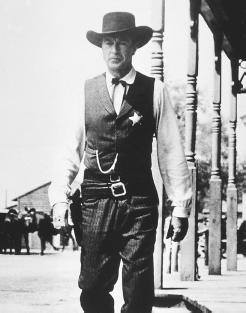
Retired lawman Will Kane(Gary Cooper), about to leave town with his new bride (Grace Kelly), seeks allies among the fearful townspeople when an outlaw he put in prison returns with his gang to take revenge.
A classic story about burning your bridges, High Noon is one of the great westerns, despite breaking of many time-honored genre codes. The film plays out in real time and contains little action until the last act, which is unique for westerns of the time. Likewise, it's politics seem to serve as an allegory for the rise of McCarthyism, but ironically the film was embraced by conservatives who admired its emphasis on duty and courage.
The film effectively draws tension from Kane's desperation. Various high angle shots and images of clocks reinforce the imposing time limit. The film reveals information about Kane's past involvement with the gang very slowly with each scene, so that they dialogue is both about the current attack and the past. Worth a gander.
Writing credits François Truffaut Jean Gruault Jean Itard (scientific report)
Based on the true story of a child found alone in the wild and a doctor's attempts to educate him.
Truffaut's relatively accurate interpretation of the events surrounding Dr. Jean Itard's work with a wild child is as engaging as it is endearing. The film raises many interesting questions about the commonality of the human experience and man's primal nature, but mostly exists as a sincere effort to call attention to the works of Dr. Itard. The films only real drawback is Truffaut's acting, which is a bit wooden; the director claimed to have cast himself because he felt other actors weren't "utilizing the space he would offer", but as a performer, Truffaut is almost emotionless. Most of his character is laid out through voice-over, which can be a bore, but the film's brilliant cinematic construction (it was shot by Néstor Almendros, who was cinematographor for many of Rohmer's films, as well as Terrence Malick's Days of Heaven) keeps it interesting. It's also pretty short, which is always nice. Worth a look.