Showing posts with label western. Show all posts

Friday, November 16, 2007

The Western Heroes Dual Part III


Starring two of the genre’s biggest names – John Wayne and Jimmy Stewart – The Man Who Shot Liberty Valance strips the Western of its window dressing, providing a reflection on the motifs and common themes that only a director as experienced in the genre as John Ford could produce. However, perhaps most striking are its competing protagonists who, through their dual natures, become a commentary on the Western hero and on the power of mythmaking, the film’s central theme.

Liberty Valance makes its dual protagonist structure quite clear from the very beginning. Stewart’s character, an established politician named Ransom Stoddard, heads to the small town of Shinbone for a funeral. Acting as narrator, he recounts the story of the deceased – John Wayne as Tom Doniphan – through flashback. This structure, coupled with the billing of two top stars, immediately implies dual protagonists.

Doniphan, “the toughest man south of the Picketwire”, is pragmatic and bound to nothing. Like Shane, he represents the savage side of the West: he lives in a house well outside of town, is nomadic and authoritative, and, most importantly, believes in the power of a gun. Doniphan doesn’t see much use for the law books and school teaching that Stoddard brings to the town of Shinbone. Stewart’s character represents civilization in its most pure, democratic, idealized form. A young lawyer from the East headed west to strike it big, Stoddard’s knowledge of the law, ability to read and write, and sheer idealism prove to be quite useful. However, over the course of the film, Stoddard finds that he needs to adapt to Doniphan’s more savage ways to survive. In the end, he comes out on top, remembered forever as “the man who shot Liberty Valance.”


This myth is the central point of the film: while Stoddard is memorialized for ending Valance’s reign, it was Doniphan who actually did the deed. Liberty Valance pits these two characters in direct competition and uses this structure to comment upon the myth-making abilities of the West. The fact that Stoddard is remembered for Valance’s death, and not Doniphan, shows how the West as an open frontier was rife with possibility for a man to prove himself – and how rumors could easily become truths by way of the press. As Maxwell Scott, editor of a now civilized Shinbone Star says, “When the legend becomes fact, print the legend.”

Doniphan is forgotten by nearly everyone at the end of the film. Unlike Shane, his valiant efforts and self-sacrifice are not lauded or memorialized, but hidden, rejected by those who control the myth-making process for the sake of civil progress. However, Stoddard’s civility is not portrayed as cut-and-dry as that in Shane either. Stoddard lapses into savage ways, and finds his well-intended career built on a myth. It is in such a way that the themes of Liberty Valance differs from that of Shane; whereas one films finds honor in the Western Hero, the other exposes a bittersweet reality.

Check out The Western Heroes Dual Part I & Part II!

Tuesday, November 06, 2007

The Western Heroes Dual Part II


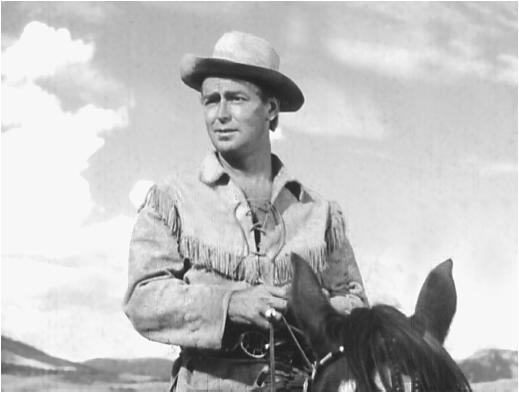
Directed by George Stevens and featuring Alan Ladd in the title role, Shane tells the story of a mysterious gunfighter who comes to the aid of an oppressed group of homesteaders. The film maintains much of the traditional iconography of the genre, from vast, sweeping landscapes to a sinister, gun-slinging villain. While consciously working within this set of images, Shane produces a vision of the West in which savage means are necessary for civil progress. The title implies that Shane, the almost miraculous gunfighter, is the main protagonist, but there are in fact two: Joe Starrett (Van Heflin), leader of the homesteaders, is equally important. These two protagonists are inexplicably linked, but embody certain opposing semantics of the West.


Shane is portrayed as a weary gunfighter, a wanderer with no place to hang his hat. He literally rides in from nowhere, his past a mystery never discussed. From the first shot of him riding on his horse, it is clear that Shane represents a dying breed of cowboy. Conversely, Joe Starrett is a family man who believes in the notion of private property and democratic organization. He represents civility, a new order of prosperity. Much of the narrative structure of the film relies on their relationship, their strengths and their weaknesses, to shape meaning.

Though wary of each other at first, the two are quickly presented as a team, working together to mutually improve quality of life. Joe hires Shane as an extra hand on the farm, providing him a temporary home, and the film shows how Shane’s cowboy qualities come in use. One scene boils it down into an easy metaphor: a tree stump too heavy for Joe to move by himself is lifted, with some strain, when he works with Shane. This scene could be interpreted as a summation of the movie; Joe can’t seem to shake the ranchers that want him off the land, but together with Shane, the two manage to put up a fight.


The oppression from the ranchers is much greater than that of a stump, however, and develops a much more complex relationship between the two protagonists. Both Shane and Starrett can fight physically – an extended fight sequence in the saloon exhibits this fact – but Shane’s quick-shot skills are necessary in keeping the film’s ultimate villain, a gun-for-hire named Jack Wilson (Jack Palance), at bay. Conversely, Shane’s presence irks some of the homesteaders, some of which feel they “don’t need no bodyguard” while others simply want to pack up and quit. Starrett’s unending optimism and oratory skills, coupled with his American ideals of individualized prosperity, manage to keep the homesteaders aligned even in the darkest of times, something Shane could not do. In turn, Shane and Starrett bridge together traits from both the savage and civil West that are necessary in accomplishing the plots ultimate goal – winning the land for the homesteaders.

However the narrative also pits the two characters in competition with one another, especially in relation to the Starrett family. Joe’s young son is constantly sizing his father up in comparison to Shane. He asks Joe many questions – “Could you shoot better than Shane? Could you whip him?” – that elaborate upon why Shane’s presence is so necessary for the homesteaders. Likewise, Joe’s wife, precautious but intrigued by the gunfighter, develops a flirting infatuation for Shane, which Starrett comes to recognize towards the end, admitting that if something were to happen to him, he’d at least know she’d be “taken care of and in good hands”.


This competition elaborates upon why the savage Westerner was so crucial, and helps glorify his nature, but the film remains conscious that he is a dying breed. Shane’s gun-toting way of life, though helpful in the circumstances, cannot work in the civil setting. He is conscious of this: “There's no living with a killing. There's no goin' back from one,” he says. “Right or wrong, it's a brand... a brand sticks. There's no goin' back... And there aren't any more guns in the valley.” The film ends with Shane riding back into the wilderness, but the shouts from Starrett’s son are a reminder that he is one cowboy that will not be forgotten.

Such is not the case for The Man Who Shot Liberty Valance...

Check out Part I
The Western Heroes Dual Part III coming soon!

Friday, November 02, 2007

The Western Heroes Dual, Part I


As a film genre deeply rooted in the transposition of civilized and savage elements, the Western inherently allows for the exploration and establishment of specific, individualized moral codes. In turn, the Western offers a variety of protagonist archetypes: the outstandingly upright Ladds, the forthright and masculine Waynes, the morally ambiguous Eastwoods, the slightly on edge Stewarts. These Western Heroes may have spurs and a sense of ruggedness in common, but it’s their distinct moral personalities that made them legends. Perhaps this is why it is most interesting when a film places two protagonist types in a dual narrative structure. Aside from adding layers of tension to melodrama, dual protagonists allow for a tiered representation of the civilizing process; a kaleidoscope that refracts concepts of a blossoming America.


However that is not to say all Westerns with dual protagonist structures reach the same conclusions. Both Shane (1953) and The Man Who Shot Liberty Valance (1962) feature dual protagonists, but their reflections on the civilized West are much different. Each film contains a ‘savage’ and ‘civil’ protagonist, and both favor the prospect of democratic growth. But where Shane shows clear praise for it’s savage hero, Liberty Valance paints a storybook West in which one myth is exchanged for another. The next few posts will be dedicated to exploring dual protagonists as they exist in these two films.

The Western Heroes Dual Part II coming soon!

Tuesday, October 30, 2007

Revisit: Ride the High Country


An MGM film 1962

Directed by Sam Peckinpah

Written by N.B. Stone Jr.


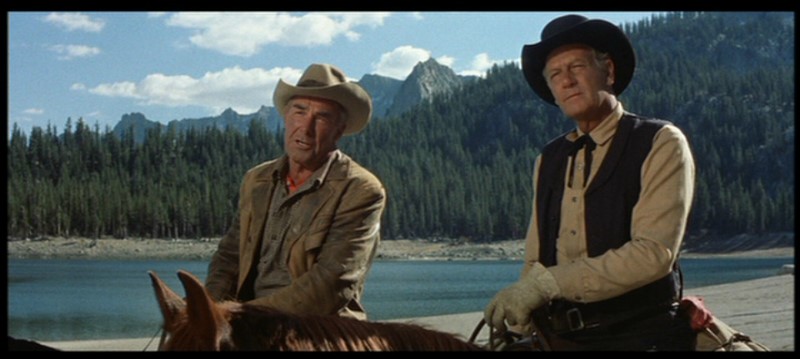
Ride the High Country is a eulogy for the traditional western. The film is conscious of the myth of the American Frontier, presenting it as dying legend that can, and has been, manipulated. Here is a version of the West where Eastern civilizing culture and ideals have pushed savage lands to the very corners of the Earth. However, that’s not to say that such savage ideals don’t exist. The film doesn’t exactly regret the loss of traditional Western values, but rather appears to celebrate moral ambiguity in the genre, desiring to push that trend even further.


The film provides three male heroes: Steve Judd, moral and upright, the Gary Cooper template for the classical Western hero; Gil Westrum, a good but morally gray man, the John Wayne type; and Heck Longtree, a youngin’, the next generation of cowboy. While Judd is presented as upstanding, his character is constantly referred to as old and out of date; even from the beginning, when he mysteriously rides into town in the most classical fashion, it is made clear that this character’s function in the genre is no longer effective. In the end, he is the only one killed off. Westrum, seemingly corrupt and villainous at times, is redeemed, rewarded in the end for his ability as a character to make sacrifice and overcome immoral temptation. Likewise, Longtree grapples with morality, ultimately establishing an honor code from both Judd and Westrum.

Peckinpah finds good humor in the banter between the two dying breeds of hero, but the real excitement in the film comes through the villains. These men are equally morally blurred, as they exhibit knowledge of moral codes, but choose to ignore them, instead settling for insincere symbolic measures that clean the appearance of their evil ways. The Hammond Gang represents tiers of damaged psychology, from sharp and sly to straight crazy, and they incite all of the riotous action in the film. While Ride the High Country is aware that it is declaring the end of one classical mode, it appears to be celebrating a newfound interest in damaged characters, and ambiguity in savagery.

Thursday, March 15, 2007

Revisit: High Noon


A United Artists release 1952

Directed by Fred Zinnemann

Writing credits
John W. Cunningham (story)
Carl Foreman (screenplay)

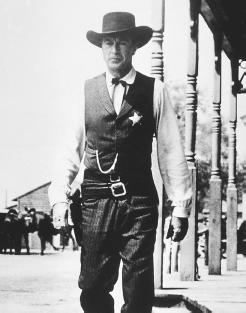
Retired lawman Will Kane(Gary Cooper), about to leave town with his new bride (Grace Kelly), seeks allies among the fearful townspeople when an outlaw he put in prison returns with his gang to take revenge.


A classic story about burning your bridges, High Noon is one of the great westerns, despite breaking of many time-honored genre codes. The film plays out in real time and contains little action until the last act, which is unique for westerns of the time. Likewise, it's politics seem to serve as an allegory for the rise of McCarthyism, but ironically the film was embraced by conservatives who admired its emphasis on duty and courage.

The film effectively draws tension from Kane's desperation. Various high angle shots and images of clocks reinforce the imposing time limit. The film reveals information about Kane's past involvement with the gang very slowly with each scene, so that they dialogue is both about the current attack and the past. Worth a gander.

Monday, March 12, 2007

Revisit: The Sons of Katie Elder


A Paramount Pictures release 1965

Directed by Henry Hathaway

Writing credits
Talbot Jennings (story)
William H. Wright (screenplay)
Allan Weiss (screenplay)
Harry Essex (screenplay)

The infamous Elder boys return to Clearwater, Texas for their Mother's funeral, only to face a slew of trouble surrounding the murder of their father and the loss of his ranch.


A well made western that doesn't play with tension quite like Rio Bravo, but rather builds upon it's characters backstories and focuses on mystery. Katie Elder's strentgh is it's excellent cast, which includes John Wayne, Dean Martin, George Kennedy and a young Dennis Hopper. The four brothers bounce off each other real well and the film has some genuine moments between them. There are also some great shoot-outs towards the end - look for an awesome shot of a so-pissed-he's-constipated-looking Wayne firing two pistols at once way before John Woo ever came up with the idea.

Saturday, January 27, 2007

Revisit: Rio Bravo


A Warner Brothers release 1959
Directed by Howard Hawks
Writing Credits:
B.H. McCampbell (short story)
Jules Furthman (screenplay)
Leigh Brackett (screenplay)

The sheriff (John Wayne) of a small town in southwest Texas must keep custody of a murderer whose brother, a powerful rancher, is trying to help him escape. After a friend is killed trying to muster support for him, he and his deputies - a disgraced drunk (Dean Martin) and a cantankerous old cripple (Walter Brennan) - must find a way to hold out against the rancher's hired guns until the marshal arrives. In the meantime, matters are complicated by the presence of a young gunslinger (Ricky Nelson) - and a mysterious beauty (Angie Dickinson) who just came in on the last stagecoach.


One of the quintessential westerns, Rio Bravo is a textbook example of Hawks versatility as a director. His eye for storytelling and technical mastery is evident in most every genre he tackles, westerns included. He works through the western without missing a beat, providing a full show, while adding his own distinct, right-wing politics. The characters in the film are rich and fully-rounded, their behavior and psychology focused. John Wayne plays the curt, upstanding sheriff with usual excellence. Personally, I think Walter Brennan's Stumpy steals the show. Must see for fans of the genre.

Saturday, January 20, 2007

Revisit: High Plains Drifter


A Universal Pictures release 1973
Directed by Clint Eastwood
Written by Ernest Tidyman

A stranger (Clint Eastwood) rides out of the hot desert into the small western town of Lago. The towns people are scared of him, and 3 gunmen try unsuccessfully to kill him. He takes a room and decides to stay. Meanwhile, a group of outlaws are about to return to town and take their revenge. Can the town convince the mysterious man to help?


I miss the old days of Clint's westerns. The colors were already washed out - none of that digital tinting bullshit.
This is your pretty standard post-goldern western, lots of gunplay and bloody as hell. While Fistfull of Dollars may remain the offical Yojimbo adaptation, Eastwood seems to have piggy-backed a lot of the samurai saga's basic structure, while reverting the conflict from an inner struggle to an outside figure (the two gangs in Yojimbo vs. the roaming bandits in Drifter). Though it may not be the most original of westerns, it's a pretty fun movie.