A documentary that follows the staging of tightrope walker Philippe Petit's daring, but illegal, high-wire routine performed between New York City's World Trade Center's twin towers in 1974.
I first learned of Philippe Petit when I was a freshman in college. I saw photographs of his daring tightrope walk between the Twin Towers and was instantly amazed by the image. He appeared to be walking on air, floating, literally dancing in the sky. It was unbelievable. Still is.
Man on Wire is a fantastic documentary that follows the events preceding Petit's famous walk, what some consider the "artistic crime of the century". It's not a flashy film, nor does it need to be -- the subject matter and main protagonist are in and of themselves so enigmatic and interesting that the film's composition barely matters. Focusing mainly on the planning and the event itself, the film often compares Philippe's artistic vision to a heist, using the bank robbery metaphor several times. But the profound beauty of Philippe's actions and the dedication of his cohorts make it a noble cause.
Perhaps what I took away most from this film is that this was a once in a lifetime event -- in the wake of terrorism and high security, a stunt like Philipe's is not only impossible physically, but philosophically. Public space isn't equated with public ownership in the same way; performance pieces like Philippe's rarely come without press releases, and tightrope walking is a particularly antiquated (and French) art form. But Man on Wire serves to celebrate and preserve that moment in time, in all its beauty. Easily the best documentary of 2008.
The extraordinary life and times of famed French singer Edith Piaf (Marion Cotillard)
Like most biopics, this incredibly uneven but suprisingly moving portrait of Edith Piaf, one of France's national treasures, relies heavily on the performance of its lead, Marion Cotillard. Thankfully she nails Piaf to a tee, capturing her movements and manneurisms with such precision it's almost uncanny.
If only the script did her performance justice. Dahan's presentation of periods in Piaf's life is so scatterbrained, it's almost hard to tell what is going on. The film does an incredible amount of jumping back and forth through time in the most illogical of ways; snippets from Piaf's childhood are connected to her final days or mid-life antics without any real causal connection, thematically or emotionally. The poor pacing results in a fragmented portrait of this powerful artist, one that leaves the spectator feeling as though they are missing something, despite the film's two and a half hour plus run time.
If you're already a fan of Piaf, then you're sure to love this film. If not, stick to the soundtrack - it'll tell you all you need to know.
Written by: Pierre Dumarchais (novel) Jacques Prévert (screenplay)
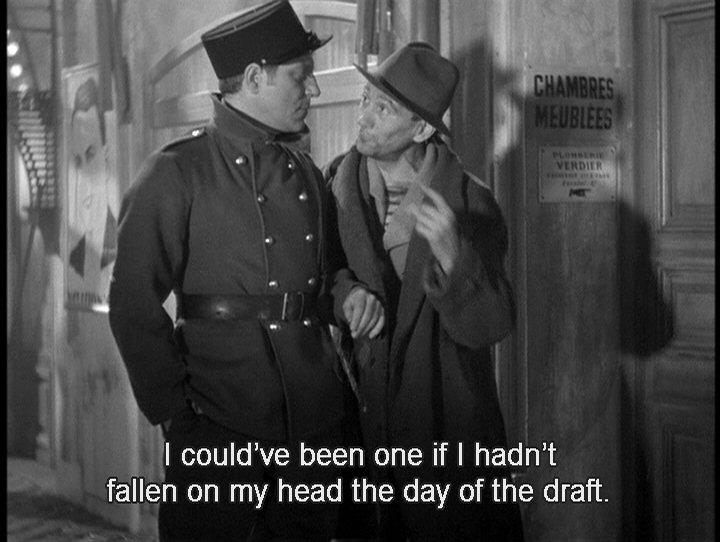
A military deserter (Jean Gabin) finds love and trouble in a smoky French port city.
A truly beautiful film that follows the classic Hollywood template, Carné's Port of Shadows is the kind of movie where all of the elements culminate into a near-perfect package. The air-tight script is chock full of fantastic dialogue and well-rounded characters, aided by the incredible cast, which includes Jean Gabin, Michel Simon, and Michele Morgan. Even minor characters are surprisingly well developed. Likewise, there isn't a shot in the film that feels out of place or sloppy; everything is essential. The lighting, grain, and over-all look of the film is quite stunning and especially effective in telling the story. It's interesting to note that this film is pre-WWII, as much of the script feels like an allusion to the war. A must see.
The formal differences between Godard’s approach to modernization in Two or Three Things and Tati’s Mon Oncle are clear: one takes on a lingual, documentary style while the other focuses on visual cues and spatial relations. However, both films feature similarly negative views on modern construction and seem to be of the viewpoint that ‘newer’ doesn’t necessarily mean ‘better’. While Godard is preoccupied with the cinema and modernizations effects on language, his assertions that commoditized culture has negatively impacted individualism mirror Tati’s sentiments. Likewise, Tati’s affinity for old time housing and ways of life can be seen in Godard’s demonizing of urban organization and physical growth.
However, neither film is without hope. While Tati’s message may seem bleak, his humor-based approach stands as a silver lining. Likewise, Godard’s playful attempts to render verbal and written language through the cinema act as a call for greater attention to language as a cultural entity. The results are a vision of Paris, a modern city, which is both culturally expanding and aware of its own deficiencies.
WORKS CITED
Barthes, Roland. “Towards a Semiotics of Cinema: Barthes in interview with Michel Delahaye, Jacques Rivette”. Cahiers du Cinema: The 1960s. Jim Hillier. Massachusetts: Harvard University Press, 1986.
Chion, Michel. The Films of Jacques Tati. New York: Guernica, 1997. Leutrat, Jean-Louis. “The Power of Language”. The Cinema Alone: Essays on the Work of Jean-Luc Godard. Michael Temple & James S. Williams. Amsterdam: Amsterdam University Press, 2000.
Makeieff, Macha. Playtime. Notes on Lecture, 4/10/2007.
Ramierz, Francis and Christian Rolot. Mon Oncle: Jacques Tati. Collection Synopsis, no. 16. Paris: Nathan, 1993.
Mon Oncle. Jacques Tati. DVD. Criterion, 2001.
Stam, Robert. French New Wave II. Notes on Lecture, 2/8/2007.
Thiher, Allen. “Postmodern Dilemmas: Godard's Alphaville and Two or Three Things That I Know about Her”. Boundary 2, Vol. 4, No. 3. (Spring, 1976), pp. 947-964.
Two or Three Things I Know About Her. Jean-Luc Godard. VHS. New Yorker Films, 1988.
Godard plays with the idea of consumption and mass culture throughout Two or Three Things. He offers many symbols of culture – magazine covers, famous quotes, novels – but sets them up so that, as signifiers, they offer little meaning. In one scene, Juliette and fellow prostitute Miriam don duffel bags bearing TWA and PAN-AM logos and are forced to parade around naked. In another, two men sit in a café compiling sentences out of novels in the hope of composing the ultimate book. Both these scenes exhibit the appropriation of cultural images or objects, but recontextualize them so that all meaning is obscured.
Godard keeps a philosophical dialogue going throughout the film via a non-diegetic voiceover. Considering the narrator’s penchant for the first person, and his lengthy transcendental musings, it’s almost appropriate to assume that it is a surrogate for Godard himself. One scene is particularly telling of this idea: as the camera focuses in on a cup of coffee, the narrator laments his inability to understand objects, and his verbose speech peters out into a verifiable spew of words. It is as if Godard himself is lamenting the way language has been corrupted by culture, rendered ineffective. “To say that the limits of language, of my language, are those of the world, of my world, and that in speaking, I limit the world, I end it” he cries.
If Two or Three Things presents the idea that consumerism has limited man’s ability to communicate, than it also suggests that the modern environment limits man’s ability to connect. As previously stated, construction is depicted in the film as imposing, a dominating force. But already established edifices are given equally biting critiques. “A landscape is like a face”. Towards the end of the film, Godard pans around Juliette’s building complex as she says this phrase. We see that the area is completely enclosed by buildings, each one composed of tiny little boxes, presumably individual apartments. The space is called le grand ensemble, a new form of urban organization implying a certain sense of togetherness, and yet we can only perceive the area in fragments, as each individual who lives there must do as well.
“I examine the city, its inhabitants, and the bonds between them as closely as a biologist examines the relations between individuals and race in evolution. Only thus can I tackle problems of social pathology and formulate hope for a genuine new city” - Narrator
The opening credits of Two or Three Things I Know About Her feature an inter-title that informs the viewer that the word Her refers to the Paris region, while it also refers to the main protagonist and the actress playing her. This concept – the suggestion of dual intendment behind a word – is crucial to the film. Like in Mon Oncle, Two or Three Things offers a semblance of a narrative: the film follows a day in the life of a suburban housewife who practices prostitution part-time in order to afford luxuries that society deems necessary. Through herstruggles to stay on top in life, the film explores mankind’s relationship to language, semiotics and meaning.
Two or Three Things opens with the image of a large highway construction site. The interminable racket of modern development heard over the credits is hushed as a voice over begins, outlining history and establishing philosophical viewpoints. Both of these elements remain constant throughout the film. Godard offers documentary style visuals of the physical growth of Paris; giant cranes and dump trucks, unfinished highways over dilapidated homes. The construction seems daunting, as modern buildings and work sites seem to tower into the sky, envelope older cityscapes. The fact that these are actual shots of Paris reinforces the cinematic idea of injecting symbolism onto reality, an idea that plays a crucial role in the film. How do we accept cinematic representations as being ‘real’ when the basic properties of film automatically convert all images into symbols? Godard plays with this idea by showing these construction sites, presenting them as they exist, but over-scoring their presence, having them appear monstrous and dwarfing. Thus the audience understands both what is ‘real’, and the critique of progress the images present.
A similar example of this idea can be found at the beginning of the film when the main protagonist, Juliette, is introduced. The voice over first introduces her as the actress Marina Vlady. Then the scene repeats, reintroducing her under her characters name. This demonstrates how the cinematic medium converts what is real into a symbol; Vlady is at once her real self, and her fictional cinematic counterpart. As Allen Thiher points out, this allows Juliette, as a cinematic character, to have multiple voices: “On one level she speaks as a fictional housewife-prostitute in a non-reflexive manner. On a second level she examines her language and uses self-reflexive language. This level leads to a third where she tests her language against her environment, which often shows how absurdly incongruous her language is with regard to the images that present her situation” (958).
From here, Godard is able to disregard conventional cinematic standards for conversation and allow the character to slip out of a scene and impose additional commentary. This, coupled with the film’s documentary style approach, grants access into the thoughts of both major and minor characters, almost in a novel-like fashion, highlighting the shortcomings of language and the cinematic medium.
For example, in the scene in the shop where Juliette purchases a new dress, the camera picks up the banal chatter of several young girls. In one shot, the camera stops and focuses on a girl, who says “I have a date with Jean-Claude at 8. We go to a restaurant, sometimes a film.” This part of the scene appears like a documentary, the camera focusing on the girl as if it were asking her a question.
However, when Juliette speaks into the camera seconds later, it becomes clear that Godard is not interested in the banality of the girls conversation, but rather their inability to fully communicate due to the consumer-based, degrading environment surrounding them. “I know how to talk. Let’s talk together,” Juliette begins. “Together is a word I like. Together means thousands of people, perhaps a whole city. No one knows what the city of the future will be like. Part of the wealth of meaning it had will undoubtedly be lost. The creative and formative roles of the city will be taken over by other forms of communication. Maybe… television and radio…Vocabulary and syntax, consciously and deliberately.” This reflexive speech seems to draw on the Parisian girls inability to discuss anything real. And yet, the speech itself seems equally disgenuine, clearly scripted. The following shot of a trashy paperback shows Godard is commenting on the way language seems to have piggybacked off of a massified culture. Language is no longer an effective mode of expression, because it has been commoditized, marketed, and consumed.
Sterility is a major theme throughout the film. The old sect is constantly littered with garbage; a man is put to the seemingly never-ending task of sweeping, and can be seen constantly, but contently, attempting to clean up after his fellow townspeople. Madame Arpel is obsessed with cleaning as well, but their overly aseptic home provides her with little opportunities for any actual work. So, she can be seen constantly scrubbing windows that are already clear, objects that aren’t dusty. The best example of this comes in the Arpels introduction, in which she can be seen washing windows, pulling at creases on her husbands suit, fixing his tie, and scrubbing strange objects: a plant, the front gate, her sons briefcase, the car. Everything she touches she has to give a good once-over with her washcloth. Madame Arpel especially treats her son, Gerard, with a germicidal zeal. “Gerard, don’t mess up your room! Take off your shoes and wash your hands!” she tells him when he enters the house. Gerard can be seen rubbing his feet furiously on the mats outside, and his mother, dressed like a nurse in a long white coat and blue gloves, sprays him with a large hose.
Sterility can be found in the kitchen as well. The Arpel’s modern home allows them to cook without ever touching the food. Cooking is impersonal, handled at a distance by buttons and machines. Madame Arpel flips a grey, sickly-looking steak by pressing a button under the stove; she butters a pan by spraying it with a hose-like object. This is shown in stark contrast to the way food is handled in the old town. The local market features carts of vegetables and fruits fingered by all sorts of people; an old woman picks up a head of lettuce, weighs it in her hand, and puts it back for a different piece. Later, a man grills meats and sweet bread for children on a large wooden cart, handling the food with a charred spatula. The children accept readily with their hands.
This idea of sterility stems from the Arpel’s obsession with status. Madame Arpel gives three separate tours of the house in the film, each time pointing out insignificant objects and highlighting the ultra-modern aspects of the space. One object, a ridiculous looking fish-shaped fountain, is particularly telling of this obsession with status. Madame Arpel rushes to turn it on whenever someone enters the gate. However, if it’s not someone she is trying to impress (Hulot, peddlers), she shuts it off in disgust. Likewise, Monsieur Arpel’s car is an object of status. However, once it enters the main road, we that everyone in town owns a car that appears only slightly different. The cars show that the modern society upholds an ideal of massified individualism funneled through consumerism.
It would appear that Tati is making a concrete criticism of modern society – that so-called ‘progress’ leads to disconnect with humanity, with an over-emphasis on status quo – however, that’s not entirely the case. While the characters in the old section are presented as livelier and less preoccupied than that of the new one, there is no evidence to show that the residents of the modern world are discontent. In fact, it would appear that the Arpels are perfectly happy in their tech-savvy world. Likewise, Hulot’s inability to adjust to their world stems not from his disinterest, but rather his lack of familiarity and physical awkwardness. We must, then, view these people as social types, representative of ways of being and not specifically critical of any particular way of life.
It is only in Gerard, the indelible young nephew of Hulot, that we see any true character-based critique of the modern society. Gerard seems stifled by the trappings of his parent’s modern ways, and is sternly attached to the lackadaisical Hulot; he prefers the simplistic toy presented to him by his uncle to the complex motor engine given to him by his father. When in the modern home, Gerard appears despondent, bored, and lifeless. He seems to desire nothing more than to join the group of mischievous troublemakers who play freely in the old town; and, when he finally does join their company, his face exudes pure joy. Here, Tati presents perhaps his most biting criticism: that the shiny conveniences of modern life stifle the imagination of youth.
Mon Oncle & Forms of Comedy “This is our very own corner… The vase… All of our house is air-conditioned… And I must tell you it was all designed at my husbands factory!” – Madame Arpel
With the release of Play Time in 1967, Jacques Tati completed his masterwork: a film so expertly handled, with so much precise attention to detail, that it took over ten years and required the construction of an entire city to complete. At first glance, Play Time may seem to be the perfect film to address when referring to visions of a modernized Paris. With its ultra-chic, hyper-stylized formations and startling empty spaces, Tatiland appears on screen as a futuristic version of the city, impersonal and indifferent to its inhabitants. But the critique in Play Time is not so much specific to Paris as it is to cities as a whole; as Tati historian Macha Makeieff points out, “Tatiland is not a vision of Paris, but of cities across the globe.” Despite a single scene in which a reflection of the Eiffel Tower is visible in a swinging glass door, Play Time offers much evidence that the city represented within is not specific to a singular location, but rather an amalgamation of multiple regions.
Rather, it is in Tati’s earlier picture, the less abstracted Mon Oncle, where one finds his most distinct representation of Paris. Released in 1958, Mon Oncle is in many ways Tati’s most straightforward film. Michel Chion writes: “Mon Oncle (1958) is, in the works of Tati, the film which most conforms to the classical narrative system, and even represents the only example of its creator’s efforts to unfold a genuine story till the end, starting from a succession of causes and consequences” (32). That story, which focuses on Madame Arpel’s attempts to ‘clean up’ her brother, the insufferable M. Hulot, is in it’s own right a direct representation of modernization. Tati’s Hulot, who lives a simple life in the old part of town, cannot seem to conform to his sister’s hyper-controlled, sterilized ways. While the humor and themes remain constructed through Tati’s dialogue-less, seemingly meandering style, the film is very much aware of its narrative focus, going so far as to make self-reflexive nods. “Listen, what my poor brother needs is an objective… a home… like all this!” proclaims the most determined Madame Arpel.
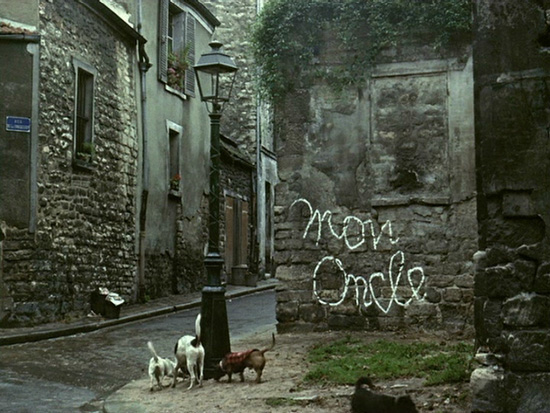
Tati divides his vision of the city into two halves: the quaint, cobblestone old town in which Hulot lives, and the homogenized modern section of the Arpels. The film sets up this division immediately in the opening credits. Beginning with a shot of a crane and the harsh jackhammer sounds of a construction site, the camera pans down across architect nameplates, which feature the credits. The main title, however, is scribbled in chalk on a building in the old world, and the flighty musical theme of the film begins. This theme becomes a crucial cue in distinguishing the two locations. While the music is prevalent throughout the old section, it is never heard in the modern one, except for in a single scene in which Monsieur Arpel telephones Hulot from his boss’ office to see if he would be interested in a position at the factory. Even then, the music is heard only through the telephone, and disappears when their conversations ends, further accenting the juxtaposition between the whimsical old town and the stuffy modern one. In fact, most of the sounds in the modern section are sharp, grating, or otherworldly; strange buzzes, odd bloops, and accented clanks. However, the pervading sonic mode is silence.
Further shots accent the division between the two sections of the city. The old section is notably characterized by its brick buildings and cobblestone streets, which give it a lively sense of color and human-like imperfections. Conversely, the new section features stark grey buildings that seem identical in form. When a character transitions between the two, Tati offers a shot of a crumbled brick gate, a figure of the old town, with the skyline of the grey modern section dominating the background. This shot, used multiple times in the film, is representative of the deteriorating old ways of Paris. Likewise, inhabitants of the old section seem free to walk as they please, harmonious with nature, while in the modern section, distinct pathways direct characters in motion. In the Arpel’s home, no one is allowed to step on the grass, for fear of ruining the perfect lawn.
The image seems clear. A giant crane towers over fractured earth; its red steel beams crosscutting sections of a bright blue sky. Thunderous shrieks of metal rubbing against rust permeate the air as the machine slowly turns, moving large pieces of pipe to their desired destination. A group of men in plastic orange suits work feverishly below, setting fire to steel and debating the specifics of their creation. Dump trucks rush past, carrying tons of dirt and rock, leaving trails of dust in their place. Fragments of ground spew forth; everywhere the land is shifted, reshaped, recycled.
The image seems clear, but it is contradictory. It is at once a sign of progress, and of gentrification. Construction and deconstruction. Destruction. We tear down the past to make room for the future. Destroy in the name of creation. The City is no stranger to the effects of modernized men; who, of the belief that ‘newer’ is synonymous with ‘better’, rebuild to reconstitute their surroundings and align them with contemporary modes of thought.
But what effects does this modernization have on the people? Where does the simple man fit into this neoteric equation? And who is to say that progress necessitates physical growth?
The French New Wave directors were not quick to dismiss old ideas, nor were they content to celebrate innovation. As post-war Paris experienced its largest development since 1914; as the suburbs began to expand considerably with the construction of large social estates known as cites; as a comprehensive express subway system, the RER, was built to complement the Métro and a network of freeways began circling around the city, New Wave directors explored city life with a watchful eye, observant of the profound effects innovation had on its inhabitants.
And perhaps no two directors were more cognizant of this transmuting social climate than Jacques Tati and Jean-Luc Godard. Tati, with his long overcoat and towery frame, seemed ill suited for modern life, uncomfortable in his surroundings as he was within his own skin. More a predecessor than a part of the New Wave, his uncompromising vision and inability to meld into modernity made him an influential figure within the movement, and it is difficult to separate his image from that of la Nouvelle Vague. Likewise, Godard, the figurehead and an inscrutable insurgent, proposed radical explorations of humanity and social order. His films question the commonality of the human experience, and prompt viewers to re-evaluate the significance, practice, and capacity of culture.
For both directors, the devastating effects of modern times proved fertile ground for thematic exploration across multiple films. However, Tati’s Mon Oncle (1958) and Godard’s Two or Three Things I Know About Her (1967) are their respective seminal works on the subject. While they were made almost ten years apart from each other, both films present representations of the modernization and physical growth of Paris. Both filmmakers use intertexts to comment upon this rapid expansion: Godard through semiotics and the written word, Tati through the modes of silent comedy.
However, beneath these intertexts lies each director's comprehensive knowledge and technical abilities to make full use of the malleability of the film image. It becomes necessary, then, to explore these two films specifically as representations of a ‘modern’ Paris and how these representations relate to the flexibility and sculpture-like qualities of the cinematic image.
On Tuesday I was lucky enough to catch a screening of Play Time, Jacques Tati's undisputed comedic masterpiece and possibly my favorite film of all time. The print was absolutely beautiful - restored for the 2002 Cannes Film Festival by Macha Makeïeff through her distribution company, Les films de mon oncle. Makeïeff was even there in person for a Q&A afterwards, in which she discussed the beauty in Tati's image, theatrical influences, Tatiland as a representation of the modern city (rather than an interpretation of circa-1967 Paris), and Tati's amazing comedic ability to transform objects into sources of tension.
A clip from Play Time
I can not stress enough how beautiful Tati's films are. Though he only made five in the span of thirty years, each one is rich with humor and a unique understanding of the world. Generally unknown to those outside of the academic cinema world, his work remains criminally underrated and unseen. Thankfully the French Institute is hosting a retrospective of all of Tati's films throughout the month of April. While it may be too late to catch Play Time (make sure to rent the fantastic Criterion release on DVD), you can still go see Mon Oncle, Parade, and M.Hulot's Holiday. Catching these films on print is rare, so if you're in NYC anytime soon, I highly suggest you check them out. Here are the dates:
Tuesday, April 17 at 12:30, 4 & 7:30pm Four Short Films By Tati
Friday, April 20 at 7pm Mon Oncle (My Uncle)
Tuesday, April 24 at 12:30 & 7:30pm Parade
Tuesday, April 24 at 4 & 9pm Les vacances de Monsieur Hulot (Mr. Hulot's Holiday)
All screenings are at the Florence Gould Hall, 55 East 59th Street.
Written & Directed by Jean-Luc Godard Jean-Pierre Gorin
Examines the structure of movies, relationships and revolutions through the life of a couple (Jane Fonda, Yves Montand) in Paris.
One of the biggest problems I have with Godard is that his politics are often misinterpreted as sincere, concrete beliefs. It's easy to romaticize the iconoclast ideals of May '68, and unfortunately Godard's films are too often regarded as soapboxes for the student revolution. While he may be aligned with the left simply through his intellectual status, Godard himself would be the first to admit that he knows nothing of politics. Politics of the cinema, however, is Godard's fortee, and he uses his distinct ability to manipulate image and sound to playfully comment on all sorts of political manifesto.
No film may make this more clear than Tout Va Bien, in which Godard examines the rapidly changing politics of post-68 France. The film comically depicts both the bourgeoisie and working class, using multilayered sound, response style monologues, slow pans and other traditional Godardian tactics to render all politics into senseless jargon. The film is swift despite its heavy thematic undertones, and effective in portraying languages inability to communicate the complicated needs and desires of political advocates both right and left. Remember that scene in The Life Aquatic where the Belafonte is dissected through a side shot of all the cabins? Wes Anderson got that from this film.
Ten years later, this is what the French were up to:
Writing credits Jacques Lagrange Jean L'Hôte Jacques Tati
M. Hulot bumbles his way through this satire of French modernization that emphasizes the problems with upperclass living - namely, style over practicality. Despite its two-hour run time, the film is light, easy to watch and geniuinely funny. Tati, as always, draws from silent-era slapstick and Chaplinesque characters to create humor that is easy to understand in any language. Highly-focused sound effects add to the films unique rhythm. Only bested by Tati's follow-up, Play Time.
Is there anyone who speaks French who could translate this interview for me? I'm really interested to see what Tati has to say about the making of the film.
Writing credits François Truffaut Jean Gruault Jean Itard (scientific report)
Based on the true story of a child found alone in the wild and a doctor's attempts to educate him.
Truffaut's relatively accurate interpretation of the events surrounding Dr. Jean Itard's work with a wild child is as engaging as it is endearing. The film raises many interesting questions about the commonality of the human experience and man's primal nature, but mostly exists as a sincere effort to call attention to the works of Dr. Itard. The films only real drawback is Truffaut's acting, which is a bit wooden; the director claimed to have cast himself because he felt other actors weren't "utilizing the space he would offer", but as a performer, Truffaut is almost emotionless. Most of his character is laid out through voice-over, which can be a bore, but the film's brilliant cinematic construction (it was shot by Néstor Almendros, who was cinematographor for many of Rohmer's films, as well as Terrence Malick's Days of Heaven) keeps it interesting. It's also pretty short, which is always nice. Worth a look.
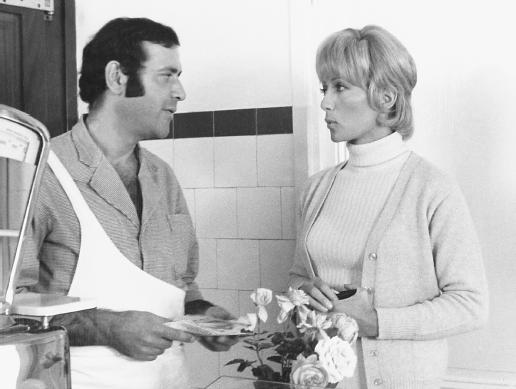
Butcher Popaul (Jean Yanne) falls in love with schoolteacher Helene (Stéphane Audran). When a series of murders begin to disrupt the town, Helene begins to suspect Popaul.
An extremely simple yet highly effective thriller. The Hitchcockian story leaves much ambiguity; we never see the crimes, nor are they discussed at great length. Rather we are given a series of clues to link the Butcher to the murders, creating an undercurrent of tension leading to his confession. Helene's inability to confess her knowledge of the clues culminates in the final scene, in which she contemplates the events at the edge of a foggy river. It makes you wonder whether or not Helene took pleasure in the killings; a sort of bizzare quasi-sexual ambiguity linked with the violence. Not a second is wasted - each scene is rich with visual and verbal metaphors that further story while strengthing the bond between the two protagonists. Le Boucher is essentially a perfect film.
Writing credits: Jean-Louis Richard Suzanne Schiffman François Truffaut
Tension builds as lives collide during the making of a film titled "Je vous presente Pamela"
Truffaut's cinema du cinema reminds me a lot of an Altman picture - huge ensemble cast, lots of over-lapping dialogue, short snippets of plot dragged across small scenes of character interaction. Truffaut generally works better with a smaller cast and more focused narrative, however; his cinematic tricks are few and far inbetween here, and most of what is unique about the film gets lost between moments that feel highly scripted. It's interesting, but only sustains momentum for an act or so.
A Pathé Contemporary Films 1970 Written & Directed by Eric Rohmer
Jean-Louis (Jean-Louis Trintignant), a devout Catholic, moves to a provincial town and vows to marry Francoise (Marie-Christine Barrault), a pretty blond he notices at mass. Vidal (Antoine Vitez), an old school friend, invites him to visit the recently divorced Maud (Françoise Fabian), and he ends up staying the night, having philosophical discussions in her bedroom. The events prompt Jean-Louis to persue his ideal lover.
My Night at Maud's was Rohmer's first big success and made him an international presence. The fourth installment of his Six Moral Tales, Maud's proves that long intellectual discussions can be just as cinematic as more obviously visual material. The film contains little physical action, but plenty of dialogue, contemplating mathematics, religion, and philosophy as related to Catholicism and 17th Century French Philosopher Blaise Pascal. A bit unsettling at first, the film really hits its stride midway as the characters take shape and become more than just platforms for Rohmer to spill his philosophical musings. We see them as real people, raw and conflicted, as their moral codes both hinder and dictate their movement. Witty, intelligent, and erotic, it's a film full of interesting ideas, in the least. If you can stomach the initial slow pace, it proves worth it in the end.
As adults, best friends Julien (Guillaume Canet) and Sophie (Marion Cotillard) continue the odd game they started as children -- a fearless competition to outdo one another with daring and outrageous stunts. While they often act out to relieve one another's pain, their game might be a way to avoid the fact that they are truly meant for one another.
While at times wonderful to look at, Love Me If You Dare suffers from that sort of French cinematic whimsy that starts off sweet but ends in a dizzy spell. The protagonists are two of the most mean-spirited characters I've ever seen, and the events in their life represent nothing grounded in reality or truth. Rather, the film is carried along by this sort of lovesick current, a strand of illogical, emotionally driven beats. The effect makes certain scenes hard to swallow, while others seem fatastic and otherworldly. Not for the cynical or the black-hearted.