Showing posts with label Dreamworks. Show all posts

Tuesday, March 24, 2009

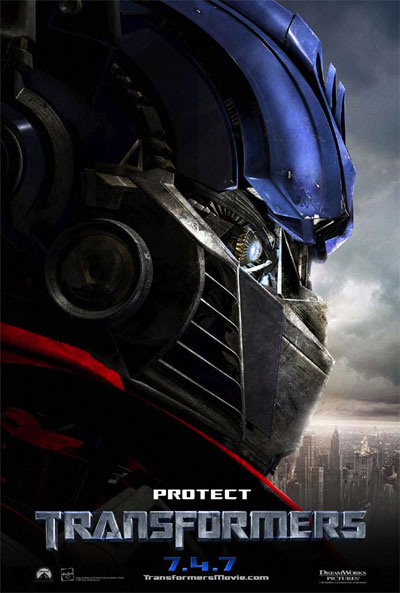
Revisit: Transformers


A Dreamworks film 2007

Directed by Michael Bay

Written by Roberto Orci & Alex Kurtzman

An ancient struggle re-erupts on Earth between two extraterrestrial clans, the heroic Autobots and the evil Decepticons, with a clue to the ultimate power held by a young teenager.


Transformers is a big, loud, dumb movie. That would be fine - I'd expect nothing less, especially from Michael Bay - if it were fun. But it isn't. It's just big, loud, and dumb.

What's wrong with it? Two things, namely: the script, and the action. Writers Roberto Orci & Alex Kurtzman spend a lot of time dilly-dallying, wasting our time with corny jokes, backstory and general B.S. before getting to the action. When it finally comes, the robots move too quickly, with their 'transformations' so visually complex, that it's difficult to follow. The result: boring boring boring.

How hard is it to make giant robots fun? Get 'em smashing shit and we've got a movie! You would think pairing Michael Bay and giant friggin' robots would be a match made in heaven. Hopefully they up the ante with the sequel, due this summer, cause this first installment was quite the snoozefest.

Thursday, January 22, 2009

2008 Oscar Nominations


The 2008 Oscar Nominations were released today, and while there were a few surprises, mostly I think this list stinks of mediocrity. What a bad year for movies, 2008! Dark Knight got snubbed (as we all expected) for... The Reader? Really?... while Slumdog & Benjamin Button lead the pack with 10 & 13 nominations respectively.

Slumdog isn't my kind of fare but I can see why people liked it -- uplifting, exotic, moving, and contrived, it's definitely a romanticized viewpoint of the world and a treatise on fate, love, & destiny, which is a subject people tend to cling to. Outside of the technical achievements, I have no idea what anyone liked about Benjamin Button. A crapfest in every sense of the word, it was by far the most snooze-inducing, mind-numbingly vacant film I'd seen all year.

That said, I'm really glad to see Michael Shannon get his due for Revolutionary Road. The man slays in the picture, and is a fantastic actor all around that elevates basically every project I've ever seen him in, so kudos to that. Likewise for Josh Brolin in Milk, which was a fantastic and understated performance from a man who's had one hell of a track record as of late. Of course they'll both lose to Dead Ledger, but that's fine -- Dark Knight was my favorite film of the year and he was incredible.

The only other surprise was the snubbing of both Bruce Springsteen & Clint Eastwood in the Best Original Song category. The academy must really love that westernized India shit; I didn't even realize Slumdog had 'original songs'.

Otherwise this list just sort of stands to show how boring boring boring boring 2008 was for movies. None of the top films are that memorable, nor would I bother to watch any again (except maybe Milk). Truly this is one of the lousiest Oscar nomination lists I've ever seen.

Oh well. What's done is done. I guess I'll have to check out the Animated Shorts soon as they make the theater rounds. Here's the full list of nominees:

Best Motion Picture of the Year

*The Curious Case of Benjamin Button (2008): Ceán Chaffin, Kathleen Kennedy, Frank Marshall
*Frost/Nixon (2008): Brian Grazer, Ron Howard, Eric Fellner
*Milk (2008): Bruce Cohen, Dan Jinks
*The Reader (2008): Nominees to be determined
*Slumdog Millionaire (2008): Christian Colson

Performance by an actor in a leading role

* Richard Jenkins in “The Visitor” (Overture Films)
* Frank Langella in “Frost/Nixon” (Universal)
* Sean Penn in “Milk” (Focus Features)
* Brad Pitt in “The Curious Case of Benjamin Button” (Paramount and Warner Bros.)
* Mickey Rourke in “The Wrestler” (Fox Searchlight)

Performance by an actor in a supporting role

* Josh Brolin in “Milk” (Focus Features)
* Robert Downey Jr. in “Tropic Thunder” (DreamWorks, Distributed by DreamWorks/Paramount)
* Philip Seymour Hoffman in “Doubt” (Miramax)
* Heath Ledger in “The Dark Knight” (Warner Bros.)
* Michael Shannon in “Revolutionary Road” (DreamWorks, Distributed by Paramount Vantage)

Performance by an actress in a leading role

* Anne Hathaway in “Rachel Getting Married” (Sony Pictures Classics)
* Angelina Jolie in “Changeling” (Universal)
* Melissa Leo in “Frozen River” (Sony Pictures Classics)
* Meryl Streep in “Doubt” (Miramax)
* Kate Winslet in “The Reader” (The Weinstein Company)

Performance by an actress in a supporting role

* Amy Adams in “Doubt” (Miramax)
* Penélope Cruz in “Vicky Cristina Barcelona” (The Weinstein Company)
* Viola Davis in “Doubt” (Miramax)
* Taraji P. Henson in “The Curious Case of Benjamin Button” (Paramount and Warner Bros.)
* Marisa Tomei in “The Wrestler” (Fox Searchlight)

Best animated feature film of the year

* “Bolt” (Walt Disney), Chris Williams and Byron Howard
* “Kung Fu Panda” (DreamWorks Animation, Distributed by Paramount), John Stevenson and Mark Osborne
* “WALL-E” (Walt Disney), Andrew Stanton

Achievement in art direction

* “Changeling” (Universal), Art Direction: James J. Murakami, Set Decoration: Gary Fettis
* “The Curious Case of Benjamin Button” (Paramount and Warner Bros.), Art Direction: Donald Graham Burt, Set Decoration: Victor J. Zolfo
* “The Dark Knight” (Warner Bros.), Art Direction: Nathan Crowley, Set Decoration: Peter Lando
* “The Duchess” (Paramount Vantage, Pathé and BBC Films), Art Direction: Michael Carlin, Set Decoration: Rebecca Alleway
* “Revolutionary Road” (DreamWorks, Distributed by Paramount Vantage), Art Direction: Kristi Zea, Set Decoration: Debra Schutt

Achievement in cinematography

* “Changeling” (Universal), Tom Stern
* “The Curious Case of Benjamin Button” (Paramount and Warner Bros.), Claudio Miranda
* “The Dark Knight” (Warner Bros.), Wally Pfister
* “The Reader” (The Weinstein Company), Chris Menges and Roger Deakins
* “Slumdog Millionaire” (Fox Searchlight), Anthony Dod Mantle

Achievement in costume design

* “Australia” (20th Century Fox), Catherine Martin
* “The Curious Case of Benjamin Button” (Paramount and Warner Bros.), Jacqueline West
* “The Duchess” (Paramount Vantage, Pathé and BBC Films), Michael O’Connor
* “Milk” (Focus Features), Danny Glicker
* “Revolutionary Road” (DreamWorks, Distributed by Paramount Vantage), Albert Wolsky

Achievement in directing

* “The Curious Case of Benjamin Button” (Paramount and Warner Bros.), David Fincher
* “Frost/Nixon” (Universal), Ron Howard
* “Milk” (Focus Features), Gus Van Sant
* “The Reader” (The Weinstein Company), Stephen Daldry
* “Slumdog Millionaire” (Fox Searchlight), Danny Boyle

Best documentary feature

* “The Betrayal (Nerakhoon)” (Cinema Guild), A Pandinlao Films Production, Ellen Kuras and Thavisouk Phrasavath
* “Encounters at the End of the World” (THINKFilm and Image Entertainment), A Creative Differences Production, Werner Herzog and Henry Kaiser
* “The Garden” A Black Valley Films Production, Scott Hamilton Kennedy
* “Man on Wire” (Magnolia Pictures), A Wall to Wall Production, James Marsh and Simon Chinn
* “Trouble the Water” (Zeitgeist Films), An Elsewhere Films Production, Tia Lessin and Carl Deal

Best documentary short subject

* “The Conscience of Nhem En” A Farallon Films Production, Steven Okazaki
* “The Final Inch” A Vermilion Films Production, Irene Taylor Brodsky and Tom Grant
* “Smile Pinki” A Principe Production, Megan Mylan
* “The Witness - From the Balcony of Room 306” A Rock Paper Scissors Production, Adam Pertofsky and Margaret Hyde

Achievement in film editing

* “The Curious Case of Benjamin Button” (Paramount and Warner Bros.), Kirk Baxter and Angus Wall
* “The Dark Knight” (Warner Bros.), Lee Smith
* “Frost/Nixon” (Universal), Mike Hill and Dan Hanley
* “Milk” (Focus Features), Elliot Graham
* “Slumdog Millionaire” (Fox Searchlight), Chris Dickens

Best foreign language film of the year

* “The Baader Meinhof Complex” A Constantin Film Production, Germany
* “The Class” (Sony Pictures Classics), A Haut et Court Production, France
* “Departures” (Regent Releasing), A Departures Film Partners Production, Japan
* “Revanche” (Janus Films), A Prisma Film/Fernseh Production, Austria
* “Waltz with Bashir” (Sony Pictures Classics), A Bridgit Folman Film Gang Production, Israel

Achievement in makeup

* “The Curious Case of Benjamin Button” (Paramount and Warner Bros.), Greg Cannom
* “The Dark Knight” (Warner Bros.), John Caglione, Jr. and Conor O’Sullivan
* “Hellboy II: The Golden Army” (Universal), Mike Elizalde and Thom Floutz

Achievement in music written for motion pictures (Original score)

* “The Curious Case of Benjamin Button” (Paramount and Warner Bros.),Alexandre Desplat
* “Defiance” (Paramount Vantage), James Newton Howard
* “Milk” (Focus Features), Danny Elfman
* “Slumdog Millionaire” (Fox Searchlight), A.R. Rahman
* “WALL-E” (Walt Disney), Thomas Newman

Achievement in music written for motion pictures (Original song)

* “Down to Earth” from “WALL-E” (Walt Disney), Music by Peter Gabriel and Thomas Newman, Lyric by Peter Gabriel
* “Jai Ho” from “Slumdog Millionaire” (Fox Searchlight), Music by A.R. Rahman, Lyric by Gulzar
* “O Saya” from “Slumdog Millionaire” (Fox Searchlight), Music and Lyric by A.R. Rahman andMaya Arulpragasam

Best motion picture of the year

* “The Curious Case of Benjamin Button” (Paramount and Warner Bros.), A Kennedy/Marshall Production, Kathleen Kennedy, Frank Marshall and Ceán Chaffin, Producers
* “Frost/Nixon” (Universal), A Universal Pictures, Imagine Entertainment and Working Title Production,Brian Grazer, Ron Howard and Eric Fellner, Producers
* “Milk” (Focus Features), A Groundswell and Jinks/Cohen Company Production, Dan Jinks and Bruce Cohen, Producers
* “The Reader” (The Weinstein Company), A Mirage Enterprises and Neunte Babelsberg Film GmbH Production, Nominees to be determined
* “Slumdog Millionaire” (Fox Searchlight), A Celador Films Production,Christian Colson, Producer

Best animated short film

* “La Maison en Petits Cubes” A Robot Communications Production, Kunio Kato
* “Lavatory - Lovestory” A Melnitsa Animation Studio and CTB Film Company Production, Konstantin Bronzit
* “Oktapodi” (Talantis Films) A Gobelins, L’école de l’image Production, Emud Mokhberi and Thierry Marchand
* “Presto” (Walt Disney) A Pixar Animation Studios Production, Doug Sweetland
* “This Way Up”, A Nexus Production, Alan Smith and Adam Foulkes

Best live action short film

* “Auf der Strecke (On the Line)” (Hamburg Shortfilmagency), An Academy of Media Arts Cologne Production, Reto Caffi
* “Manon on the Asphalt” (La Luna Productions), A La Luna Production, Elizabeth Marre and Olivier Pont
* “New Boy” (Network Ireland Television), A Zanzibar Films Production, Steph Green and Tamara Anghie
* “The Pig” An M & M Production, Tivi Magnusson and Dorte Høgh
* “Spielzeugland (Toyland)” A Mephisto Film Production, Jochen Alexander Freydank

Achievement in sound editing

* “The Dark Knight” (Warner Bros.), Richard King
* “Iron Man” (Paramount and Marvel Entertainment), Frank Eulner and Christopher Boyes
* “Slumdog Millionaire” (Fox Searchlight), Tom Sayers
* “WALL-E” (Walt Disney), Ben Burtt and Matthew Wood
* “Wanted” (Universal),Wylie Stateman

Achievement in sound mixing

* “The Curious Case of Benjamin Button” (Paramount and Warner Bros.), David Parker, Michael Semanick, Ren Klyce and Mark Weingarten
* “The Dark Knight” (Warner Bros.), Lora Hirschberg, Gary Rizzo and Ed Novick
* “Slumdog Millionaire” (Fox Searchlight), Ian Tapp, Richard Pryke and Resul Pookutty
* “WALL-E” (Walt Disney),Tom Myers, Michael Semanick and Ben Burtt
* “Wanted” (Universal), Chris Jenkins, Frank A. Montaño and Petr Forejt

Achievement in visual effects

* “The Curious Case of Benjamin Button” (Paramount and Warner Bros.), Eric Barba, Steve Preeg, Burt Dalton and Craig Barron
* “The Dark Knight” (Warner Bros.), Nick Davis, Chris Corbould, Tim Webber and Paul Franklin
* “Iron Man” (Paramount and Marvel Entertainment), John Nelson, Ben Snow, Dan Sudick and Shane Mahan

Adapted screenplay

* “The Curious Case of Benjamin Button” (Paramount and Warner Bros.), Screenplay by Eric Roth, Screen story by Eric Roth and Robin Swicord
* “Doubt” (Miramax), Written by John Patrick Shanley
* “Frost/Nixon” (Universal), Screenplay by Peter Morgan
* “The Reader” (The Weinstein Company), Screenplay by David Hare
* “Slumdog Millionaire” (Fox Searchlight), Screenplay by Simon Beaufoy

Original screenplay

* “Frozen River” (Sony Pictures Classics), Written by Courtney Hunt
* “Happy-Go-Lucky” (Miramax), Written by Mike Leigh
* “In Bruges” (Focus Features), Written by Martin McDonagh
* “Milk” (Focus Features), Written by Dustin Lance Black
* “WALL-E” (Walt Disney), Screenplay by And
Tuesday, February 27, 2007

Spielberg: 30 Years of Blockbusters part IV


Special effects play a large role in both War of the Worlds and Jaws. They reinforce the fear of the ‘other’ by revealing its physical characteristics in a spectacular fashion. In the case of War of the Worlds, these effects dominate the screen right from the beginning. From earth-shattering explosions to enormous alien ‘tripods’ to the Martians themselves, Worlds is an onslaught of big budget, state of the art wizardry. In fact, most of the excitement and thrills in War of the Worlds rely on the fantastic visuals. On the other hand, the special effects in Jaws appear sparingly, substituting shark POV shots for the actual beast. Part of this is due to budget restrictions (Jaws cost $10 mil., which even by today’s dollar would be significantly less than Worlds $132 mil.) and part to technical complications; according to Peter Biskind’s book Easy Riders, Raging Bulls mechanical malfunctions forced Spielberg to scale down some of the intense shark scenes he had originally planned (Biskind 265). Regardless, the use special effects mark a severe difference in rhythm between the two films. War of the Worlds moves at breakneck speed, hardly stopping the effects extravaganza, while Jaws is punctuated, building the image of the shark piece by piece until the beast is revealed in the climactic final act.


Ultimately, these posts might come off as a bit biased. They talk a lot about the ways in which Jaws succeeds as a film and War of the Worlds fails. It’s crucial to keep in mind that, in terms of Spielberg’s career, Jaws remains the template for many of his subsequent films. The structural similarities between Jaws and his other movies are certainly present and, after all, Jaws was a tremendous hit, so it would only make sense for Spielberg to retain its mold. Clearly, differences influenced by budget cost, social issues, source text, and technology have effected the ways in which Spielberg makes movies. His increased use of special effects also reflects the current movie market, in which audiences look for new thrills in the form of new technology. However, one element strings all of Spielberg’s works together: excitement.

Monday, February 26, 2007

Spielberg: 30 Years of Blockbusters part III


Politics play a large role in motivating the characters and events that occur in Jaws. Brody’s decision to leave the beach open after the first attack goes against his morals. Rather, he is motivated by pressure from the Mayor, who fears the town will “be on welfare the whole winter” if they close the beach. This results in a second attack involving a young child. However, the Mayor and local business owners yet again force Brody to keep the beach open. By the Forth of July, beach goers refuse to enter the water. An interesting scene unfolds between the Mayor and a local: worried about the fear stricken tourists, the Mayor assertively tells the man, “No one is going in! Please, go in the water!” The Mayor holds significant pull within the town, and though his plea sparks a rush of tourists into the ocean, his denial of the shark also results in another death, and endangers the life of Brody’s son. This vilification of the Mayor presents a post-Watergate assessment of corrupt authority, disdain towards the elected official, and reinforces the approval of the average American.


Politics are present throughout War of the Worlds as well; however, they do not function as character motivation. Rather, Spielberg uses the backdrop of an alien invasion to create a post-911 allegory. Images throughout the film recall the 2001 terrorist attacks on the World Trade Center: mass destruction of buildings, raining clothing, people in large groups running down city streets, a destructive plane crash, clouds of dust comprised of human remains. In once scene, Ray Ferrier actually gets covered in thick layers of this dust, quite like those who witnessed the real attacks first hand. Later, a fence is erected with photos and memorials, signs searching for missing people, just like the ones established at Ground Zero. Blunt dialogue works to reinforce the post-911 themes as well:

Rachel Ferrier: Is it the terrorists?

Robbie Ferrier: What is it? Is it terrorists?


Perhaps Spielberg is attempting to counter balance the lack of audience alignment with the film’s characters by paralleling the effects of the invasion with 9-11. Following this logic, a sort of direct, “this could happen to you” form of horror similar to that of Jaws could be argued, particularly regarding the progression of imagery. As the characters move outward from city to suburbs to farmland, the violence and carnage of the attacks grows increasingly more graphic. For example, people simply burst into dust when attacked in Jersey City, while bloody dismembered bodies litter the rivers and farmland. This could be interpreted as an attack on the comfort of Middle America, dispelling the misconception that only cities are in danger by showing that even the heartland is not safe from destruction. However, these overt references to 9-11 do not add depth to the story or motivate characters, but rather justify the extravagant special effects that overrun the duration of the film.

Part IV Coming Soon!
Check out the rest of the article!

Saturday, February 24, 2007

Spielberg: 30 Years of Blockbusters part II

Both Jaws and War of the Worlds revolve around the concept of an ‘other’ invading and threatening the American way of life. Spielberg uses this ‘other’ in two ways: 1) to outline a political hierarchy, focusing specifically on the everyman in relation to familial themes, and 2) to generate escalating amounts of excitement with the aid of special effects. Essentially, if one were to boil the Spielberg blockbuster down to a formula, this use of the ‘other’ would stand as the crux of his films. In the case of Jaws and War of the Worlds, it acts as the template for plot design.


Jaws centers on the small beachside community of Amity, a town that relies on summer tourism to create revenue. When a Great White shark threatens the town’s shorelines, Police Chief Martin Brody (Roy Scheider) is faced with a dilemma – pressured to keep the beaches open by local businessmen and politicians, he must decide between jeopardizing public safety or destroying community income. Without ever drawing our attention away from the problem of the shark, Spielberg hints at the generic Americanization of Amity through the use of a non-star cast, subtle visuals and dialogue. Visually, Amity is characterized by white-wash buildings, wooden docks and picket fences. It is no mistaking that one scene takes place in front of a parade, another at town hall. And when we hear locals complain to Chief Brody about “kids’ karate chopping my fence”, “sick vandalism”, and “parking violations”, it only serves to remind us of the nonspecific American setting. Similarly, the destiny of those who ultimately take on the shark reflects Spielberg’s affinity for the average man; Quint (Robert Shaw), the right-winged macho shark hunter, is killed, while Hooper (Richard Dreyfuss), the intellectual left, is impaired, leaving Brody, the everyman cop, to successfully destroy the shark (Biskind 279). Ultimately, this works to effectively produce the true ‘horror’ aspect of the film. Spielberg’s assertion of the main protagonist as the generic everyman creates a direct connection with the spectator. When audiences see the Great White tear apart a young child near the beach, they realize that the people on screen are easily substituted: we place ourselves within the film.


War of the Worlds attempts to establish a similar sense of blue collar ambiguity, but ultimately fails to do so for several reasons. The film begins on the Jersey City docks, introducing protagonist Ray Ferrier (Tom Cruise). Like a modern Fred Flintstone, Ferrier operates a large crane, stacking loading boxes near the water. He looks grungy in a pair of jeans, a flannel shirt, and workman gloves. Dialogue establishes that Ferrier works long hours, and that he belongs to a workers union. This scene lasts about two minutes until a cut shifts to Ferrier’s small ranch style home, where he meets his kids, products of a failed marriage. This is followed by about seven minutes worth of character development which demonstrate that 1) Ray neglects his kids and 2) the kids do not like Ray. Spielberg isn’t working very subtlety here; unlike in Jaws, where the blue collar-ness weaves in and out of the story, War of the Worlds very bluntly places its small-town emphasis right at the beginning, failing to resonate throughout the rest of the film, resulting in a lack of connection between the film’s characters and its audience. In addition, the presence of megastar Tom Cruise detracts from the believability of the story. One of the highest paid actors in the world, Cruise generally portrays upper-class aggressors (Eyes Wide Shut) or pretty boy action heroes (Mission Impossible, Top Gun). With this iconic connection already firmly planted in the audience’s mind, it makes it difficult to see Cruise as a dead beat union worker, negating the effect audience alignment with characters in the film.


Part III Coming Soon!
Check out Spielberg Part I!

Thursday, February 22, 2007

Spielberg: 30 Years of Blockbusters part I


The 1975 release of Steven Spielberg’s Jaws coincided with the arrival of the New Hollywood, a golden age of American film production in which creative power transferred from studio heads to film directors. Despite being a product of this artistic flourish, Jaws represents several milestones in Hollywood business practices. By twisting its now legendary shooting fiascos into hype, saturating theaters through wide release, and expanding promotional advertising beyond traditional print and radio into television – an advertising medium still in its infancy – as well as commercial tie-ins, Universal Studios formed the archetype of blockbuster advertising out of Spielberg’s action/horror hybrid (Schatz 24). The resulting success not only set the precedent for current modes of movie marketing, but launched the career of director Steven Spielberg.

Thirty years later, Spielberg released War of the Worlds, a high octane special effects extravaganza based on the classic novel by H.G. Wells. LikeJaws before it, War of the Worlds served as summer popcorn fare, escapist cinema functioning solely to entertain, excite, and encompass audiences in the wizardry of special effects. Unlike Jaws, however, which was generally praised for being an effective thriller, War of the World met several detractors, dismissing it as one of Spielberg’s lesser films, a soul-less “exploitation of tragic iconography” (Stephen Whitty, Newark Star Ledger). What, if anything, about Spielberg’s cinematic approach differs between these two films? In analyzing the thematic and stylistic content of both Jaws and War of the Worlds, one notices that, though the formula remains the same, subtle disparities make a World of difference .


Before I begin to closely examine these films, it is necessary to explore the circumstances surrounding their individual productions. The production of Jaws revolved around a novice director, a cast of unknowns, and unreliable, untested special effects. Spielberg resisted casting any star power, acquiring actors whom he felt reinforced the realism of the story. According to a quote attributed to Spielberg in Peter Biskind’s Easy Riders, Raging Bulls, he “wanted somewhat anonymous actors to be in it so you would believe this was happening to people like you and me” (Biskind 265). Similarly, Spielberg’s visual aesthetic reinforced this idea of realism. Refusing to work within a studio, production moved to the open sea, where technical problems and production delays pushed the budget well beyond the initial projected $3.5 million. Ultimately, shooting went 104 days over schedule and nearly $7 million over budget (Biskind 267). Alternately, War of the Worlds quick production reflects a confident, assured director. Initially set for a 2007 release date, the film was abruptly green-lit in August 2004, and released summer 2005. Unlike with Jaws, the presence of megastar Tom Cruise was crucial to getting Worlds off the ground. Spielberg shot the film within four months on a gargantuan budget of over $132 million. Pre-publicity for the film focused on the large budget – an August 18th 2004 article on IMDB.com reported “Steven Spielberg's upcoming movie War of the Worlds is poised to make history in Hollywood as the most expensive film ever made - surpassing Titanic's $198 million budget... No expense will be sparred” – as well as the large profit Spielberg, Cruise, and the studios stood to make from the film’s success (imdb.com).

These two radically different productions reflect a director refocusing his priorities despite making similar movies. Spielberg’s budget problems and production delays onJaws rose out of the need to tell the story realistically and effectively. His choice to use unknown actors and real sets reinforced the blue-collar, everyman feel of the movie. Contrarily, Spielberg used budget and star power to the extreme while producing War of the Worlds. He ignored the stigma surrounding actor Tom Cruise, and focused his attention on the extravagance of effects, producing aesthetically different results.


Spielberg Part II Coming Soon!

Tuesday, January 02, 2007

Review: Dreamgirls

When I was in high school I sat next to the captain of the football team in home room. He was a jock, for sure - stocky, with broad shoulders and little brains - but a nice guy, jovial and very easy-going. We'd talk from time to time, sharing quick conversations before class began. He was just friendly enough to keep it from being awkward, just funny enough to keep things interesting. When Christmas time rolled around our sophomore year, he wore a big Santa hat that pushed his red hair out at all different ends and matched the color of his freckles. He turned to me and asked, "Did you put up your tree yet?" No, I replied. I'm a jew. He looked at me puzzled, his right eyebrow cocked as if he didn't know what I had meant. "So you don't have a tree?" Nope, I responded cooly. "What about lights, do you put up any lights?" No, I repeated. Jews don't put up lights. "You gotta have lights," he said, "for Santa!" No, I said a forth time, wondering if he was just pulling my leg or if he was actually being serious. Jews don't put up lights. "Well how do you celebrate the birth of the lord Jesus Christ, then?" he asked. I sat there a bit stunned for a second before replying, I go to the movies.


Every jew celebrates Christmas at the movies. Though it would appear to be out of convience (considering everything else on earth is closed), it's actually a tradition, one that has lasted for generations and probably dates back to the golden age of the nickelodeon. While the rest of the world is opening presents and sucking down egg-nog, we kosher children flock to see films. As a movie buff, it's one tradition that I admire and anticipate. In fact, if I don't see a movie on Christmas, I get angry, uppity and annoyed. It's the equivalent of a Christian family forsaking the tree - it just doesn't feel like Christmas.
Looking back, however, I can't say that Christmas times makes for memorable movie-going experiences. In fact, I can only remeber a select handful of the films I've seen on Christmas day, most of which were mildly entertaining (Mars Attacks!, Bad Santa), or piddling crap (Man on the Moon) . Hollywood generally doesn't leave much options for the jews of suburbia come December 25th. While most of the Oscar-buzz pictures are still relegated to art houses in NY/LA, your average cinema generally offers a handful of holiday themed, family-friendly affairs or non-spectacular, soft-R rated thrillers. Throw in a biopic and a Ben Stiller comedy and you've got a good idea of what's going to be playing at a theater near you this holiday season.


This year was no different. With Children of Men in limited release and Pan's Labarynth set for December 29th (expect reviews of each shortly), I lost out on all the pictures I asked for this Christmas. My family decided they were going to see Dreamgirls whether I liked or not, so I was stuck. It's not like I wasn't going to see something, I mean... it's Christmas.

Originally I had understood that Dreamgirls was a biopic based on the life and times of Diana Ross and the Supremes. I understood that it starred Eddie Murphy, Jamie Foxx, Beyonce and some girl from American Idol that I didn't care about, and was directed by Bill Condon, who did Kinsey, Gods and Monsters, and a few other films I didn't care about. In fact, I didn't care about any of it - there's nothing that irks me more than musical biopics (I'll say it - Ray sucked), and this seemed to me like the lowest of the low.
However, the film is not a biopic, it's strictly a musical. It takes it root from a broadway show of the same name that premiered in 1981 starring Loretta Devine. While comparisons to the biography of the Supremes are fitting, the characters in the film are original and seem to be extrapolated from a variety of African-American musicians from the past fifty years.

That being said, I was happy it was not a biopic. I can't stand that shit. But cinematic adaptations of broadway shows are often even more disasterous than films with impersonations of famous people. (Anyone remember last years horrid Broadway-style remake of Mel Brooks The Producers? I didn't think so.) It's easy for Hollywood to match the bright lights, glitz and glamor of Broadway, but very difficult to recreate the spirit of the stage. Live performances are engaging on a whole nother level, one that the cinematic performance very rarely captures. Something is ultimately lost in the transition from B'way to the big screen, and Dreamgirls is no exception. For a movie about soul music, the film has very little soul. It degenerates some of the most trying and important times in the history of black music - and America in general - to banal cliches and clear black vs white, good vs bad dichotomies. This is the scourge of Broadway in general: much of everything is simplified and easy to digest. But it doesn't mean that complicated issues have to become cliches, especially in the cinema. The film batters through history like a wrecking ball, giving brief contextual moments before breaking into song and dance. It all makes the Dreamettes rise to fame seem a little too easy, and unbelievable.

Perhaps Condon was focusing his efforts on characterization, but many of the key performances here lack the kind of power they require to breathe life into the film. Foxx starts things off with a whole lotta sleaze as the group's manager and somehow turns what should be a character who's torn between doing what's right and his dreams of granduer into one big money-grubbing cliche. Beyonce offers a big voice but little personality for a character who supposedly can't sing but has plenty of charisma.


That being said, if you see this movie for one thing it should be Jennifer Hudson, that American Idol girl I mentioned earlier. Her performance as Effie, the head-strong lead singer who gets kicked out of the group before their rise to fame, is easily one of the years best. She nails her character to a T, and offers a pair of pipes that can blow the extensions off Beyonce's head quicker than you can say 'destiny's child'. Check her version of "And I Am Telling You I'm Not Going" that's featured in the film, and you'll hear what I mean.


Likewise, Eddie Murphy gives a rousing performance as James 'Thunder' Early, an amalgamation of Chuck Berry and James Brown and a bunch of other crack-slewing soul brothers. He adds a lot of depth to a character that easily could have been the comic relief. And who knew he could sing?

I saw this film right outside of Asbury Park, New Jersey. The theater was absolutely filled with black people, and it was great. It was like going to church in Alabama; everyone was hootin' and hollerin' and cheerin' along, singing the songs with the film. For all the movie's faults, this seemed to make it a bit more palatable. I can't say I reccomend it - there are a million better musicals out there, with better songs and better performances. But if you absolutely love Broadway and can't make the trek out to NYC, maybe this film is for you. It's got lots of bright lights and sequin dresses, and it certainly captures the shallowness of 42nd Street, but it lacks the heart and soul of the music it supposedly represents. Let's just thank god it wasn't a biopic.
A DreamWorks SKG/Paramount Pictures release 2006
Directed byBill Condon
Writing credits:
Bill Condon (screenplay)
Tom Eyen (book)