5th Annual New York Jewish Student Film Festival

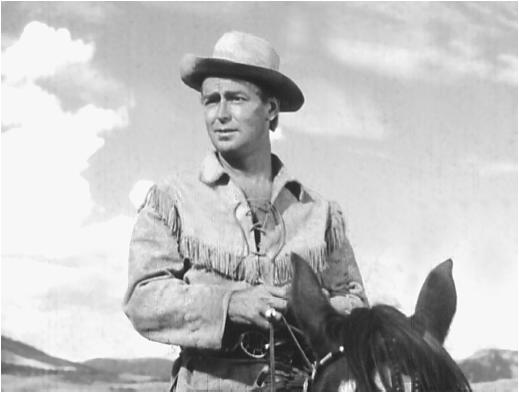
Directed by George Stevens and featuring Alan Ladd in the title role, Shane tells the story of a mysterious gunfighter who comes to the aid of an oppressed group of homesteaders. The film maintains much of the traditional iconography of the genre, from vast, sweeping landscapes to a sinister, gun-slinging villain. While consciously working within this set of images, Shane produces a vision of the West in which savage means are necessary for civil progress. The title implies that Shane, the almost miraculous gunfighter, is the main protagonist, but there are in fact two: Joe Starrett (Van Heflin), leader of the homesteaders, is equally important. These two protagonists are inexplicably linked, but embody certain opposing semantics of the West.
Shane is portrayed as a weary gunfighter, a wanderer with no place to hang his hat. He literally rides in from nowhere, his past a mystery never discussed. From the first shot of him riding on his horse, it is clear that Shane represents a dying breed of cowboy. Conversely, Joe Starrett is a family man who believes in the notion of private property and democratic organization. He represents civility, a new order of prosperity. Much of the narrative structure of the film relies on their relationship, their strengths and their weaknesses, to shape meaning.
Though wary of each other at first, the two are quickly presented as a team, working together to mutually improve quality of life. Joe hires Shane as an extra hand on the farm, providing him a temporary home, and the film shows how Shane’s cowboy qualities come in use. One scene boils it down into an easy metaphor: a tree stump too heavy for Joe to move by himself is lifted, with some strain, when he works with Shane. This scene could be interpreted as a summation of the movie; Joe can’t seem to shake the ranchers that want him off the land, but together with Shane, the two manage to put up a fight.
The oppression from the ranchers is much greater than that of a stump, however, and develops a much more complex relationship between the two protagonists. Both Shane and Starrett can fight physically – an extended fight sequence in the saloon exhibits this fact – but Shane’s quick-shot skills are necessary in keeping the film’s ultimate villain, a gun-for-hire named Jack Wilson (Jack Palance), at bay. Conversely, Shane’s presence irks some of the homesteaders, some of which feel they “don’t need no bodyguard” while others simply want to pack up and quit. Starrett’s unending optimism and oratory skills, coupled with his American ideals of individualized prosperity, manage to keep the homesteaders aligned even in the darkest of times, something Shane could not do. In turn, Shane and Starrett bridge together traits from both the savage and civil West that are necessary in accomplishing the plots ultimate goal – winning the land for the homesteaders.
However the narrative also pits the two characters in competition with one another, especially in relation to the Starrett family. Joe’s young son is constantly sizing his father up in comparison to Shane. He asks Joe many questions – “Could you shoot better than Shane? Could you whip him?” – that elaborate upon why Shane’s presence is so necessary for the homesteaders. Likewise, Joe’s wife, precautious but intrigued by the gunfighter, develops a flirting infatuation for Shane, which Starrett comes to recognize towards the end, admitting that if something were to happen to him, he’d at least know she’d be “taken care of and in good hands”.
This competition elaborates upon why the savage Westerner was so crucial, and helps glorify his nature, but the film remains conscious that he is a dying breed. Shane’s gun-toting way of life, though helpful in the circumstances, cannot work in the civil setting. He is conscious of this: “There's no living with a killing. There's no goin' back from one,” he says. “Right or wrong, it's a brand... a brand sticks. There's no goin' back... And there aren't any more guns in the valley.” The film ends with Shane riding back into the wilderness, but the shouts from Starrett’s son are a reminder that he is one cowboy that will not be forgotten.
Such is not the case for The Man Who Shot Liberty Valance...
Check out Part I
The Western Heroes Dual Part III coming soon!
As a film genre deeply rooted in the transposition of civilized and savage elements, the Western inherently allows for the exploration and establishment of specific, individualized moral codes. In turn, the Western offers a variety of protagonist archetypes: the outstandingly upright Ladds, the forthright and masculine Waynes, the morally ambiguous Eastwoods, the slightly on edge Stewarts. These Western Heroes may have spurs and a sense of ruggedness in common, but it’s their distinct moral personalities that made them legends. Perhaps this is why it is most interesting when a film places two protagonist types in a dual narrative structure. Aside from adding layers of tension to melodrama, dual protagonists allow for a tiered representation of the civilizing process; a kaleidoscope that refracts concepts of a blossoming America.
However that is not to say all Westerns with dual protagonist structures reach the same conclusions. Both Shane (1953) and The Man Who Shot Liberty Valance (1962) feature dual protagonists, but their reflections on the civilized West are much different. Each film contains a ‘savage’ and ‘civil’ protagonist, and both favor the prospect of democratic growth. But where Shane shows clear praise for it’s savage hero, Liberty Valance paints a storybook West in which one myth is exchanged for another. The next few posts will be dedicated to exploring dual protagonists as they exist in these two films.
The Western Heroes Dual Part II coming soon!
An MGM film 1962
Directed by Sam Peckinpah
Written by N.B. Stone Jr.
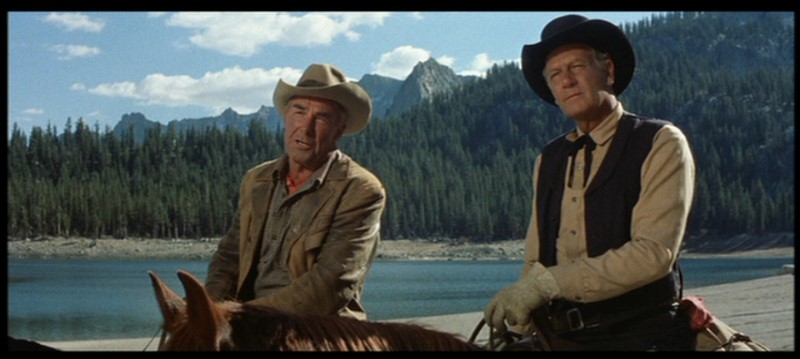
Ride the High Country is a eulogy for the traditional western. The film is conscious of the myth of the American Frontier, presenting it as dying legend that can, and has been, manipulated. Here is a version of the West where Eastern civilizing culture and ideals have pushed savage lands to the very corners of the Earth. However, that’s not to say that such savage ideals don’t exist. The film doesn’t exactly regret the loss of traditional Western values, but rather appears to celebrate moral ambiguity in the genre, desiring to push that trend even further.
The film provides three male heroes: Steve Judd, moral and upright, the Gary Cooper template for the classical Western hero; Gil Westrum, a good but morally gray man, the John Wayne type; and Heck Longtree, a youngin’, the next generation of cowboy. While Judd is presented as upstanding, his character is constantly referred to as old and out of date; even from the beginning, when he mysteriously rides into town in the most classical fashion, it is made clear that this character’s function in the genre is no longer effective. In the end, he is the only one killed off. Westrum, seemingly corrupt and villainous at times, is redeemed, rewarded in the end for his ability as a character to make sacrifice and overcome immoral temptation. Likewise, Longtree grapples with morality, ultimately establishing an honor code from both Judd and Westrum.
Peckinpah finds good humor in the banter between the two dying breeds of hero, but the real excitement in the film comes through the villains. These men are equally morally blurred, as they exhibit knowledge of moral codes, but choose to ignore them, instead settling for insincere symbolic measures that clean the appearance of their evil ways. The Hammond Gang represents tiers of damaged psychology, from sharp and sly to straight crazy, and they incite all of the riotous action in the film. While Ride the High Country is aware that it is declaring the end of one classical mode, it appears to be celebrating a newfound interest in damaged characters, and ambiguity in savagery.
A Miramax release 2007
Directed by Ben Affleck
Writing credits:
Ben Affleck (screenplay)
Aaron Stockard (screenplay)
Dennis Lehane (novel)
Two Boston area detectives investigate a little girl's kidnapping, which ultimately turns into a crisis both professionally and personally.
Ben Affleck's directorial debut is by no means memorable, but it is an effective, well made film that shows promise from the former Academy Award winner. Affleck handles his camera with an assured confidence, and while the script lapses at points, the picture drives towards some interesting ideas on moral ambiguity and making firm decisions.
Where the film succeeds most is in its casting. Affleck manages to draw some intense performances from his actors, particularly his brother, Casey, who despite wire thin, boyish looks, takes charge of the screen. Likewise, Amy Ryan completely captures the emotion of a cracked-out mother searching for her child. Ed Harris gets a bit hammy as a police detective on the case, and Morgan Freeman sort of sleepwalks throughout, but neither feel out of place.
The script has some dips, particularly a twist towards the end that doesn't sit well, but at the same time feels necessary, mostly because it secures the main theme of morality. Having kids clearly effected Affleck, and he's not afraid to probe what it means to be a parent, to do what's right for a child. The Boston location adds depth to the concept of community, and makes the film feel much more real. The final shot of Casey sitting on a couch with the newly returned child is both depressing and poignant.
Overall, Gone Baby Gone isn't a perfect film, but Affleck managed to wring a lot of interesting ideas out of the material, and handled the picture with confidence. It scares me to say it, but I'm looking forward to his next picture. Worth a gander.
A Picturehouse Entertainment release 2007
Directed by Olivier Dahan
Written by Olivier Dahan & Isabelle Sobelman
The extraordinary life and times of famed French singer Edith Piaf (Marion Cotillard)
Like most biopics, this incredibly uneven but suprisingly moving portrait of Edith Piaf, one of France's national treasures, relies heavily on the performance of its lead, Marion Cotillard. Thankfully she nails Piaf to a tee, capturing her movements and manneurisms with such precision it's almost uncanny.
If only the script did her performance justice. Dahan's presentation of periods in Piaf's life is so scatterbrained, it's almost hard to tell what is going on. The film does an incredible amount of jumping back and forth through time in the most illogical of ways; snippets from Piaf's childhood are connected to her final days or mid-life antics without any real causal connection, thematically or emotionally. The poor pacing results in a fragmented portrait of this powerful artist, one that leaves the spectator feeling as though they are missing something, despite the film's two and a half hour plus run time.
If you're already a fan of Piaf, then you're sure to love this film. If not, stick to the soundtrack - it'll tell you all you need to know.
An MGM film 1948
Directed by Abraham Polonsky
Writing by Abraham Polonsky & Ira Wolfert
Lawyer Joe Morse (John Garfield) wants to consolidate all small-time numbers racket operators into one big powerful operation. But he is met with conflict from his elder brother Leo (Thomas Gomez), who as one of those small-time operators prefers not to deal with the gangsters who dominate the big-time.
Watch a clip from Force of Evil here!
Abraham Polonksy's directorial debut is a noir masterpiece, a film that effectively depicts a world rampant with greed, corruption, and dispair. Polonsky, who had already achieved a name for himself as a scriptwriter, most notably for the gritty boxing film Body and Soul also starring John Garfield, was eventually blacklisted under the HUAC communist investigations. Watching Force of Evil, it's hard to separate Polonsky's political views from the story, which comes off as a strong critique of capitalist practices. However, the film contains with such beautiful wordplay and lingual puns that it's almost breathtaking. Likewise, the complex relationship between the brothers forms a delicate psychological, emotional and narrative core - a great example of powerful noir filmmaking. The film was a key influence on Scorsese's Raging Bull and, surprisingly enough, was selected for preservation in the United States National Film Registry. A must see.
A Fine Line Features release 1990
Written & Directed by Hal Hartley
A pregnant teen (Adrienne Shelly) meets a moody genius (Martin Donovan) with a hand grenade.
Hal Hartley's satirical view of suburban drama is arbitrary, but interesting none-the-less; a soap-opera world of absurdisms stuck in a Long Island vacuum, where things just happen. Roger Ebert once wrote "when a Hartley film plays on TV, you won't be tempted to go channel-surfing because the movie will seem to be switching programming for you", and it's true, but that's not necessarily a bad thing. Trust has just enough American-indie, dysfunctional family quirk to keep it from feeling manufactured; considering the time of its release, it's probably more responsible for influencing the modern commodified indie backlash. The film is a ball of ideas, some work and some don't, but they all seem to point towards the fucked-up-ness of east coast suburban living, a theme Hartley has dealt with his entire career. The performances here are amusingly dead-pan, and the colors drab. If you like your hopeless romanticism with a bit of restraint, this film is for you.
Longing for the days of the Drive-in? Grand Opening is Manhattan's only drive-in cinema - in a store. Choose your favorite film from the 60's - 90's, book a one-of-a-kind 1965 Ford Falcon convertible with seating for six and a full concession stand, and relax like it's the good old days all over again. Highlights include Dr. Strangelove, Cool Hand Luke, The Hustler, Pulp Fiction, and many more.
$75 per show
(Car seats up to 6 passengers)
2 shows per night (7pm and 10pm)
139 Norfolk Street
New York, NY 10002
Grand Opening
A Focus Features release 2007
Written by Steve Knight
Directed by David Cronenberg
When an innocent midwife (Naomi Watts) accidentally uncovers potential evidence against his Russian mobster family, Nikolai (Viggo Mortensen) must put into motion a harrowing chain of murder, deceit, and retribution.
While not as thematically complex as A History of Violence, Cronenberg's latest offering is a taut, moody thriller, almost economic in approach. No Cronenberg film makes a stronger tie to Hitchcockian modes of storytelling; each scene moves the story efficiently, while maintaining maximum entertainment value. Yet, the film also contains that trademark Cronenberg style, a queasy mix of violence and humor, absurdity and density.
Viggo Mortensen gives a bravura performance, one of intense restraint yet physical prowess. The knife fight scene, already infamous, will go down as one of the best fight scenes in history.
Definitely worth a look.
Primer: David Cronenberg
The Onion's AV Club has taken the liberty of dictating a pretty basic introduction to the works of one of my favorite filmmakers, David Cronenberg, for those of you unfamiliar with his body of work. Cronenberg is the genius behind some of the most psychologically twisted, reality-bending films of the past three decades, not to mention the inventor of 'body horror'. It's a great read, check it out.
There's an auction going on Ebay right now that offers the chance for a private dinner with director Brett Ratner. Right now the current bid is at US $8,643.73, which is a heck of a lot of money. The disclaimer says nothing about bodygaurds being present, so let's hope whomever wins this bad boy takes the opportunity to punch Ratner in the face. They'd be doing film fans everywhere a favor.
A 20th Century Fox film 2007
Directed by David Silverman
Writing Credits:
James L. Brooks screenplay
Joel Cohen consultant writer
John Frink consultant writer
Matt Groening screenplay
Al Jean screenplay
Tim Long consultant writer
Ian Maxtone-Graham screenplay
George Meyer screenplay
David Mirkin screenplay
Michael Price consultant writer
Mike Reiss screenplay
Mike Scully screenplay
Matt Selman screenplay
John Swartzwelder screenplay
Jon Vitti screenplay
After polluting the local lake, resulting in Springfield being put under a giant government instituted glass dome, Homer must simultaneously save the town and his marriage.
Those of you who read this site may have noticed that I haven't written a review of a new film in quite a long time. That's because I haven't been to the theaters in over two months. That's right - two whole months have passed since I've been compelled to go to my favorite place on Earth, the movie theater, and watch a film. I've been so fed up with the crap that Hollywood has churned out this summer that I simply decided to boycott pretty much every movie that has been released. Sequel after sequel, revised franchise to remake, I couldn't stand to sit through any of them.
But The Simpsons was something I had to see. Eighteen years in the making, The Simpsons Movie was something that was always on the tips of everyone's tongue, but seemed like it would never happen; a mythical idea that looked great on paper but could never be done. Like most of my generation, I grew up watching The Simpsons, and just couldn't picture a jump onto the big screen that would do the show justice.
So when the movie finally landed - to rave reviews, nonetheless - I had to see it. I went in with the best of expectations: that it would undoubtedly disappoint, but if there were two or three good jokes, I'd be happy. And I'm glad to say that the film not only met those expectations, but exceeded them. The Simpsons Movie is about as good of a film one could ask for from a show that seemed to have run its course almost a decade ago.
Without side-stepping the legacy that they've already built, Groening and Co. have managed to craft a fast paced, funny, cinematic counterpart to the show that retains its spot-on portrait of the American family. While some might complain that the satire isn't as biting as, say, South Park: Bigger, Longer, & Uncut, the film somehow manages to make its points clear while staying fresh. After all, The Simpsons was never really about controversy, at least not in the same way as South Park, but the dives it takes at religion and American life are still quite funny while aimed at an incredibly wide audience; I saw the flick with my whole family, and my parents laughed just as hard as I did.
Ultimately the film is a bit short and maybe too fast paced for its own good - it's a bit top heavy and starts to lose steam towards the last act - but I have to say I was impressed. Was it worth the eighteen year wait? No - but it didn't ruin the show in any way, and was certainly an improvement upon the last couple of seasons. If anything, it reminded me of why I liked The Simpsons so much to begin with, and that's certainly a good thing.
Lots of people have been asking me how I feel about the J.J. Abrams produced as-of-yet-untitled monster movie codenamed Cloverfield that's been driving the Infernets crazy these days. If you haven't heard about it, get on over to /film.com, who has the up to the minute skinny on this super secret, virally marketed flick. But back to my feelings... I think this photo sums it up pretty well:
Until they start releasing something more concrete than a two minute teaser, a no-name cast list and some blurry cell phone shots, I could care less about this 'mystery' project. After all, this is just a revised form of the marketing for Snakes on a Plane, and we all know how that turned out. Sorry, Paramount - Internet games and rumors are simply not enough to get this film nut in a frenzy. I'll get excited when I hear the film is actually watchable.
A Warner Brothers picture 1941
Directed by Raoul Walsh
Writing credits:
W.R. Burnett (novel & screenplay)
John Huston (screenplay)
Roy 'Mad Dog' Earle (Humphrey Bogart) is broken out of prison by an old associate who wants him to help with an upcoming robbery.
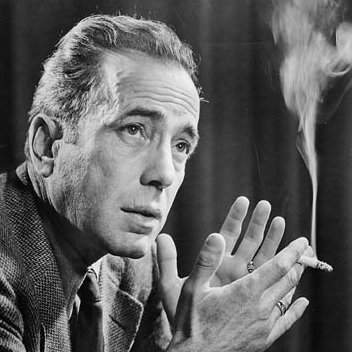
The film that made Humphrey Bogart a star, High Sierra also put film-noir on the top of Hollywood's to do list. A tense crime caper with a dark, bloody ending, it's no surprise that Dillinger is mentioned in the trailer - Sierra was loosely based on his life, despite his name being high on the blacklist of topics too taboo for mainstream cinema. The film also features Ida Lupino, who despite being one of the first female directors in Hollywood doesn't quite get the recognition she deserves. She's a great actress, and a fine director to boot. The picture is pretty straight forward, but it's great to see a pre-Casablanca Bogie perfecting his hard-ass image.
A Black Gold/Roadside Attractions film 2005
Directed by Liam Lynch
Written by Sarah Silverman
Narrative digressions on sex, race, politics, and more from comedienne Sarah Silverman.
Essentially a Sarah Silverman stand-up special, Jesus is Magic doesn't veer far from the traditional three shot format of most comic films, but it does have some added benefits: a few suped-up musical interludes, and Sarah Silverman, whose uncouth, obnoxious J.A.P. persona is actually a better schtick on stage than in sketch shows or straight narratives. Everyone knows that girl, the kind of oblivious, self-centered show off whose heart is full of sentiment but in all the wrong places, and Silverman works it to perfection. The jokes are fierce and funny, and it certainly helps that she's a looker. But if you're not into those so-called 'alternative' comedians, this probably won't be for you. I can't help but add that I was disappointed by Liam Lynch's lackluster direction - the musical interludes look great, but he simply plopped the camera down for the stand-up, which could have benefit from some variety in terms of movement. Surely there are more ways to shoot a comedian on stage than just close-ups and medium shots, but this film isn't look to push the format any farther.
For those Hitchcock fans wanting to find each and every cameo, here they all are, broken down into pictures. Pretty cool!
Here's a recent article written by Johnathan Foster discussing the two differing schools on Michael Bay: explosions vs art. Foster's makes a pretty simple argument
I gave up on Michael Bay movies having great stories or strong characters long ago, and yet, I find that he continually fails to deliver thrills. He wields explosions around as gracelessly as bad comedies do jokes, and yet his pyrotechnic fervor has wrongly come to symbolize the entire genre: the bigger the fireworks, the better the film.
A Columbia Pictures release 1972
Directed by Peter H. Hunt
Written by Sherman Edwards & Peter Stone (also play)
A musical outlining the birth of the Declaration of Independence.
Before he was roaming the halls as Mr. Fenie in Boy Meets World, William Daniels portrayed John Adams in this musical interpretation of the events that led to the birth of the United States. The film, based on the Broadway musical of the same name, is fairly straight-forward, unflashy, and lacks any real memorable numbers. However, if you're a history buff, or if the thought of seeing our fore-fathers parading around while singing songs about voting and Congress piques your interest, this may be the film for you.
An MGM release 1960
Directed by Melvin Frank
Written by:
Melvin Frank (screenplay)
Norman Panama (screenplay)
Bob Hope and Lucille Ball fall in love during a romantic getaway in Acapulco. There's only one problem - they're both already married!
Not to be confused with the classic TV show of the same name, this adult comedy contains some racy material, considering the year of its release. Bob Hope and Lucille Ball fall in love, but both are already married with children, and hilarity ensues as they try to cope with an extramarital affair. It's probably the only classical Hollywood film I can think of that tries to place a humorous spin on adultery. Its very much a reaction to the tedium brought upon by the construct of the American family in the 1950's; tension is derived from the difficulties of trying to keep the affair a secret, and the affair is not criticized as harshly as the home life. In fact, the film forces you to root for the adulterers, because they are 'in love' and their marriages are so poor. Of course this is a Hollywood film, and things do go sour in the end as they realize their actions are wrong. But it succeeds in making quite the case for adultery. It's also interesting that Ball acts as the films narrator; we're given much of the "woman's" perspective (written by males), but no real insight into the man's desires. Hope and Ball are at the top of their game in a film that is far more serious than most of their previous roles, and the picture was nominated for five Academy Awards, winning one for Costume Design.