Monday, January 07, 2008

Monday, December 31, 2007
Top Movies of 2007
My favorite films of the year thus far:
And there are still many more I have to see... Things may change after voting for this year's Independent Spirit Awards begins.
Here's this year's NYC Screening Room dates


Saturday, December 29, 2007
Review: I Am Legend
A Warner Brothers picture 2007
Directed by Francis Lawrence
Writing credits:
Mark Protosevich (screenplay)
Akiva Goldsman (screenplay)
Richard Matheson (novel)
After a supposed miracle vaccine turns the world's population into undead mutants, one scientist (Will Smith) fights for a cure.
This apocalyptic effects extravaganza suffers from the worst of Hollywood flaws - a poor script. The idea itself is great: a man, perhaps the last alive in the entire world, struggles to find a cure for a devastating vaccine that was supposed to cure cancer. One man alone in the world... think of all the things you could do with that concept! Well, this movie doesn't do anything interesting, and is riddled with plot holes and hokey movie-science.
SPOILERS! WARNING!
Legend sets up some basic facts for the environment and the effects of the virus: 1) Manhattan is completed quarantined, as the bridges were all blown up. 2) The virus is spread both air-borne and through saliva. 3) The creatures effected by the virus show no signs of human behavior, social skills, or human intelligence.
The film then systematically debunks all of these rules through action.
Questions:
If Manhattan has no road access, how do Anna and her son Ethan, Smith's supposed saviors, drive their car onto the island? Where do the deer and lions roaming the streets come from?
How come 1% of the population is immune the virus? Why are some animals effected by the airborne virus, but others are not? At what point did the virus stop curing cancer and start killing people?
The film spends time setting up this arch-nemesis type creature who appears bigger than the other mutant humans and seems to exhibit some basic behavior skills. For example, he runs after the woman creature Smith catches; he sets up a trap for Smith; he leads the creatures in the attack on Smith's fortress. But the script doesn't elaborate on this idea any further, and goes out of its way to suggest that this character is merely a freak anomaly. So what's the point? Likewise, why did Smith kill himself at the end? There's no reason for it - he could have easily tossed the grenade and hid with the woman and things would have turned out the same.
There is also a lot of coincidence and repetition of scenes. Smith's character just so happens to find the cure as the creatures are breaking into his fortress - just like how Anna just so happens to show up right as Smith is about to kill himself. Smith hunts deer at least twice. Why do we need to see this more than once? Why is he hunting deer in the first place? It's not like he needs them for food. Repetition is a tall tell sign of poor screen writing.
The landscape scenes look gorgeous - especially on IMAX - but the creature effects are extremely second rate. They could have easily just dressed up a bunch of people as zombies but for some reason they used this incredibly fake looking CGI.
Millions of people have already seen this movie and it blows my mind that no one has taken the time to just think about what the film presents. Two minutes of meditation on the story reveals that it's a pretty incoherent, illogical pile of crap - not even in a nit-picky sense, but on a basic transitional level. See it on IMAX, if you must see it at all.

Friday, December 21, 2007
Macho Feminism pt I
A Look at Female Spectatorship & Genre
The role of the female in cinema as both screen presence and spectator exists as a highly debated struggle between filmic representation and psychological theory. In her essay Visual Pleasure in Narrative Cinema, Luara Mulvey explores the power of the female image in relation to cinema and psychoanalysis. Early in this essay, she writes: "Woman then stands in patriarchal culture as signifier for the male other, bound by a symbolic order in which man can live out his fantasies and obsessions through linguistic command by imposing them on the silent image of a woman still tied to her place as bearer of meaning, not maker of meaning" (Mulvey 838). In simpler terms, Mulvey describes the woman as an object of fantastic lust trapped in a male-oriented society. She furthers this concept by discussing Freud's notions of scopophilia and the voyeuristic gaze. According to Freud, it is natural human instinct to regard other people as objects, often subjecting them to controlling, curious, or erotic gazes. Mulvey aligns this with the cinema, considering film a stimulant of the voyeuristic instinct and separating it into a contradition between the libido and ego. Out of this contradiction, she surmises, forms identification processes and elicits sexual desire. From there she continues to outline the cinematic functions of the female: "as erotic object for the characters within the screen story, and as erotic object for the spectator" (Mulvey 841-42). She describes the current Hollywood narrative format as supportive of the male role in accelerating story, and thus controlling fantasy and gaze. She writes: "the male protagonist is free to command the stage, a stage of spatial illusion in which he articulates the look and creates the action" (Mulvey 842). Consequentially, spectatorss can identify with male protagonists, and indrectly possess the sexualized female. Mulvey broadens these ideas with more psychoanalysis; the threat of sexual castration, represented by the female screen presence, forces the male to escape this anxiety via the destruction or fetishizing of the female.
Mary Ann Doane's essay Film & the Masquerade: Theorizing the Female Spectator takes these concepts one step further, allowing room for the female audience. Like Mulvey, Doane channels her theories through Freud and psychoanalysis. She writes that the voyeur must maintain distance between objects and self in order to create desire, and that the female spectator can never form this distance because of a "claustrophobic closeness" to the female body present on screen (Doane 24). Too easily related to the objectified, female spectators must therefore readily accept a masculinized form of spectatorship. Doane likens this to the transvestite; mobile in their sexual identity, females can steal masculine traits, and often compensate for this masculinity by excessively flaunting femininity. This explains the creation of the femme fatale character, a sort of sexually empowered distinctly feminine mask. Doane fuels her article with cinematic examples of desirous, gaze controlling females - all of whom are punished or meet untimely deaths. She concludes by almost dismissing the feminine spectral gaze entirely.
My interest in these theories lies not in general assessments of feminine spectatorship, but rather as they apply to specific film genres. Though it is fair to characterize the female role in cinema, both as spectator and image, according to current pyschological practices, I do not feel it is worthwhile to apply these theories to cinema as a whole. Rather, it is of great necessity to study the feminine gaze in relation to genre and the evolving trends of cinematic practice. Genre, defined as the categorical division of artistic works based on specific criterion, shapes a great deal of cinematic traditions and representations. How an object appears and functions on screen depends significantly on the genre or genres in which a film is based. For example, a gun in a horror film might signify death or fear to the spectator, while at the same time affirming safety or security in an action thriller. This does not stand to negate Mulvey or Doane's claim that women are assigned certain (often surface or erotic) positions in cinema, but rather calls for the further exploration of these positions as they are related to distinct filmic types.
Other film critics seem to agree with me. Linda Williams writes: "this [feminine] victimization is very different in each type of film and cannot be accounted for simply by pointing to the sadistic power and pleasure of masculine subject positions punishing or dominating feminine objects" (Williams 732). In her essay Film Bodies: Gender, Genre & Excess, Williams complicates Doane's assertions about the female spectator by raising questions specific to genre. For example, Williams discusses Horror, a genre referred to by Doane as an example of defeating feminie gaze, claiming that even in the most violent of feminine suffering, there must always remain a component of either power or pleasure for the woman victim. Similarly, Williams argues that while melodrama might seem to drown female viewers in an excess of forced emotion, it also suggests and alignment with powerful matriarchal figures. Ultimately, she concludes: "the subject positions that appear to be constructed by each of the genres are not as gender-lionked and gender-fixed as has often been supposed" (Willaims 735).
But what happens when we remove the sexualized woman from the screen entirely? What if she is replaced by glorified male figures? What, if anything, shifts in gendered spectral gaze? In order to address these questions, we must find a film genre in which the female screen presence is rendered obsolete. The Macho Action film may fit this description.
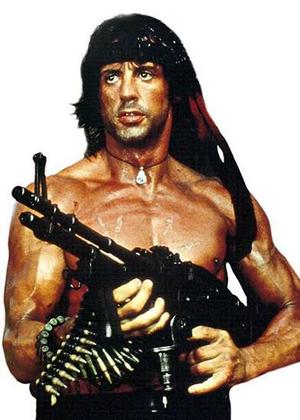
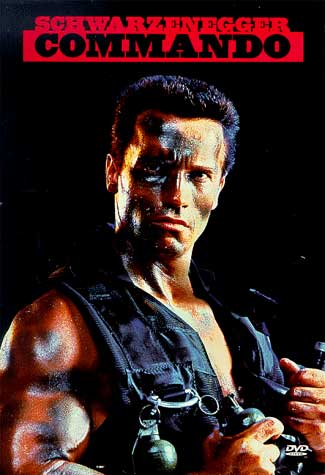
Developed out of Hollywood's displacement of art to action in the 1980's, the Macho film places and emphasis on a sort of surreal masculinity where the male body occupies the main narrative focus. Fueled by a sort of weightless politics, these hyper-male heroes obliterate their way through thinly outlined, special-effects-laden espionage scenarios. Starring buff body-builders such as Arnold Schwartzenegger, Sylvester Stallone, and Chuck Norris, the Macho film glorifies the sculpted male figure, often focusing on the charm and sex appeal of the Macho while still remaining action packed. Camera use in these films general accents physical size, featuring extreme close-ups of biceps, triceps, pecks and other impressive physical attributes. These male bodies can also withstand extreme physical pain, as if they posses superhuman tolerance and can refocus their agony towards eliminating the enemy. And, interestingly enough, sexualized female presence in these films appears almost non-existent (Vincente).
Look out for Macho Feminism Part II coming soon!
Tuesday, November 20, 2007
WGA Strike
Screenwriter Irv Brecher (Meet Me In St. Louis, Shadow of the Thin Man, Marx Bros' At The Circus) offers his perspective on current WGA strike.
Friday, November 16, 2007
The Western Heroes Dual Part III
Starring two of the genre’s biggest names – John Wayne and Jimmy Stewart – The Man Who Shot Liberty Valance strips the Western of its window dressing, providing a reflection on the motifs and common themes that only a director as experienced in the genre as John Ford could produce. However, perhaps most striking are its competing protagonists who, through their dual natures, become a commentary on the Western hero and on the power of mythmaking, the film’s central theme.
Liberty Valance makes its dual protagonist structure quite clear from the very beginning. Stewart’s character, an established politician named Ransom Stoddard, heads to the small town of Shinbone for a funeral. Acting as narrator, he recounts the story of the deceased – John Wayne as Tom Doniphan – through flashback. This structure, coupled with the billing of two top stars, immediately implies dual protagonists.
Doniphan, “the toughest man south of the Picketwire”, is pragmatic and bound to nothing. Like Shane, he represents the savage side of the West: he lives in a house well outside of town, is nomadic and authoritative, and, most importantly, believes in the power of a gun. Doniphan doesn’t see much use for the law books and school teaching that Stoddard brings to the town of Shinbone. Stewart’s character represents civilization in its most pure, democratic, idealized form. A young lawyer from the East headed west to strike it big, Stoddard’s knowledge of the law, ability to read and write, and sheer idealism prove to be quite useful. However, over the course of the film, Stoddard finds that he needs to adapt to Doniphan’s more savage ways to survive. In the end, he comes out on top, remembered forever as “the man who shot Liberty Valance.”
This myth is the central point of the film: while Stoddard is memorialized for ending Valance’s reign, it was Doniphan who actually did the deed. Liberty Valance pits these two characters in direct competition and uses this structure to comment upon the myth-making abilities of the West. The fact that Stoddard is remembered for Valance’s death, and not Doniphan, shows how the West as an open frontier was rife with possibility for a man to prove himself – and how rumors could easily become truths by way of the press. As Maxwell Scott, editor of a now civilized Shinbone Star says, “When the legend becomes fact, print the legend.”
Doniphan is forgotten by nearly everyone at the end of the film. Unlike Shane, his valiant efforts and self-sacrifice are not lauded or memorialized, but hidden, rejected by those who control the myth-making process for the sake of civil progress. However, Stoddard’s civility is not portrayed as cut-and-dry as that in Shane either. Stoddard lapses into savage ways, and finds his well-intended career built on a myth. It is in such a way that the themes of Liberty Valance differs from that of Shane; whereas one films finds honor in the Western Hero, the other exposes a bittersweet reality.
Check out The Western Heroes Dual Part I & Part II!

Thursday, November 08, 2007

Tuesday, November 06, 2007
The Western Heroes Dual Part II
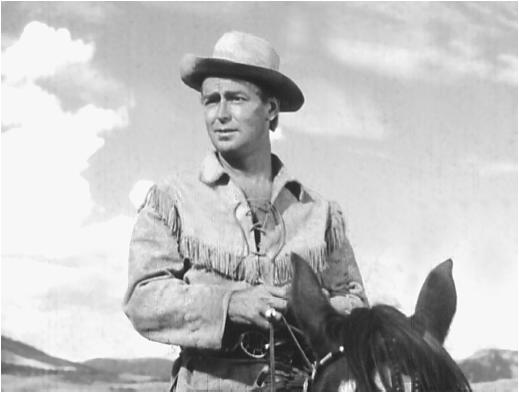
Directed by George Stevens and featuring Alan Ladd in the title role, Shane tells the story of a mysterious gunfighter who comes to the aid of an oppressed group of homesteaders. The film maintains much of the traditional iconography of the genre, from vast, sweeping landscapes to a sinister, gun-slinging villain. While consciously working within this set of images, Shane produces a vision of the West in which savage means are necessary for civil progress. The title implies that Shane, the almost miraculous gunfighter, is the main protagonist, but there are in fact two: Joe Starrett (Van Heflin), leader of the homesteaders, is equally important. These two protagonists are inexplicably linked, but embody certain opposing semantics of the West.
Shane is portrayed as a weary gunfighter, a wanderer with no place to hang his hat. He literally rides in from nowhere, his past a mystery never discussed. From the first shot of him riding on his horse, it is clear that Shane represents a dying breed of cowboy. Conversely, Joe Starrett is a family man who believes in the notion of private property and democratic organization. He represents civility, a new order of prosperity. Much of the narrative structure of the film relies on their relationship, their strengths and their weaknesses, to shape meaning.
Though wary of each other at first, the two are quickly presented as a team, working together to mutually improve quality of life. Joe hires Shane as an extra hand on the farm, providing him a temporary home, and the film shows how Shane’s cowboy qualities come in use. One scene boils it down into an easy metaphor: a tree stump too heavy for Joe to move by himself is lifted, with some strain, when he works with Shane. This scene could be interpreted as a summation of the movie; Joe can’t seem to shake the ranchers that want him off the land, but together with Shane, the two manage to put up a fight.
The oppression from the ranchers is much greater than that of a stump, however, and develops a much more complex relationship between the two protagonists. Both Shane and Starrett can fight physically – an extended fight sequence in the saloon exhibits this fact – but Shane’s quick-shot skills are necessary in keeping the film’s ultimate villain, a gun-for-hire named Jack Wilson (Jack Palance), at bay. Conversely, Shane’s presence irks some of the homesteaders, some of which feel they “don’t need no bodyguard” while others simply want to pack up and quit. Starrett’s unending optimism and oratory skills, coupled with his American ideals of individualized prosperity, manage to keep the homesteaders aligned even in the darkest of times, something Shane could not do. In turn, Shane and Starrett bridge together traits from both the savage and civil West that are necessary in accomplishing the plots ultimate goal – winning the land for the homesteaders.
However the narrative also pits the two characters in competition with one another, especially in relation to the Starrett family. Joe’s young son is constantly sizing his father up in comparison to Shane. He asks Joe many questions – “Could you shoot better than Shane? Could you whip him?” – that elaborate upon why Shane’s presence is so necessary for the homesteaders. Likewise, Joe’s wife, precautious but intrigued by the gunfighter, develops a flirting infatuation for Shane, which Starrett comes to recognize towards the end, admitting that if something were to happen to him, he’d at least know she’d be “taken care of and in good hands”.
This competition elaborates upon why the savage Westerner was so crucial, and helps glorify his nature, but the film remains conscious that he is a dying breed. Shane’s gun-toting way of life, though helpful in the circumstances, cannot work in the civil setting. He is conscious of this: “There's no living with a killing. There's no goin' back from one,” he says. “Right or wrong, it's a brand... a brand sticks. There's no goin' back... And there aren't any more guns in the valley.” The film ends with Shane riding back into the wilderness, but the shouts from Starrett’s son are a reminder that he is one cowboy that will not be forgotten.
Such is not the case for The Man Who Shot Liberty Valance...
Check out Part I
The Western Heroes Dual Part III coming soon!


Friday, November 02, 2007
The Western Heroes Dual, Part I
As a film genre deeply rooted in the transposition of civilized and savage elements, the Western inherently allows for the exploration and establishment of specific, individualized moral codes. In turn, the Western offers a variety of protagonist archetypes: the outstandingly upright Ladds, the forthright and masculine Waynes, the morally ambiguous Eastwoods, the slightly on edge Stewarts. These Western Heroes may have spurs and a sense of ruggedness in common, but it’s their distinct moral personalities that made them legends. Perhaps this is why it is most interesting when a film places two protagonist types in a dual narrative structure. Aside from adding layers of tension to melodrama, dual protagonists allow for a tiered representation of the civilizing process; a kaleidoscope that refracts concepts of a blossoming America.
However that is not to say all Westerns with dual protagonist structures reach the same conclusions. Both Shane (1953) and The Man Who Shot Liberty Valance (1962) feature dual protagonists, but their reflections on the civilized West are much different. Each film contains a ‘savage’ and ‘civil’ protagonist, and both favor the prospect of democratic growth. But where Shane shows clear praise for it’s savage hero, Liberty Valance paints a storybook West in which one myth is exchanged for another. The next few posts will be dedicated to exploring dual protagonists as they exist in these two films.
The Western Heroes Dual Part II coming soon!


Tuesday, October 30, 2007
Revisit: Ride the High Country
An MGM film 1962
Directed by Sam Peckinpah
Written by N.B. Stone Jr.
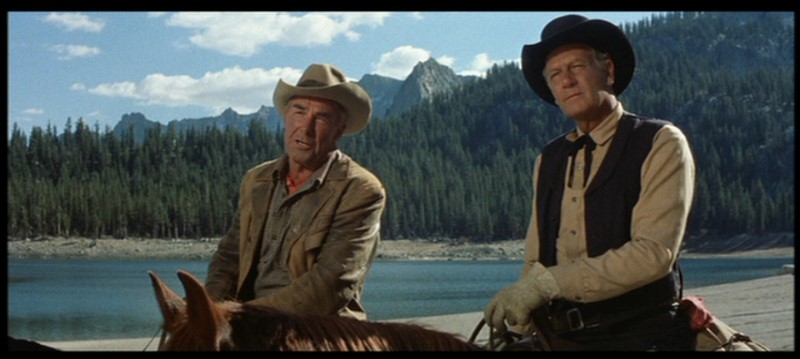
Ride the High Country is a eulogy for the traditional western. The film is conscious of the myth of the American Frontier, presenting it as dying legend that can, and has been, manipulated. Here is a version of the West where Eastern civilizing culture and ideals have pushed savage lands to the very corners of the Earth. However, that’s not to say that such savage ideals don’t exist. The film doesn’t exactly regret the loss of traditional Western values, but rather appears to celebrate moral ambiguity in the genre, desiring to push that trend even further.
The film provides three male heroes: Steve Judd, moral and upright, the Gary Cooper template for the classical Western hero; Gil Westrum, a good but morally gray man, the John Wayne type; and Heck Longtree, a youngin’, the next generation of cowboy. While Judd is presented as upstanding, his character is constantly referred to as old and out of date; even from the beginning, when he mysteriously rides into town in the most classical fashion, it is made clear that this character’s function in the genre is no longer effective. In the end, he is the only one killed off. Westrum, seemingly corrupt and villainous at times, is redeemed, rewarded in the end for his ability as a character to make sacrifice and overcome immoral temptation. Likewise, Longtree grapples with morality, ultimately establishing an honor code from both Judd and Westrum.
Peckinpah finds good humor in the banter between the two dying breeds of hero, but the real excitement in the film comes through the villains. These men are equally morally blurred, as they exhibit knowledge of moral codes, but choose to ignore them, instead settling for insincere symbolic measures that clean the appearance of their evil ways. The Hammond Gang represents tiers of damaged psychology, from sharp and sly to straight crazy, and they incite all of the riotous action in the film. While Ride the High Country is aware that it is declaring the end of one classical mode, it appears to be celebrating a newfound interest in damaged characters, and ambiguity in savagery.

Thursday, October 25, 2007
Review: Gone Baby Gone
A Miramax release 2007
Directed by Ben Affleck
Writing credits:
Ben Affleck (screenplay)
Aaron Stockard (screenplay)
Dennis Lehane (novel)
Two Boston area detectives investigate a little girl's kidnapping, which ultimately turns into a crisis both professionally and personally.
Ben Affleck's directorial debut is by no means memorable, but it is an effective, well made film that shows promise from the former Academy Award winner. Affleck handles his camera with an assured confidence, and while the script lapses at points, the picture drives towards some interesting ideas on moral ambiguity and making firm decisions.
Where the film succeeds most is in its casting. Affleck manages to draw some intense performances from his actors, particularly his brother, Casey, who despite wire thin, boyish looks, takes charge of the screen. Likewise, Amy Ryan completely captures the emotion of a cracked-out mother searching for her child. Ed Harris gets a bit hammy as a police detective on the case, and Morgan Freeman sort of sleepwalks throughout, but neither feel out of place.
The script has some dips, particularly a twist towards the end that doesn't sit well, but at the same time feels necessary, mostly because it secures the main theme of morality. Having kids clearly effected Affleck, and he's not afraid to probe what it means to be a parent, to do what's right for a child. The Boston location adds depth to the concept of community, and makes the film feel much more real. The final shot of Casey sitting on a couch with the newly returned child is both depressing and poignant.
Overall, Gone Baby Gone isn't a perfect film, but Affleck managed to wring a lot of interesting ideas out of the material, and handled the picture with confidence. It scares me to say it, but I'm looking forward to his next picture. Worth a gander.

Friday, October 05, 2007
Review: La Vie en Rose
A Picturehouse Entertainment release 2007
Directed by Olivier Dahan
Written by Olivier Dahan & Isabelle Sobelman
The extraordinary life and times of famed French singer Edith Piaf (Marion Cotillard)
Like most biopics, this incredibly uneven but suprisingly moving portrait of Edith Piaf, one of France's national treasures, relies heavily on the performance of its lead, Marion Cotillard. Thankfully she nails Piaf to a tee, capturing her movements and manneurisms with such precision it's almost uncanny.
If only the script did her performance justice. Dahan's presentation of periods in Piaf's life is so scatterbrained, it's almost hard to tell what is going on. The film does an incredible amount of jumping back and forth through time in the most illogical of ways; snippets from Piaf's childhood are connected to her final days or mid-life antics without any real causal connection, thematically or emotionally. The poor pacing results in a fragmented portrait of this powerful artist, one that leaves the spectator feeling as though they are missing something, despite the film's two and a half hour plus run time.
If you're already a fan of Piaf, then you're sure to love this film. If not, stick to the soundtrack - it'll tell you all you need to know.

Revisit: Force of Evil
An MGM film 1948
Directed by Abraham Polonsky
Writing by Abraham Polonsky & Ira Wolfert
Lawyer Joe Morse (John Garfield) wants to consolidate all small-time numbers racket operators into one big powerful operation. But he is met with conflict from his elder brother Leo (Thomas Gomez), who as one of those small-time operators prefers not to deal with the gangsters who dominate the big-time.
Watch a clip from Force of Evil here!
Abraham Polonksy's directorial debut is a noir masterpiece, a film that effectively depicts a world rampant with greed, corruption, and dispair. Polonsky, who had already achieved a name for himself as a scriptwriter, most notably for the gritty boxing film Body and Soul also starring John Garfield, was eventually blacklisted under the HUAC communist investigations. Watching Force of Evil, it's hard to separate Polonsky's political views from the story, which comes off as a strong critique of capitalist practices. However, the film contains with such beautiful wordplay and lingual puns that it's almost breathtaking. Likewise, the complex relationship between the brothers forms a delicate psychological, emotional and narrative core - a great example of powerful noir filmmaking. The film was a key influence on Scorsese's Raging Bull and, surprisingly enough, was selected for preservation in the United States National Film Registry. A must see.


Wednesday, September 26, 2007
Revisit: Trust
A Fine Line Features release 1990
Written & Directed by Hal Hartley
A pregnant teen (Adrienne Shelly) meets a moody genius (Martin Donovan) with a hand grenade.
Hal Hartley's satirical view of suburban drama is arbitrary, but interesting none-the-less; a soap-opera world of absurdisms stuck in a Long Island vacuum, where things just happen. Roger Ebert once wrote "when a Hartley film plays on TV, you won't be tempted to go channel-surfing because the movie will seem to be switching programming for you", and it's true, but that's not necessarily a bad thing. Trust has just enough American-indie, dysfunctional family quirk to keep it from feeling manufactured; considering the time of its release, it's probably more responsible for influencing the modern commodified indie backlash. The film is a ball of ideas, some work and some don't, but they all seem to point towards the fucked-up-ness of east coast suburban living, a theme Hartley has dealt with his entire career. The performances here are amusingly dead-pan, and the colors drab. If you like your hopeless romanticism with a bit of restraint, this film is for you.

Tuesday, September 25, 2007
NYC Drive In!
Longing for the days of the Drive-in? Grand Opening is Manhattan's only drive-in cinema - in a store. Choose your favorite film from the 60's - 90's, book a one-of-a-kind 1965 Ford Falcon convertible with seating for six and a full concession stand, and relax like it's the good old days all over again. Highlights include Dr. Strangelove, Cool Hand Luke, The Hustler, Pulp Fiction, and many more.
$75 per show
(Car seats up to 6 passengers)
2 shows per night (7pm and 10pm)
139 Norfolk Street
New York, NY 10002
Grand Opening

Friday, September 21, 2007
Review: Eastern Promises
A Focus Features release 2007
Written by Steve Knight
Directed by David Cronenberg
When an innocent midwife (Naomi Watts) accidentally uncovers potential evidence against his Russian mobster family, Nikolai (Viggo Mortensen) must put into motion a harrowing chain of murder, deceit, and retribution.
While not as thematically complex as A History of Violence, Cronenberg's latest offering is a taut, moody thriller, almost economic in approach. No Cronenberg film makes a stronger tie to Hitchcockian modes of storytelling; each scene moves the story efficiently, while maintaining maximum entertainment value. Yet, the film also contains that trademark Cronenberg style, a queasy mix of violence and humor, absurdity and density.
Viggo Mortensen gives a bravura performance, one of intense restraint yet physical prowess. The knife fight scene, already infamous, will go down as one of the best fight scenes in history.
Definitely worth a look.

Friday, September 07, 2007
AV Club on Cronenberg
Primer: David Cronenberg
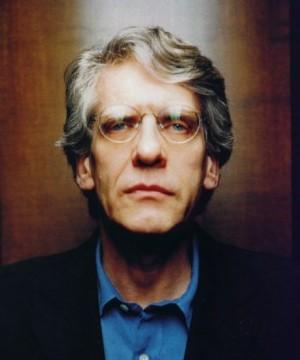
The Onion's AV Club has taken the liberty of dictating a pretty basic introduction to the works of one of my favorite filmmakers, David Cronenberg, for those of you unfamiliar with his body of work. Cronenberg is the genius behind some of the most psychologically twisted, reality-bending films of the past three decades, not to mention the inventor of 'body horror'. It's a great read, check it out.
Monday, August 13, 2007
Dinner with the Rat
There's an auction going on Ebay right now that offers the chance for a private dinner with director Brett Ratner. Right now the current bid is at US $8,643.73, which is a heck of a lot of money. The disclaimer says nothing about bodygaurds being present, so let's hope whomever wins this bad boy takes the opportunity to punch Ratner in the face. They'd be doing film fans everywhere a favor.

Saturday, August 04, 2007
Review: The Simpsons Movie
A 20th Century Fox film 2007
Directed by David Silverman
Writing Credits:
James L. Brooks screenplay
Joel Cohen consultant writer
John Frink consultant writer
Matt Groening screenplay
Al Jean screenplay
Tim Long consultant writer
Ian Maxtone-Graham screenplay
George Meyer screenplay
David Mirkin screenplay
Michael Price consultant writer
Mike Reiss screenplay
Mike Scully screenplay
Matt Selman screenplay
John Swartzwelder screenplay
Jon Vitti screenplay
After polluting the local lake, resulting in Springfield being put under a giant government instituted glass dome, Homer must simultaneously save the town and his marriage.
Those of you who read this site may have noticed that I haven't written a review of a new film in quite a long time. That's because I haven't been to the theaters in over two months. That's right - two whole months have passed since I've been compelled to go to my favorite place on Earth, the movie theater, and watch a film. I've been so fed up with the crap that Hollywood has churned out this summer that I simply decided to boycott pretty much every movie that has been released. Sequel after sequel, revised franchise to remake, I couldn't stand to sit through any of them.
But The Simpsons was something I had to see. Eighteen years in the making, The Simpsons Movie was something that was always on the tips of everyone's tongue, but seemed like it would never happen; a mythical idea that looked great on paper but could never be done. Like most of my generation, I grew up watching The Simpsons, and just couldn't picture a jump onto the big screen that would do the show justice.
So when the movie finally landed - to rave reviews, nonetheless - I had to see it. I went in with the best of expectations: that it would undoubtedly disappoint, but if there were two or three good jokes, I'd be happy. And I'm glad to say that the film not only met those expectations, but exceeded them. The Simpsons Movie is about as good of a film one could ask for from a show that seemed to have run its course almost a decade ago.
Without side-stepping the legacy that they've already built, Groening and Co. have managed to craft a fast paced, funny, cinematic counterpart to the show that retains its spot-on portrait of the American family. While some might complain that the satire isn't as biting as, say, South Park: Bigger, Longer, & Uncut, the film somehow manages to make its points clear while staying fresh. After all, The Simpsons was never really about controversy, at least not in the same way as South Park, but the dives it takes at religion and American life are still quite funny while aimed at an incredibly wide audience; I saw the flick with my whole family, and my parents laughed just as hard as I did.
Ultimately the film is a bit short and maybe too fast paced for its own good - it's a bit top heavy and starts to lose steam towards the last act - but I have to say I was impressed. Was it worth the eighteen year wait? No - but it didn't ruin the show in any way, and was certainly an improvement upon the last couple of seasons. If anything, it reminded me of why I liked The Simpsons so much to begin with, and that's certainly a good thing.

Thursday, August 02, 2007
Cloverfield
Lots of people have been asking me how I feel about the J.J. Abrams produced as-of-yet-untitled monster movie codenamed Cloverfield that's been driving the Infernets crazy these days. If you haven't heard about it, get on over to /film.com, who has the up to the minute skinny on this super secret, virally marketed flick. But back to my feelings... I think this photo sums it up pretty well:
Until they start releasing something more concrete than a two minute teaser, a no-name cast list and some blurry cell phone shots, I could care less about this 'mystery' project. After all, this is just a revised form of the marketing for Snakes on a Plane, and we all know how that turned out. Sorry, Paramount - Internet games and rumors are simply not enough to get this film nut in a frenzy. I'll get excited when I hear the film is actually watchable.

Subscribe to:
Posts (Atom)
