In Berlin, an alcoholic man, recently released from prison, joins his elderly friend and a prostitute in a determined dream to leave Germany and seek a better life in Wisconsin.
Herzog's second masterpiece with muse Bruno S., Stroszek is a deconstruction of the American Dream as it is confronted by reality, and (as always!) the inability to communicate. Bruno expects riches when he comes to the states, but he finds his girlfriend is still a whore and no one can understand him, nor he understand them. The film is sad, beautiful, and hilarious. Typical Herzog firing at all cylinders. A must see.
SPOILER: THIS IS THE FAMOUS ENDING SEQUENCE, WHICH IS GODDAMN AMAZING
In the Nineteenth Century, feared bandit Francisco Manoel da Silva (Cobra Verde) is sent to Almeria, in the West of Africa, to negotiate for slaves with the crazy African King Abomey, as opposition towards the trade grows.
This film is a tough one, especially for Herzog, who tries to combine his typical 'portrait of the insane' with the beauty of nature while discussing the most deplorable African slave trade. Klaus Kinski plays the bandit Cobra Verde -- his atypical step-behind-the-times-totally-batshit-crazy type character -- who is injected into the slave trade at the end of it's run. Language plays a major theme, as it does in many of Herzog's films -- the film stresses the difficulty of global communication in the 19th century and deals with cross-cultural miscommunication and misunderstanding. But ultimately the film suffers from the weight of its subject matter -- it can't help escape a sort of 'been there, done that' feeling for all the major players, and the deplorable nature of the slave trade overshadows the struggles of the titular character, no matter how insane we already know he may be. Aside from the fantastic end sequence (which I've posted below), and some gorgeous shots of the African landscape and peoples, the film fails to tread any new ground for it's director or performer.
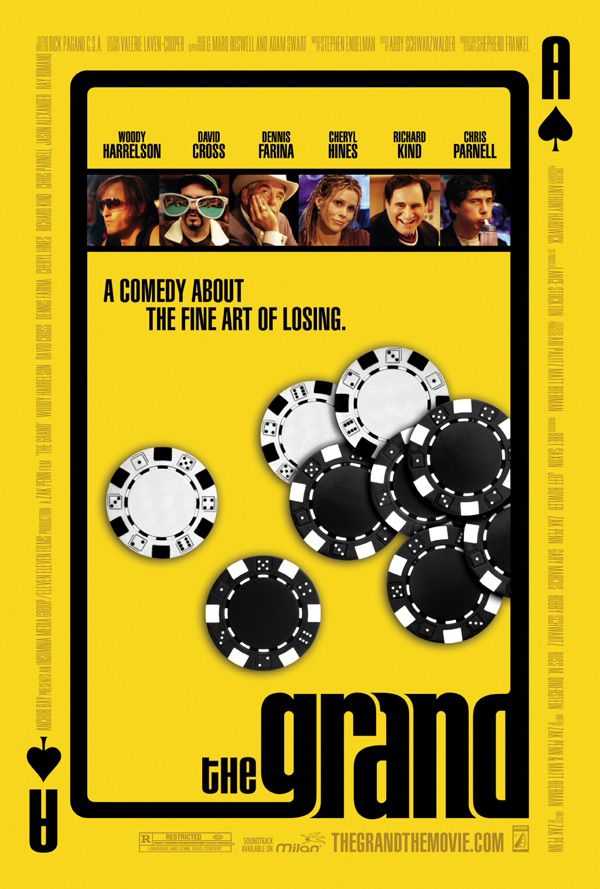
An improvisational comedy using a handful of actors playing characters competing in an actual poker tournament.
This movie is terrible. Not funny, not interesting, really dumb and lame. All sorts of bad.
Worst of all, they somehow convinced Werner Herzog to be in it, playing a German stereotype. I don't know if he needed the money to fund his next trip into the jungle or what, but poor Herzog. He provides the only real amusement, but at what cost?
According to IMDB, "The script was barely 29 pages long. Zak Penn had the actors improvise." Basically a bunch of actors did it as a favor for their writer/director pals and just decided to dick around. They probably had some fun making it, too. But it ain't no fun to watch. Seriously -- don't watch this crap.
Based upon the true and mysterious story of Kaspar Hauser, a young man suddenly appears in Nuremberg in 1828, barely able to speak or walk. His benefactor attempts to integrate him into society, with intriguing results.
Herzog's Kasper Hauser tackles the German equivalent of the French L'Enfant sauvage -- a real life wild child, abandoned at birth and void of any linguistic or cultural understanding of the world. As doctors, scientists, and the cultural elite try to 'educate' the boy, tension mounts, and the child ultimately rejects civilization, preferring to run amok in nature.
But where Truffaut's L'Enfant Sauvage focuses on the struggles of the educator (indulgently, I might add, as Truffaut cast himself in the role of Dr. Itard), Herzog's film uses Hauser as a tool to question language, religion, and society as a whole.
After all, what would happen if a person had no concept of speech, of writing, of God? How would he react when presented with such things? Herzog tackles all these issues through Hauser's 'education', and, in typical Herzog fashion, they provide a springboard for some beautiful natural imagery and a condemnation of the 'unnatural' acts of man.
As always, Herzog's camera is constantly probing the Earth, and we get some beautiful shots here -- a gull picking apart a frog, plants spiraling out of the ground, shimmering lakes and stormy deserts. Likewise, Herzog cast the perfect actor as his idiot child -- Bruno S., the real life abandoned musician whose broken speech and awkward mannerisms blur the lines of reality and fiction. The New York Times published an amazing profile on Bruno S., Herzog's former muse and the start of Kasper Hauser. Check it out: Bruno S. NY Times Profile: From Berlin's Hole of Forgottenness, A Spell of Songs
Ultimately, I prefer Herzog's film over Truffaut's. Then again, I prefer Herzog over Truffaut in general. But where Truffaut saw drama in a doctor's attempt to conquer nature, Herzog found a character who could question the very fabric of life itself. The result is a much more profound and interesting film, one that challenges our conceptions of language and nature. Worth a gander.
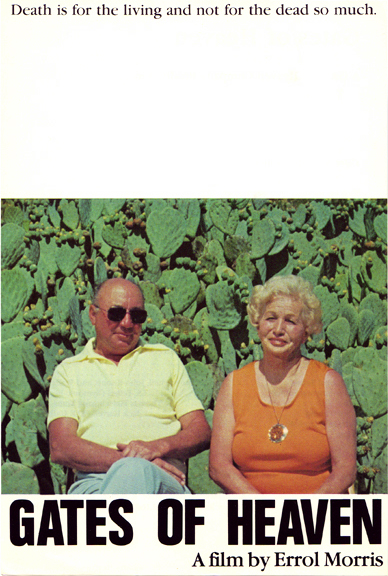
A documentary about a pet cemetary in California, and the people who have pets buried there.
Werner Herzog once bet that he would eat his shoe if a young film student named Errol Morris could complete a film about pet cemeteries. In response, Morris crafted one of the most bizarre, beautiful, funny, and pathetic documentaries of all time. Gates of Heaven probes issues of life, death, and the human condition through pet lovers, and in doing so creates a cast of vivid, real characters who are at once compelling and yet utterly strange. Featuring beautiful cinematography by Ned Burgess, the film's washed out, painterly quality ensures that it will only be more beautiful with age. A must see.