Written by James Costigan, Ivan Davis & Michael Thomas
Based on the novel by Whitley Strieber
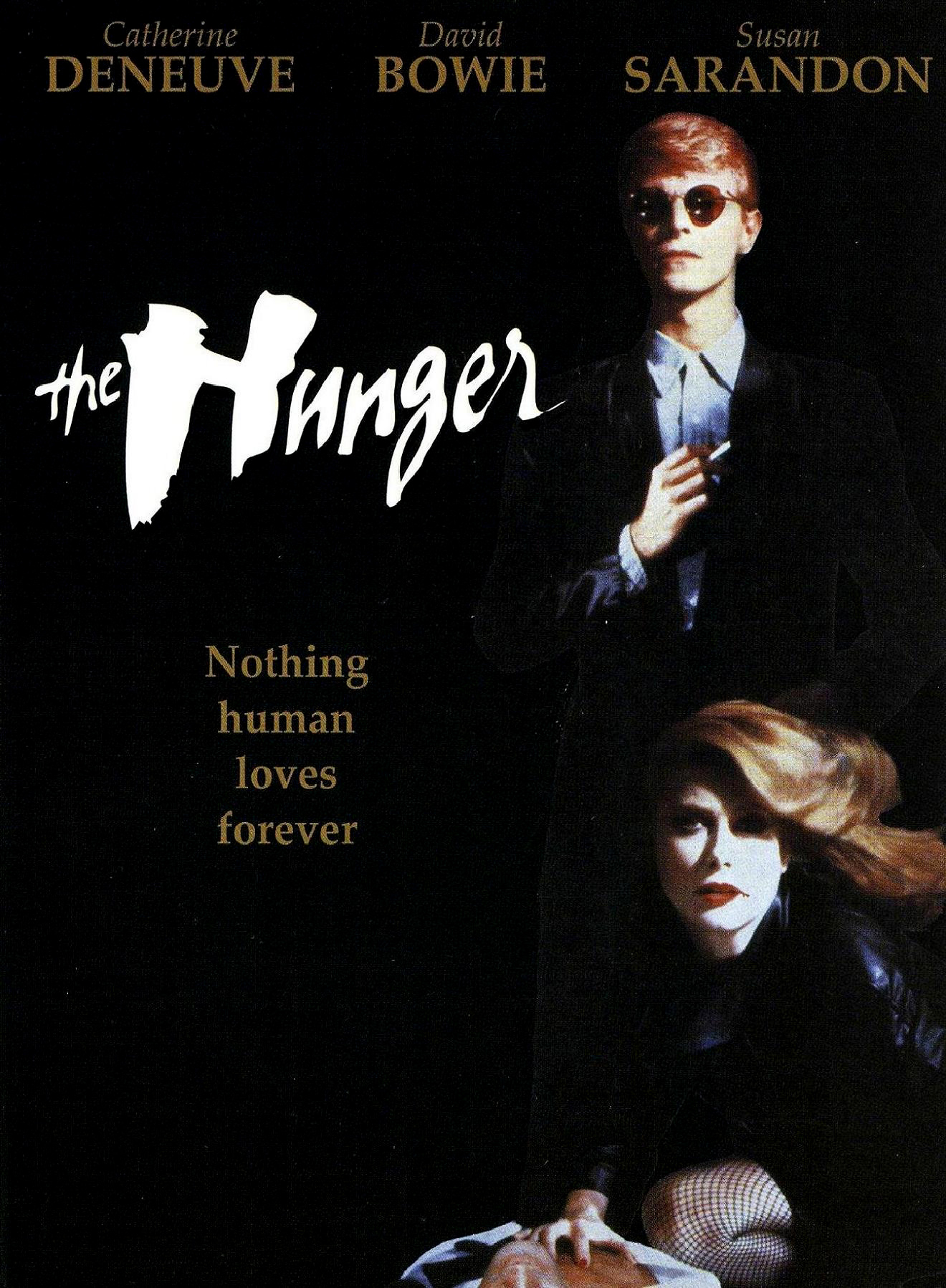
An ancient vampire seduces a famous gerontologist after her similarly ancient husband begins to fade away.
Tony Scott's studio debut has become somewhat of a cult classic since its release in 1983. The Hunger is a vampire flick cut from the Anne Rice tradition -- elegant, ageless, and refined. Much of the film focuses on the seductive powers of the female, played by the always beautiful Catherine Deneuve. Likewise, the main theme is the quest for immortality, and the consequences that come with it.
However, once you strip away the film's glamorous atmosphere, it falls rather flat. Tony Scott's films always seem to be in montage mode; he's a fan of cutting back and forth between planes of action while synchronizing voice-over to wring out double meaning, a trick I always found to be a bit obnoxious. It can be done well but here (and in another one of Scott's films, Spy Game) the cuts move so fast there's barely any time to process the visuals. It's rarely a good sign when a film starts out with a flurry of quick cuts and crazy images, and this one turned me off almost right away.
The performances aren't too great either. Say what you will about Miss Deneuve's looks, but her acting here is stoic, aloof, and disengaging. Likewise for Susan Sarandon, who looks great but is unconvincing as a doctor who specializes in aging research. Casting David Bowie, however, as Deneuve's rapidly aging husband was a very inspired choice. Bowie is by no means an extraordinary actor, but he plays the role straight and does a serviceable job. Marrying the fading vampire character with Bowie's androgynous persona, openly bisexual orientation, and frequently reinvented image adds a lot of intertextual depth that would not have been present otherwise.
If you like gothic vampire lore, you've probably already seen this flick. Otherwise I wouldn't recommend it.
Tragedy besets a broken family when a mysterious uncle returns from prison with more on his mind than a happy reunion.
An unsettling film with a strong Southern voice, Undertow is a fine representation of David Gordon Green's skills as a director. While far from perfect - the script takes a while to get going, stumbles in some information reveals and relies a little heavily on Christ metaphors - Undertow is a captivating mix of melodrama, suspense, and horror. Green really makes the most of the setting, a Southern bayou, letting cinematographer Tim Orr really stretch his camera and get a good feel for the murky, hot, muddy surroundings. Performances from Josh Lucas, Jamie Bell, and Dermot Mulroney are more than passable, elevating the somewhat leaden script to a much scarier place. Ditto for composer Philip Glass's music, which certainly adds to the tension and moves many of the scenes. Under anyone else's supervision, Undertow may have been a sub-par or downright silly affair. But David Gordon Green and his crew make it something more: a sort of modern day Night of the Hunter, fairy-tale-esque and all the more tragic. Worth a watch.
Written by Robert Collector, Dana Olsen & William Goldman
Based on the book by H.F. Saint
After a freak accident, an invisible yuppie runs from a treacherous CIA official while trying to cope with his new life.
Horror master John Carpenter teams up with Chevy Chase in this bizarre effects-pushing adaptation of H.F. Saint's famous novel. Not quite a comedy (as Chase's presence would imply), not quite a horror film, and yet not quite a thriller, Memoirs is a bit of everything but not enough of anything. A fun film, but a weird one, it's not surprising audiences didn't connect with it during it's 1992 theatrical run. The tone is simply too scattered, and Chase too uncouth and indifferent a performer to keep it centered. I've always appreciated Chase's nonchalant style, but it feels really out of place here. Carpenter surrounds Chase with a bevy of quality supporting actors, but Sam Neil seems to be trying way too hard (it's almost like he's in a different movie), Darryl Hannah is just kind of there, and Michael McKean gets nothing to work with. The real highlight (at the time) must have been the invisible effects from Industrial Light & Magic. One year before Jurassic Park blew everyone's minds, ILM was tinkering with mixing CGI and practical effects on this film. Watch only if you're a fan of those involved, or have nothing better to do.
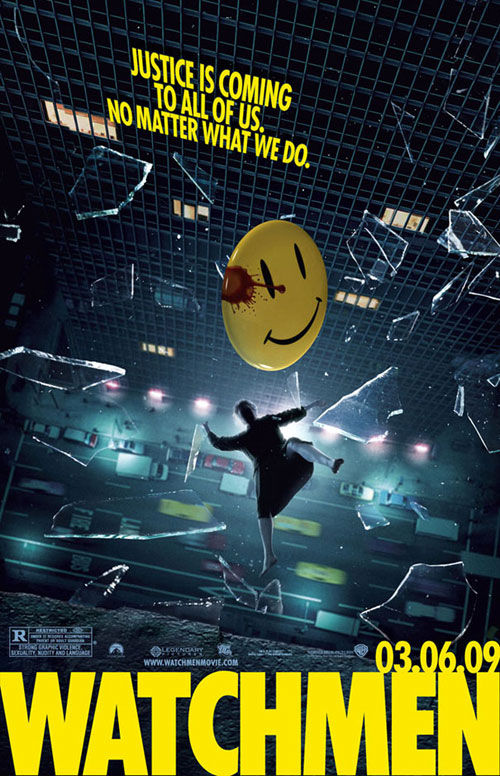
When an ex-superhero is murdered, a vigilante named Rorschach begins an investigation into the murder, which begins to lead to a much more terrifying conclusion.
Long considered 'unfilmable', Watchmen is one of the most celebrated graphic novels of all time, and often credited for ushering in an era of more serious, cerebral, adult-themed comic books. Hollywood took stabs at bringing Alan Moore & Dave Gibbon's time-altering, mind-bending grit fest to the screen for nearly 3 decades, with everyone from Paul Greengrass to Terry Gilliam to Michael Bay set to direct. Zack Snyder finally succeeded in producing the film, which finally hit theaters this week after much fanboy anticipation.
Fanboys like myself, who fell in the love with the graphic novel's sharp thematic and formal critique of the medium, as well as it's intense philosophical and political exploration, engrossing characters and wonderfully rich universe. Watchmen the novel is as complete a package as one could ever expect or want; a vast and detailed world with no stone unturned tenderly committed to the page.
Which begs the question -- why make it into a movie at all? Particularly one that adheres so faithfully to it's source?
Of course, that's the question I asked myself before the movie was released, and after having seen it, I'm not sure I have a full answer. From a business standpoint, I could understand why the movie was made -- large built-in fan base, a film that paves the way for grittier, more difficult graphic novel adaptations, and lots of fanboy cred for the distributors. But artistically, what are the merits? It seems there are some, but mainly the film exists as a celebration of Moore & Gibbon's work.
To their credit, Warner Brothers and Mr. Snyder have delivered one balls to the walls, full-force, hard R, uncompromising vision of Watchmen. Like the comic's creators, they left no stone unturned in bringing this epic to the big screen, inserting as much possible detail with extra care. For those unfamiliar with Watchmen's source, the film must be a dizzying experience with many WTF? moments, but fanboys rejoice: never has there been such a detailed adaptation in the history of the medium.
Snyder's visual flair and special effects prowess certainly help bring the panels to exacting life. Some sequences, particularly the Dr. Manhattan chapter, the back-peddling opening credits and almost anything involving Rorschach, are undeniably brilliant. Others, such as the Silk Spectre father reveal and the tweaked ending, lack some of the emotional punch delivered in the novel, but are nonetheless visually arresting.
Perhaps my biggest problem with the film is that it could never replicate all that the novel contains. Much of the climate of the Watchmen universe -- the nuclear war paranoia, the aggression towards authority figures, the degrading of social moral -- is reduced to blanket statements and quick set ups. The majority of the second and third tier characters present in the novel, many of which establish and elaborate these themes to flesh out the temporal backdrop, are absent here. Likewise, many details surrounding the characters origins are trimmed down, making their screen counterparts feel somewhat incomplete.
The music, too, felt jarring to me. The film deserves it's own original score, not some smattering of pop songs that vaguely adhere thematically to the action. I think Warner Brothers were a tad afraid of mainstream audience reactions, and figured if they put some huge pop hits behind some of the more audacious sequences it would make them more palatable. Maybe -- but it also severely undermined the tone. I highly doubt Hendrix would be blasting while Rorcshach and Nite Owl scourge Antarctica for Ozymandias's hideaway.
But with that said, it's amazing how much Synder and his team managed to cram into this two and a half hour epic, and it's even more amazing that Warner Brothers was willing to see through on his vision. This is one bloody disgusting, gut-wrenching, depressing, dark as hell film. It's views on humanity and social decency make Dark Knight look like kiddie play time. As does the on-screen sex and violence.
Watching the origins of Dr. Manhattan unfold on screen will remain one of my favorite cinematic moments for a long time. Billy Crudup does an amazing job and really nails the character to the T. But seeing it come alive, watching it unfold in real time -- nothing will ever compare. It's breathtaking. And that alone makes Watchmen worthy of repeat viewings.
And I definitely think I need to see it again, now that the fanboy giddiness is out of my system. It's hard to really critically assess Snyder's formal elements in that malaise. There is too much immediate beauty in the imagery to really look deep into what Snyder uses to shape the story. Regardless, Watchmen remains a unique ride, one that will (probably) never be duplicated.
There is no reason to remake this movie, but Hollywood's going to do it eventually anyway. It's been in the pipeline since the original was released in the states in 2005. But Will Smith is a very odd choice for this -- I don't think he has the gritty sneer to be able to pull of the titular character. Spielberg is an odd choice as well, considering the dark tone and feel of the film. And how will the hyper-but purposeful-violence of the original translate in a senseless Hollywood version?
Who knows. Who cares. Here's the side-scrolling hammer fight sequence that made the original Oldboy famous. Go rent this flick if you haven't seen it.
When an innocent midwife (Naomi Watts) accidentally uncovers potential evidence against his Russian mobster family, Nikolai (Viggo Mortensen) must put into motion a harrowing chain of murder, deceit, and retribution.
While not as thematically complex as A History of Violence, Cronenberg's latest offering is a taut, moody thriller, almost economic in approach. No Cronenberg film makes a stronger tie to Hitchcockian modes of storytelling; each scene moves the story efficiently, while maintaining maximum entertainment value. Yet, the film also contains that trademark Cronenberg style, a queasy mix of violence and humor, absurdity and density.
Viggo Mortensen gives a bravura performance, one of intense restraint yet physical prowess. The knife fight scene, already infamous, will go down as one of the best fight scenes in history.
A hapless New York advertising executive (Cary Grant) is mistaken for a government agent by a group of foreign spies, and is pursued across the country while he looks for a way to survive.
Working with screenwriter Ernest Lehman, Hitchcock was originally comissioned to do an adaptation of the novel The Wreck of the Mary Deare by Hammond Innes, but the two hit a road block. After scrapping the project, Lehman said that he wanted to write the ultimate Hichcock flick. The legend goes that Hichcock had always wanted to make a film featuring an intense climax atop Mount Rushmore, and within days North by Northwest was born.
In many ways, North by Northwestis the ultimate Hitchcock film. Perhaps his most well known, it features two iconic scenes in Hitch's canon - the intense plane sequence and the even more intense chase atop Mount Rushmore. As always with Hitchcock, the film is visually brilliant; beautiful high angle crane shots and quick pans give way to resounding depth. The film deals with traditional Hitchcock themes of mistaken identity, blurred reality, and doubling, and features the most pure example of the Hitchcock 'MacGuffin' (a physical object that everyone in a movie is chasing after but which has no deep relationship to the plot): the microfilm containing government secrets which the spies are attempting to smuggle out of the country.
Cary Grant supposedly felt the script was convoluted and didn't make sense, but that doesn't show in his performance, which comes across as effortless and breezy. Grant was almost entering the 'grouch' phase at this point is his career, but he's a pleasure to watch as an affable victim of circumstance.